
Finding specific information in a long document shouldn’t feel like searching for a needle in a haystack. Microsoft Word’s search functionality is far more powerful than most users realize. When used effectively, it can save hours of manual scrolling and scanning. Whether you're editing contracts, reviewing research papers, or formatting lengthy reports, mastering the Find and Replace tools unlocks a new level of efficiency. This guide dives into advanced techniques that go beyond Ctrl+F, helping you locate text, format elements, and even hidden characters with precision.
1. The Basics: Using Find to Locate Text Quickly
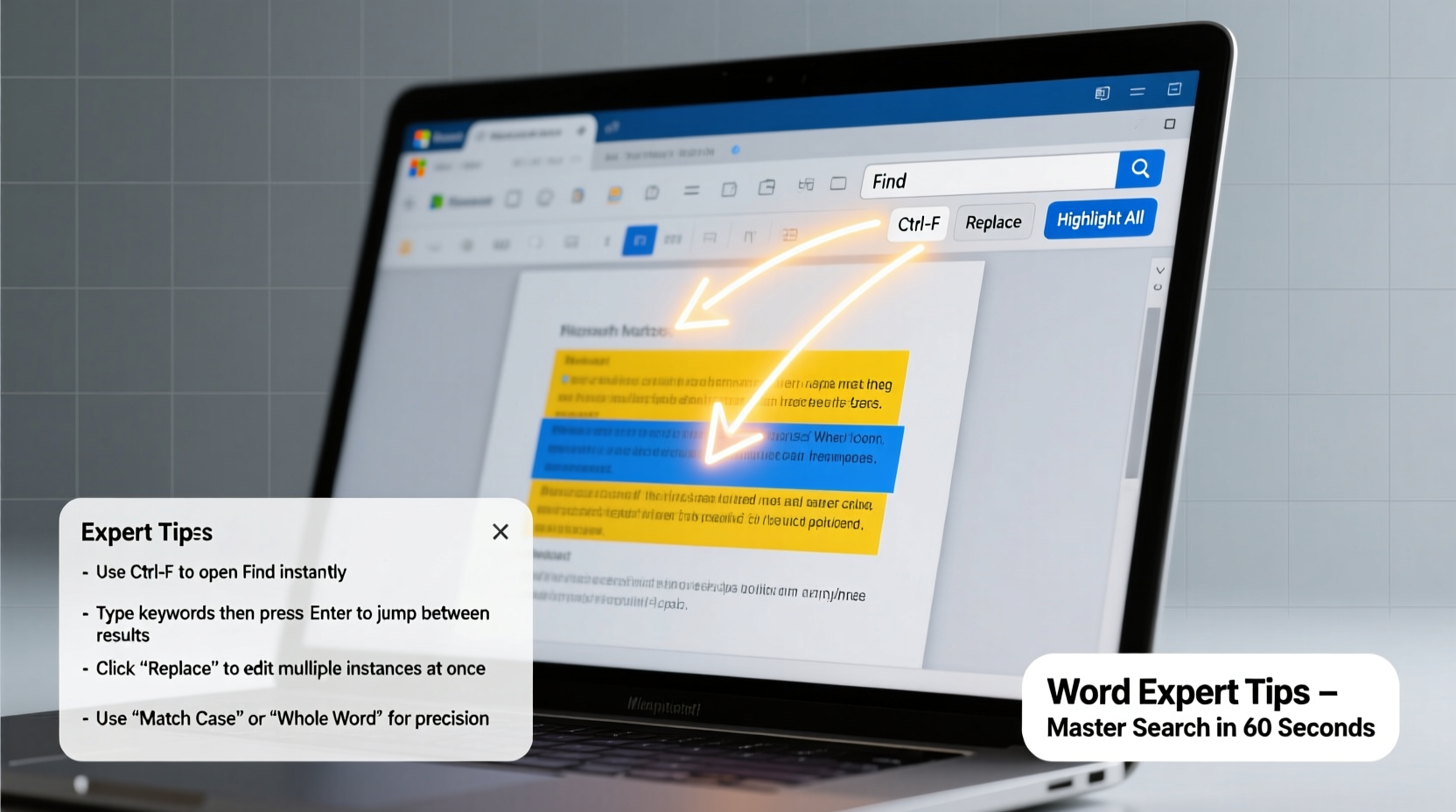
The simplest way to begin is with the basic Find feature. Press Ctrl + F (or Cmd + F on Mac) to open the Navigation pane on the left side of your screen. Type any word or phrase, and Word instantly highlights all instances throughout the document.
What many overlook is that the Navigation pane doesn’t just list matches—it allows direct navigation. Click any result to jump straight to that location. For longer documents, this eliminates endless scrolling.
To refine your search, click the dropdown arrow in the search box and select whether you want to match case, find whole words only, or use wildcards. These options become essential when dealing with technical writing or legal documents where precision matters.
2. Advanced Search with Wildcards and Special Characters
Word’s advanced search goes beyond literal text matching. By enabling wildcards, you can create dynamic queries that adapt to variations in spelling, punctuation, or structure.
To activate wildcard searches:
- Open the Find dialog (Ctrl + H opens Replace, which includes Find).
- Click “More” to expand options.
- Check the box labeled “Use wildcards.”
Once enabled, you can use pattern-based syntax. For example:
colou?rfinds both “color” and “colour” (the ? matches one optional character).se[nt]dfinds “send” or “sent” (brackets define a set of possible characters).[0-9]{3}locates any three-digit number.
This capability is especially useful for proofreaders, editors, and data-heavy documents where consistency across variable formats is key.
“Wildcards turn Word’s search into a mini scripting tool—ideal for cleaning up inconsistent terminology or formatting patterns.” — David Lin, Technical Editor & Document Automation Specialist
3. Navigating by Formatting, Not Just Text
Sometimes, you need to find content based on how it looks, not what it says. Word lets you search for specific formatting—such as bold text, font size, paragraph styles, or color.
Here’s how:
- Press Ctrl + H to open the Replace dialog.
- Click “More,” then “Format” at the bottom.
- Select an option like “Font,” “Paragraph,” or “Style.”
- Choose your criteria (e.g., bold, 14pt, Heading 2).
- Leave the “Replace with” field blank if you’re only searching.
- Click “Find Next” repeatedly to navigate matches.
This method is invaluable when auditing a document’s visual hierarchy or tracking down stray formatting inconsistencies after pasting from external sources.
| Search Goal | Method | Best For |
|---|---|---|
| Find all italicized terms | Format → Font → Italic | Academic writing, foreign phrases |
| Locate bulleted lists | Format → Paragraph → Bullets | Content audits, restructuring |
| Identify manual line breaks | Special → Manual Line Break | Clean formatting before publishing |
| Find highlighted text | Format → Highlight | Reviewing edits or flagged sections |
4. Replace with Precision: Automating Corrections
The Replace function (Ctrl + H) isn’t just for swapping words—it’s a powerful automation tool. Use it to standardize terminology, fix repeated typos, or reformat entire sections at once.
For example, if a client’s name was inconsistently written as “ACME Inc,” “Acme inc,” and “acme Inc.,” you can use multiple Replace operations to unify them under one standard format.
But caution is essential. Replacing “doc” with “document” might unintentionally change “doctor” to “doctument.” Always use “Find Next” and “Replace” instead of “Replace All” when unsure.
You can also insert special characters during replacement. Need to add a non-breaking space between a person’s first and last name? Use ^s in the Replace field. Want to insert a page break? Use ^m. A full list of codes is available under the “Special” button in the Replace dialog.
5. Real-World Example: Editing a 50-Page Report
Consider Sarah, a policy analyst tasked with updating a 50-page government report before submission. The original draft used outdated agency names, inconsistent heading styles, and scattered comments.
Instead of reading every page, she used Word’s search tools strategically:
- She searched for “Department of Environmental Safety” and replaced it with “Ministry of Climate Resilience” using “Replace All”—ensuring brand alignment.
- Using Format search, she found all paragraphs styled as “Heading 2” but formatted in Arial instead of Calibri and corrected them in bulk.
- She used wildcards to find all dates in MM/DD/YYYY format and converted them to DD/MM/YYYY for international readers.
- Finally, she searched for comments containing “verify” to address pending fact-checks before finalizing.
What would have taken half a day was completed in under an hour—all thanks to targeted search and replace workflows.
Essential Checklist: Mastering Search in Word
Apply these steps regularly to maintain control over your documents:
- ✅ Use Ctrl + F and the Navigation pane for instant keyword access.
- ✅ Enable “Match case” and “Whole words only” when precision is needed.
- ✅ Turn on wildcards for flexible, pattern-based searches.
- ✅ Search by formatting to audit fonts, styles, and layout.
- ✅ Use “Find and Replace” to standardize terms and clean up formatting.
- ✅ Leverage special characters like ^p (paragraph), ^t (tab), and ^l (line break).
- ✅ Always preview changes with “Find Next” before using “Replace All.”
Frequently Asked Questions
Can I search for footnotes or endnotes?
Yes. In the Find dialog, click “More,” then “Special,” and choose “Footnote Reference” or “Endnote Reference.” This helps verify citation numbering or locate notes for editing.
How do I find hidden text in Word?
Hidden text can be located by opening Find, clicking “More,” then “Format,” and selecting “Font.” Check the “Hidden” option. This is useful for reviewing tracked changes or legacy drafts with concealed content.
Is there a way to save common search queries?
Word doesn’t support saving search presets natively, but you can create macros for repetitive search-and-replace tasks. Record a macro while performing the operation, then assign it to a keyboard shortcut for future use.
Conclusion: Take Control of Your Documents
Searching in Word is not just about finding words—it’s about navigating complexity with confidence. From simple keyword lookups to advanced pattern matching and formatting-based navigation, these tools put you in command of even the most unwieldy documents. The time invested in learning these features pays exponential dividends in accuracy, speed, and professional polish.




 浙公网安备
33010002000092号
浙公网安备
33010002000092号 浙B2-20120091-4
Comments
No comments yet. Why don't you start the discussion?