
Geometric jewelry has emerged as a defining trend in modern fashion—not because it’s fleeting, but because it bridges minimalism and boldness with architectural precision. From sharp angles to symmetrical circles and interlocking forms, these pieces bring structure, balance, and intentionality to any ensemble. But beyond trend appeal, geometric accessories offer unmatched versatility when styled with purpose. The key lies not just in owning the pieces, but in mastering how to integrate them into everyday wear—elevating casual looks, refining office attire, or amplifying evening glamour.
This guide explores how to thoughtfully accessorize with geometric jewelry across occasions, body types, color palettes, and personal aesthetics. Whether you’re drawn to sleek gold triangles or sculptural silver cuffs, understanding the principles of proportion, contrast, and coordination ensures your accessories enhance rather than overwhelm.
The Power of Geometry in Fashion
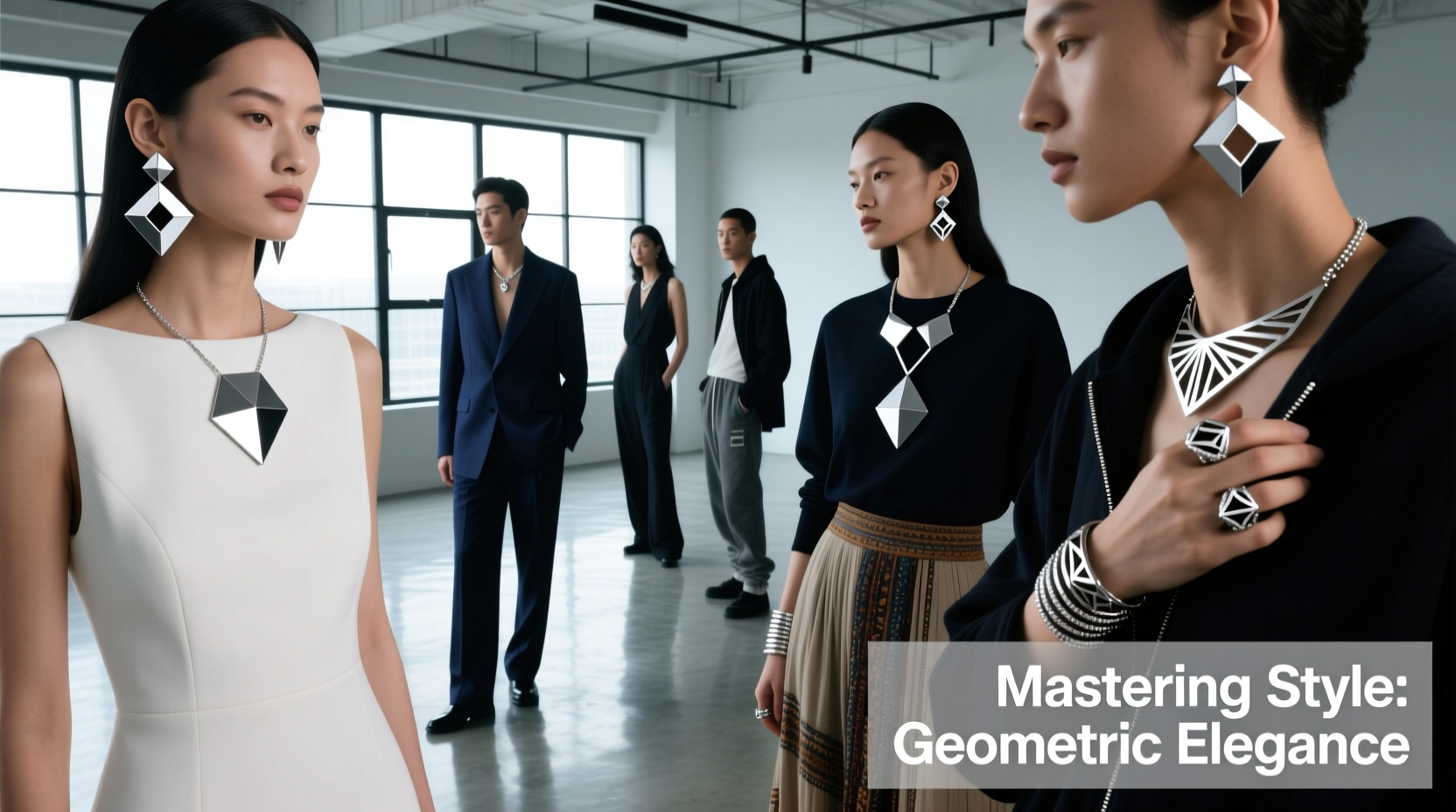
Geometry in design speaks to harmony and order. In jewelry, shapes like squares, hexagons, spirals, and asymmetrical lines do more than catch the eye—they convey confidence, intellect, and artistic sensibility. Unlike organic or floral motifs, geometric designs are often gender-neutral and timeless, making them ideal for building a capsule accessory collection.
Designers such as Paco Rabanne, Andrée Putman, and contemporary artists like Ana Khouri have long championed geometric forms for their ability to transform the wearer’s silhouette. “A well-placed angular pendant can shift the perception of posture and proportion,” says stylist and fashion consultant Lena Moreau.
“Geometric jewelry doesn’t just decorate—it redefines space around the body.” — Lena Moreau, Fashion Stylist & Creative Director
When used intentionally, geometric elements draw attention where you want it: elongating the neck with a linear choker, balancing broad shoulders with circular earrings, or adding movement through kinetic, layered rings.
How to Choose the Right Shape for Your Style and Features
Not all shapes work universally. Matching geometry to face shape, body type, and personal aesthetic enhances impact while maintaining elegance.
| Shape | Best For | Style Effect |
|---|---|---|
| Circles & Ovals | Square or angular faces | Softens edges, adds fluidity |
| Triangles & Pyramids | Rounded faces, soft features | Adds definition, creates vertical lift |
| Squares & Rectangles | Curvy figures, oval faces | Introduces structure, grounds volume |
| Abstract/Asymmetrical | Bold personalities, minimalist wardrobes | Creates focal point, sparks conversation |
| Linear/Bars | All body types (when scaled) | Elongates, streamlines, modernizes |
Styling Geometric Jewelry by Occasion
The adaptability of geometric jewelry shines when matched to context. With subtle shifts in scale and material, one piece can transition from desk to dinner.
Workwear: Subtlety with Impact
In professional settings, opt for small-scale geometric studs or a single-line bracelet. A thin rose gold hexagon pendant on a delicate chain complements a crisp white blouse without distracting. Avoid oversized or clinking pieces that may disrupt meetings.
Casual Daywear: Play with Layering
Pair a chunky brass ring shaped like an open cube with a relaxed linen shirt and jeans. Add a set of graduated circle hoops to elevate a basic tee. This is where mixing metals works best—try pairing matte black titanium with polished silver cubes for urban edge.
Evening Events: Go Sculptural
Choose bolder statements: a faceted crystal cuff inspired by molecular structures, or a collar necklace composed of interlocking triangles. These pieces command attention and pair beautifully with solid-color gowns or monochrome suits.
Special Occasions: Break Symmetry
Don’t shy away from asymmetry. Wear a single large geometric drop earring on one side with a bare opposite ear. Or stack mismatched geometric rings—one triangular, one cylindrical—on one hand for curated drama.
Step-by-Step Guide: Building a Geometric Jewelry Wardrobe
Follow this five-step process to curate a functional, expressive collection:
- Assess your wardrobe palette. Identify dominant colors (neutrals, earth tones, jewel tones). Choose metal finishes that complement them—warm gold for camel and rust, silver for navy and gray.
- Select three foundational pieces. Start with one earring type (e.g., circle studs), one necklace (linear bar), and one ring (minimalist square band).
- Add one statement item. Invest in a standout piece—perhaps a kinetic geometric pendant or a multi-tiered ear cuff.
- Experiment with layering. Combine two necklaces: a short geometric pendant with a longer abstract chain. Ensure varying lengths to avoid tangling.
- Rotate seasonally. Lighter, openwork designs suit summer; heavier, dark-metal geometrics align with autumn layers.
Mini Case Study: Transforming a Capsule Wardrobe
Maria, a 34-year-old architect based in Portland, wanted to refresh her minimalist wardrobe without buying new clothes. She owned seven tops, four bottoms, and two dresses—all in black, white, gray, and beige. By introducing a curated set of geometric jewelry, she created six distinct looks from the same base items.
For work, she wore a brushed gold triangle pendant with her turtleneck and blazer, instantly adding directional interest. On weekends, she paired oxidized silver spiral earrings with a trench coat and jeans, giving her look an artsy edge. For a gallery opening, she added a magnetic double-hoop earring with rotating cubes, transforming her little black dress into something avant-garde.
“I didn’t change my clothes,” Maria said. “I changed how they were perceived. The jewelry became the personality of the outfit.”
Do’s and Don’ts of Accessorizing with Geometric Pieces
| Do | Don’t |
|---|---|
| Match geometric complexity to outfit simplicity | Wear multiple complex pieces at once (e.g., angular earrings + bold necklace + sculptural rings) |
| Use symmetry to create balance | Ignore facial proportions—large shapes can overwhelm smaller frames |
| Mix metals if shapes are consistent (e.g., circles in gold and silver) | Clash styles—don’t pair Art Deco triangles with bohemian fringe |
| Consider negative space in design (open rings, hollow pendants) | Over-accessorize delicate necklines |
Frequently Asked Questions
Can I wear geometric jewelry if I prefer classic styles?
Absolutely. Opt for subtle interpretations—think a watch with a square face, pearl earrings framed in a rectangular setting, or a simple V-shaped pendant. These quietly nod to geometry without straying from tradition.
How do I keep geometric jewelry from looking costume-like?
Stick to high-quality materials—solid metals, natural stones, enamel finishes—and avoid plastic or overly bright coatings. Simplicity in design also helps; clean lines read as sophisticated, not theatrical.
Is geometric jewelry suitable for men?
Yes. Men’s geometric accessories—such as angular signet rings, octagonal cufflinks, or carbon-fiber bracelets—are increasingly popular in modern menswear. They project precision and innovation without sacrificing masculinity.
Final Thoughts: Make Geometry Work for You
Mastering style isn’t about following rules—it’s about understanding principles so you can bend them with confidence. Geometric jewelry offers a powerful tool for self-expression, allowing you to play with form, balance, and visual rhythm. Whether you lean toward understated elegance or bold experimentation, the right piece can redefine an entire look.
Start small. Try one geometric accent this week. Notice how it changes the way people see you—and how you see yourself. Then build from there, collecting pieces that resonate with your identity, not just the season’s trends.




 浙公网安备
33010002000092号
浙公网安备
33010002000092号 浙B2-20120091-4
Comments
No comments yet. Why don't you start the discussion?