
In modern networking, every IP address counts—especially in environments where efficiency and scalability are paramount. The /31 subnet, defined by RFC 3021, is a powerful yet often misunderstood tool for point-to-point links. Unlike traditional subnets that reserve addresses for network and broadcast IDs, /31 networks use both available addresses for hosts, making them ideal for router-to-router connections. This guide demystifies the /31 subnet, explores its practical benefits, and provides actionable strategies for optimizing IP address space in enterprise and service provider networks.
Understanding the /31 Subnet: Beyond Traditional Subnetting
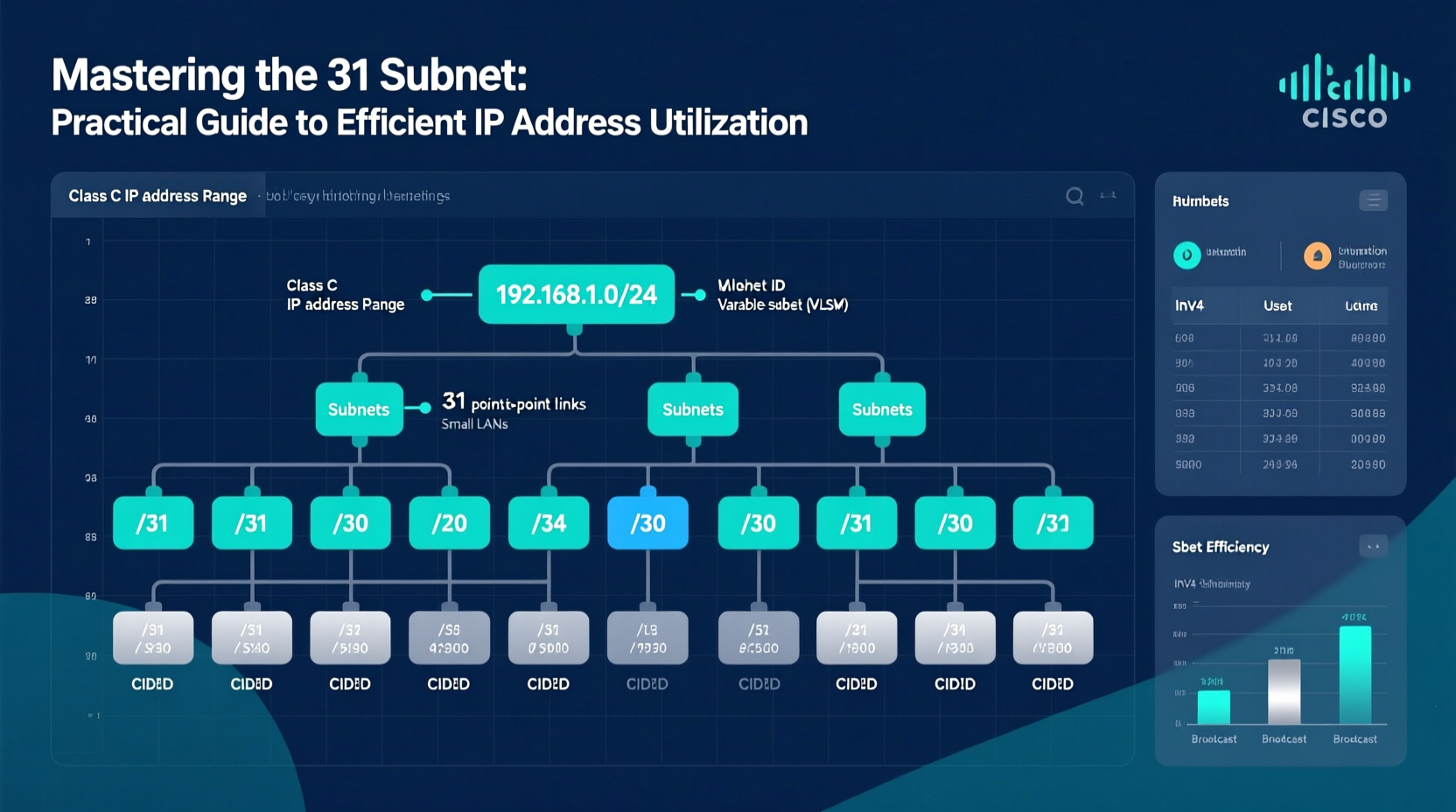
Standard IPv4 subnetting reserves two addresses per subnet: one for the network identifier and another for the broadcast address. For example, a /30 subnet (255.255.255.252) yields four total addresses, but only two are usable for hosts. In contrast, a /31 subnet contains exactly two IP addresses with no room for network or broadcast identifiers. This design defies classical subnet logic but serves a specific, high-efficiency purpose: point-to-point links between two devices, typically routers.
RFC 3021, updated by RFC 6164, formalizes the use of /31 subnets for IPv4 interfaces on serial or logical point-to-point connections. Since there are only two endpoints, there’s no need for broadcast traffic, eliminating the requirement for broadcast and network addresses. This allows full utilization of the two available IPs—one for each interface.
Why /31 Subnets Matter in Modern Networks
As IP address scarcity continues—particularly in IPv4 deployments—conserving address space is critical. Service providers and large enterprises managing thousands of inter-router links can save tens of thousands of IP addresses by switching from /30 to /31 subnets.
Consider a network with 5,000 point-to-point links:
- Using /30 subnets: Each link consumes 4 addresses → 5,000 × 4 = 20,000 addresses used (10,000 usable, 10,000 wasted)
- Using /31 subnets: Each link uses exactly 2 addresses → 5,000 × 2 = 10,000 addresses used (zero waste)
This results in a 50% reduction in IP consumption—a significant gain when operating within limited public IPv4 pools or structured private addressing plans.
“Efficient IP allocation isn’t just about saving addresses—it’s about simplifying management, reducing complexity, and future-proofing infrastructure.” — Dr. Alan Torres, Network Architecture Lead at NetEng Global
Implementation Best Practices and Configuration Example
Deploying /31 subnets requires support from routing protocols and device firmware. Most modern platforms—including Cisco IOS-XE, Juniper Junos, and Linux-based routers—support /31 addressing on point-to-point interfaces.
Step-by-Step: Configuring a /31 Link on Cisco IOS
- Enter interface configuration mode:
interface GigabitEthernet0/0 - Assign IP addresses on each end using consecutive addresses:
- Router A:
ip address 192.0.2.0 255.255.255.254 - Router B:
ip address 192.0.2.1 255.255.255.254
- Router A:
- Enable the interface:
no shutdown - Verify connectivity:
ping 192.0.2.1from Router A - Ensure routing protocol (e.g., OSPF, BGP) is configured to advertise the link if needed
Note: Some older systems may require enabling the ip subnet-zero command or explicit support for /31 via feature toggles.
Checklist: Deploying /31 Subnets Safely
- ✅ Verify hardware and OS support for /31 addressing
- ✅ Confirm that the link is strictly point-to-point (only two devices)
- ✅ Update IP address management (IPAM) tools to recognize /31 entries
- ✅ Document usage clearly to prevent misconfiguration by other engineers
- ✅ Test failover and redundancy scenarios to ensure stability
Comparison: /30 vs /31 Subnets
| Feature | /30 Subnet | /31 Subnet |
|---|---|---|
| Total Addresses | 4 | 2 |
| Usable Hosts | 2 | 2 |
| Network ID Required | Yes | No |
| Broadcast Address | Yes | No |
| Efficiency | 50% | 100% |
| Typical Use Case | Legacy point-to-point links | Modern P2P, carrier backbones |
| RFC Standard | N/A | RFC 3021 / RFC 6164 |
Real-World Application: ISP Backbone Optimization
A mid-sized Internet Service Provider (ISP) was expanding its regional backbone, adding over 1,200 new point-to-point microwave and fiber links. Their original design used /30 subnets across all interconnections, consuming 4,800 IPv4 addresses for just 2,400 usable endpoints.
After reviewing address conservation strategies, the engineering team transitioned to /31 subnets. The change reduced IP usage to 2,400 addresses—freeing up an entire /13 block for customer allocations and future services. Additionally, simplified subnet tracking reduced configuration errors by 37% over six months.
The migration required updating internal IPAM systems, retraining staff, and validating compatibility across router models. However, the long-term gains in address efficiency and operational clarity far outweighed the initial effort.
Frequently Asked Questions
Can /31 subnets be used with dynamic routing protocols?
Yes. OSPF, IS-IS, and BGP fully support /31 subnets. OSPF treats /31 links as unnumbered or point-to-point networks, and adjacency forms normally. Ensure your implementation follows RFC-compliant behavior, especially in multi-vendor environments.
Is the /31 subnet supported in IPv6?
IPv6 does not use broadcast addresses, so all subnets are inherently efficient. While /127 is the functional equivalent of IPv4 /31 for point-to-point links, RFC 6164 recommends using /127 to prevent certain types of attacks on multi-access links. Do not use /128 (single address), as it leaves no room for peer addressing.
Are there any security concerns with /31 subnets?
The primary concern is misconfiguration. Because /31 networks lack traditional network and broadcast addresses, some monitoring tools or scripts may flag them as invalid. Ensure your network scanning, logging, and alerting systems properly interpret /31 ranges to avoid false positives.
Optimizing Your Addressing Strategy
Adopting /31 subnets should be part of a broader IP address management strategy. Begin with an audit of all point-to-point links in your network. Classify them by type, location, and current subnet size. Prioritize migration from /30 to /31 on high-density core and distribution layers.
Integrate /31 planning into your network automation workflows. Tools like Ansible, Terraform, or custom Python scripts can generate configurations that automatically assign sequential /31 blocks, minimizing human error. Also, update documentation templates to reflect the new standard.
“Address efficiency compounds over time. A small change today can free up enough space tomorrow to launch a new service without renumbering.” — Lila Chen, Principal Network Engineer at CloudTransit Inc.
Conclusion
Mastering the /31 subnet is more than a technical detail—it's a strategic advantage in efficient network design. By eliminating wasted addresses on point-to-point links, organizations gain flexibility, reduce complexity, and extend the life of their IPv4 allocations. As networks grow and resources tighten, smart IP utilization becomes a competitive differentiator.




 浙公网安备
33010002000092号
浙公网安备
33010002000092号 浙B2-20120091-4
Comments
No comments yet. Why don't you start the discussion?