
Creating an accurate and properly formatted APA reference page is essential for academic integrity, credibility, and professionalism in scholarly writing. Whether you're a student, researcher, or educator, mastering APA 7th edition standards ensures your work meets institutional expectations. This comprehensive guide walks through every element of the APA reference page—structure, formatting rules, common pitfalls, and real-world applications—so you can produce flawless citations with confidence.
Understanding the Purpose of the Reference Page
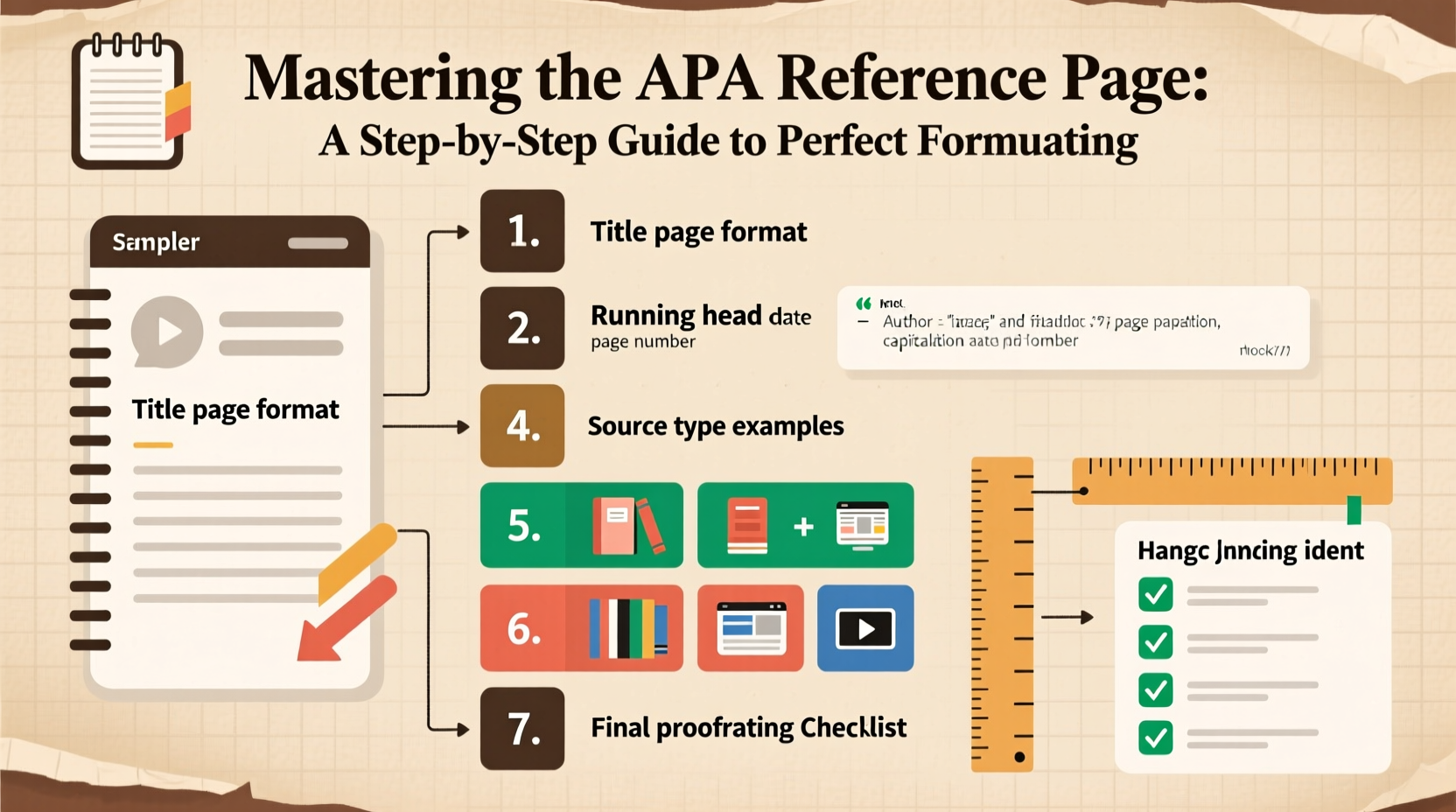
The reference page serves as a complete record of all sources cited in your paper. It allows readers to verify information, explore original materials, and assess the depth of your research. Unlike in-text citations, which briefly identify a source within the body of your text, the reference page provides full publication details in a standardized format.
According to the American Psychological Association (APA), “References provide the information necessary for readers to identify and retrieve each work cited in the text.” This means precision matters—not just for compliance, but for scholarly communication.
“Accurate referencing isn’t just about avoiding plagiarism—it’s about contributing responsibly to the academic conversation.” — Dr. Linda Harper, Academic Writing Consultant
Step-by-Step Guide to Formatting the Reference Page
Follow these steps to build a correctly structured APA reference page from scratch:
- Start on a new page: The reference page begins on its own numbered page at the end of your document.
- Title it “References”: Center the word \"References\" at the top of the page (bolded only if required by instructor; standard APA does not bold it).
- Use double spacing throughout: All text, including between entries, must be double-spaced.
- Apply a hanging indent: The first line of each reference is flush left; subsequent lines are indented 0.5 inches.
- Alphabetize entries: List references in alphabetical order by the last name of the first author.
- Include all necessary elements: Author(s), publication year, title, source, and DOI or URL where applicable.
Core Elements of an APA Reference Entry
Every reference follows a specific structure based on the type of source. The general pattern is:
Author, A. A., & Author, B. B. (Year). Title of work. Source. https://doi.org/xx.xxxx/xxxxx
Breaking Down Each Component
- Author(s): List last name followed by initials (e.g., Smith, J. K.). For multiple authors, use commas and an ampersand before the last author.
- Publication Year: In parentheses, followed by a period.
- Title of Work: Capitalize only the first word and proper nouns. Italicize book and journal titles.
- Source Information: Include publisher name for books; journal name, volume number (italicized), issue number (in parentheses, not italicized), and page range for articles.
- DOI or URL: Present DOIs as URLs (https://doi.org/10.xxxx). For online sources without DOI, include the direct URL (no “Retrieved from” unless a retrieval date is needed).
Common Source Types and Examples
Different sources require slight variations in formatting. Below is a comparison table showing correct APA 7th edition formats:
| Source Type | Example |
|---|---|
| Book | Johnson, M. L. (2020). The science of learning: From theory to practice. Oxford University Press. |
| Journal Article (with DOI) | Lee, T., & Park, S. (2021). Cognitive load in digital reading environments. Journal of Educational Psychology, 113(4), 789–802. https://doi.org/10.1037/xge0001021 |
| Website / Webpage | National Institutes of Health. (2022, March 15). Sleep and health. https://www.nih.gov/sleep-health |
| Edited Book Chapter | Adams, R. (2019). Ethics in artificial intelligence. In C. Bell (Ed.), Digital futures: Technology and society (pp. 112–130). MIT Press. |
Real Example: Building a Reference Page from Scratch
Imagine you’ve written a 5-page paper on mindfulness in education. You cited three sources:
- A book by Daniel Goleman (2015) titled *Mindfulness in Schools*
- An article by Chen et al. (2022) in the *Journal of Applied School Psychology*, volume 38, issue 2, pages 145–160, with DOI
- A webpage from Edutopia.org published in 2023
Your reference page would look like this:
References

Chen, L., Wang, Y., & Kumar, S. (2022). Implementing mindfulness programs in urban classrooms. Journal of Applied School Psychology, 38(2), 145–160. https://doi.org/10.1080/15377903.2021.2012345

Goleman, D. (2015). Mindfulness in schools: Tools for well-being and focus. HarperCollins.

Edutopia. (2023, January 10). How mindfulness transforms classroom culture. https://www.edutopia.org/article/mindfulness-transforms-classroom-culture
Note that entries are alphabetized by author last name (Chen, then Goleman, then Edutopia as organizational author), all have hanging indents, and DOIs are presented as hyperlinks.
Checklist: Final Review Before Submission
Before submitting your paper, run through this checklist to ensure your reference page meets APA 7 standards:
- ✅ Is the page titled \"References\" and centered?
- ✅ Are all entries double-spaced?
- ✅ Does each citation have a hanging indent?
- ✅ Are entries listed in alphabetical order?
- ✅ Are author names correctly formatted (Last name, Initials)?
- ✅ Are titles in sentence case and properly italicized?
- ✅ Are DOIs formatted as URLs (https://doi.org/...)?
- ✅ Are all in-text citations accounted for on the reference page?
- ✅ Are there no bullet points, numbers, or extra labels?
Frequently Asked Questions
Do I need to include retrieval dates for online sources?
No, unless the content is likely to change over time (e.g., wikis, social media). Most academic websites and articles do not require retrieval dates. Only include them when no publication date is available and the content is dynamic.
What if a source has more than 20 authors?
In APA 7, list the first 19 authors, insert an ellipsis (...), then add the final author. Do not use “et al.” in the reference list unless there are 21 or more authors.
Should I underline titles instead of using italics?
No. APA 7 uses italics for titles of books, journals, reports, and webpages. Underlining is outdated and not permitted in current guidelines.
Avoiding Common Mistakes
Even experienced writers make small errors that undermine credibility. Watch out for these frequent issues:
- Mismatched in-text and reference entries: Every source cited in-text must appear in the reference list, and vice versa.
- Incorrect capitalization: Use sentence case for article and book titles—only capitalize the first word, proper nouns, and the first word after a colon.
- Missing DOIs: Always search CrossRef.org or the article itself to find a DOI before falling back on a URL.
- Using database URLs: Never cite ProQuest, EBSCO, or JSTOR links. Use the DOI or the journal’s official website URL.
- Alphabetizing errors: Ignore “A,” “An,” or “The” at the beginning of titles when alphabetizing by organization name.
“One misplaced comma or incorrect italicization can distract a reader or suggest carelessness. Precision in references reflects rigor in thought.” — Prof. Alan Torres, Director of Academic Writing Programs
Conclusion
Mastering the APA reference page is not merely a technical requirement—it’s a reflection of your commitment to academic honesty and clarity. By following structured formatting rules, double-checking each entry, and applying consistent attention to detail, you elevate the quality and credibility of your work. Whether you’re writing a term paper, thesis, or journal submission, a perfectly formatted reference page signals professionalism and respect for the scholarly community.




 浙公网安备
33010002000092号
浙公网安备
33010002000092号 浙B2-20120091-4
Comments
No comments yet. Why don't you start the discussion?