
Decluttering a closet is one of those tasks that feels both necessary and daunting. You open the door, see clothes spilling from shelves, shoes stacked in disarray, and accessories tangled beyond recognition—and suddenly, the idea of tackling it all seems impossible. But clutter doesn’t have to dominate your space or your mindset. With the right approach, you can transform your closet into an organized, calming sanctuary without burning out in the process.
The key isn't just cleaning—it's creating a system that respects your time, energy, and emotional relationship with your belongings. This guide walks you through a realistic, sustainable method for decluttering your closet, step by step, so you maintain momentum without feeling defeated.
Start with Mindset: Why Less Is More (and Easier)
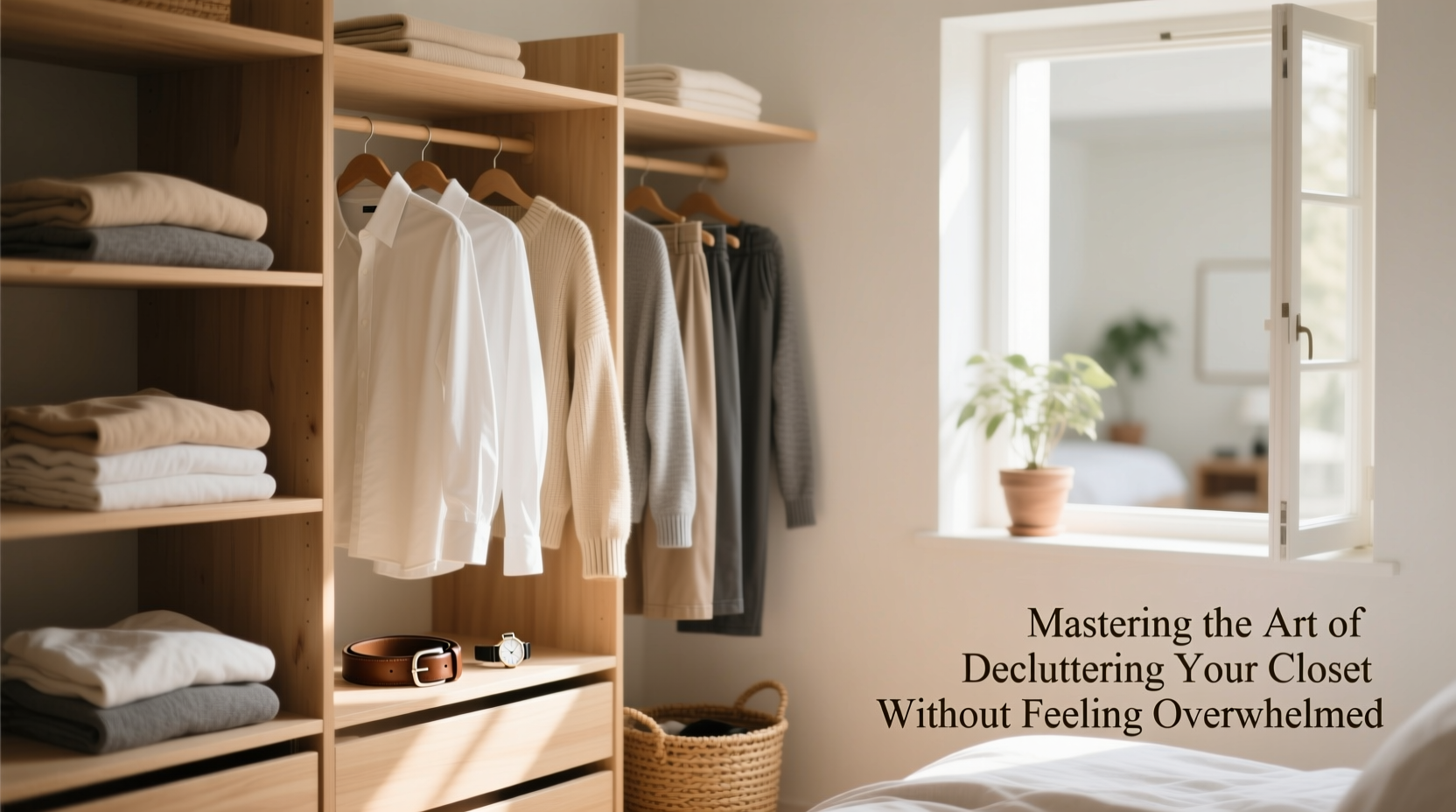
Before touching a single hanger, shift your perspective. Decluttering isn’t about punishment or deprivation; it’s about making room for clarity, ease, and intentionality. A crowded closet doesn’t mean you’re disorganized—it means you’ve accumulated options over time, many of which no longer serve you.
Studies in environmental psychology show that visual clutter increases stress and reduces focus. When your closet is overflowing, getting dressed becomes a daily negotiation rather than a simple choice. By reducing excess, you're not losing anything—you're gaining time, mental peace, and confidence in your wardrobe.
A Step-by-Step Guide to Stress-Free Closet Decluttering
Rushing through your closet in one marathon session often leads to decision fatigue and regret. Instead, follow this structured timeline to keep things manageable and effective.
- Phase 1: Prepare (Day 1 – 5 minutes)
Create space and gather supplies. Clear a bed or floor area where you can sort items. Have three bins or bags labeled: Keep, Donate/Sell, Discard. Optional: notebook for inventory or donation tracking. - Phase 2: Empty & Assess (Day 2 – 30 minutes)
Remove everything from your closet. Yes, everything. Seeing all your clothes in one place breaks denial patterns and reveals duplicates, forgotten pieces, and items you've avoided dealing with. - Phase 3: Sort by Category (Day 3 – 45 minutes)
Group similar items: tops, pants, dresses, outerwear, shoes, accessories. Sorting by type—not color or season—makes it easier to evaluate quantity and usage. - Phase 4: The One-Year Rule (Day 4 – 60 minutes)
Ask: “Have I worn this in the past year?” If not, it likely doesn’t belong in your daily rotation. Exceptions: special occasion wear, maternity clothes during pregnancy, or sentimental pieces you actively cherish. - Phase 5: Try Before You Toss (Day 5 – 30 minutes)
Try on questionable items. Does it fit? Is it comfortable? Does it reflect how you want to feel today? If not, let it go—even if it’s new or expensive. - Phase 6: Organize What Stays (Day 6 – 45 minutes)
Fold, hang, and store remaining items logically. Use consistent hangers, drawer dividers, and shelf organizers. Store seasonal items separately if needed. - Phase 7: Maintain the System (Ongoing)
Add a “one in, one out” rule: every new clothing item purchased means one old one leaves. Reassess every 3–6 months.
This seven-day framework spreads effort across manageable chunks, preventing burnout while building lasting habits.
Do’s and Don’ts of Sustainable Closet Management
Mistakes in decluttering aren’t just about what you throw away—they’re about how you set up your system afterward. Refer to this table to avoid common pitfalls.
| Do | Don’t |
|---|---|
| Sort by category, not location | Jump between drawers and shelves randomly |
| Use the same hanger type for uniformity | Mix wooden, plastic, and wire hangers |
| Store off-season clothes out of sight but accessible | Bury winter coats under summer sandals |
| Donate within 48 hours of deciding | Leave “maybe” boxes for months |
| Label storage bins clearly | Assume you’ll remember what’s inside |
| Keep a donation bag in your closet at all times | Wait until you’re “ready” to donate |
Real Example: How Sarah Transformed Her Closet in One Week
Sarah, a graphic designer and mother of two, spent years opening her closet only to sigh at the mess. She’d buy new clothes because “nothing fits” or “I have nothing to wear,” only to add more chaos. After reading about incremental decluttering, she committed to the seven-day plan.
On day one, she gathered supplies and set a five-minute timer. She cleared a corner of her bedroom floor and placed three bins nearby. Day two, she pulled everything out—72 hangers, four shoeboxes, and a heap of scarves. By categorizing, she realized she owned 14 black sweaters. “I never knew I had so many,” she said. “I thought I needed more.”
Using the one-year rule, she donated 40% of her wardrobe. She tried on three dresses she’d kept “just in case.” Two didn’t fit; one felt outdated. She let them go. By day six, her closet was streamlined: folded jeans in labeled bins, hanging shirts by sleeve length, shoes on a low rack. She added a small basket for donations near the door.
Three months later, Sarah reports dressing faster, shopping less, and feeling more confident. “It wasn’t about having fewer clothes,” she shared. “It was about keeping only what makes me feel like myself.”
Expert Insight: What Professionals Know About Wardrobe Clarity
Marie Kondo popularized joy-based sorting, but professional organizers emphasize consistency over perfection. According to Dana White, certified organizing consultant and author of *Closet Confidence*, the real transformation happens after the purge.
“People think decluttering is a one-time event. But the magic is in maintenance. A closet should work for you, not against you. If you dread opening it, it’s not organized—it’s just rearranged.” — Dana White, Professional Organizer
White recommends auditing your closet quarterly. “Set a calendar reminder. Pull out anything unworn since the last check-in. It keeps decision-making small and prevents buildup.” She also advises against over-investing in complex systems before understanding your actual usage patterns. “Start simple. Use what you have. Refine as you learn.”
Essential Checklist: Your Closet Decluttering Roadmap
Follow this checklist to stay focused and ensure no step is missed:
- ☐ Set a clear goal (e.g., “Reduce by 30%,” “Make mornings easier”)
- ☐ Gather supplies: bins, labels, trash bags, full-length mirror
- ☐ Block 15–60 minute sessions over 7 days
- ☐ Remove everything from the closet
- ☐ Sort into categories: tops, bottoms, dresses, etc.
- ☐ Apply the one-year rule to each item
- ☐ Try on borderline pieces
- ☐ Decide final fate: Keep, Donate, Discard
- ☐ Clean shelves and surfaces before returning items
- ☐ Reorganize with intention: group by type, color, frequency
- ☐ Label storage containers
- ☐ Schedule next review (3–6 months ahead)
- ☐ Place a donation bin in your closet for ongoing use
Print this list or save it digitally. Check off each box as you go—visual progress fuels motivation.
FAQ: Common Questions About Closet Decluttering
What if I’m unsure whether to keep something?
If you hesitate, place the item in a “trial” box. Seal it with a date label: six months from now. If you haven’t opened it to retrieve something by then, donate the entire box. Most people never do.
How do I deal with sentimental clothing?
Keep a small memory capsule—no more than one box. Turn a favorite shirt into a pillow, quilt, or framed art. Letting go of the physical item doesn’t erase the memory. Honor the meaning, not the mass.
Won’t donating take too much time?
Commit to dropping off donations within 48 hours. Schedule it like an appointment. Many charities offer pickup services. Delayed donations often end up back in your closet.
Conclusion: Your Closet, Your Calm
A decluttered closet isn’t just about neat hangers and matching bins. It’s about reclaiming space—physical and mental. When you stop fighting with your wardrobe every morning, you gain time, clarity, and confidence. The process doesn’t require perfection, just consistency.
You don’t need to overhaul your life in a weekend. Start small. Be kind to yourself. Celebrate progress, not completion. Every item you release makes room for something better—not just in your closet, but in your daily experience.




 浙公网安备
33010002000092号
浙公网安备
33010002000092号 浙B2-20120091-4
Comments
No comments yet. Why don't you start the discussion?