
Sending physical or digital mail may seem straightforward, but one often-overlooked detail can determine whether your message reaches the right person promptly: the attention line. Whether you're mailing a formal business proposal, an invoice, or a personal letter to a large organization, failing to direct it correctly can result in delays, misplacement, or outright disregard. The attention line—commonly abbreviated as \"Attn:\"—is not just a formality; it’s a critical routing tool that ensures your correspondence lands on the right desk.
In today’s fast-paced communication landscape, where even email inboxes are flooded daily, precision matters. This guide breaks down everything you need to know about using the attention line effectively across different types of mail, formats, and organizational structures. You’ll learn best practices, common mistakes, and how to structure your correspondence so it gets seen—and acted upon—quickly.
What Is an Attention Line and Why It Matters
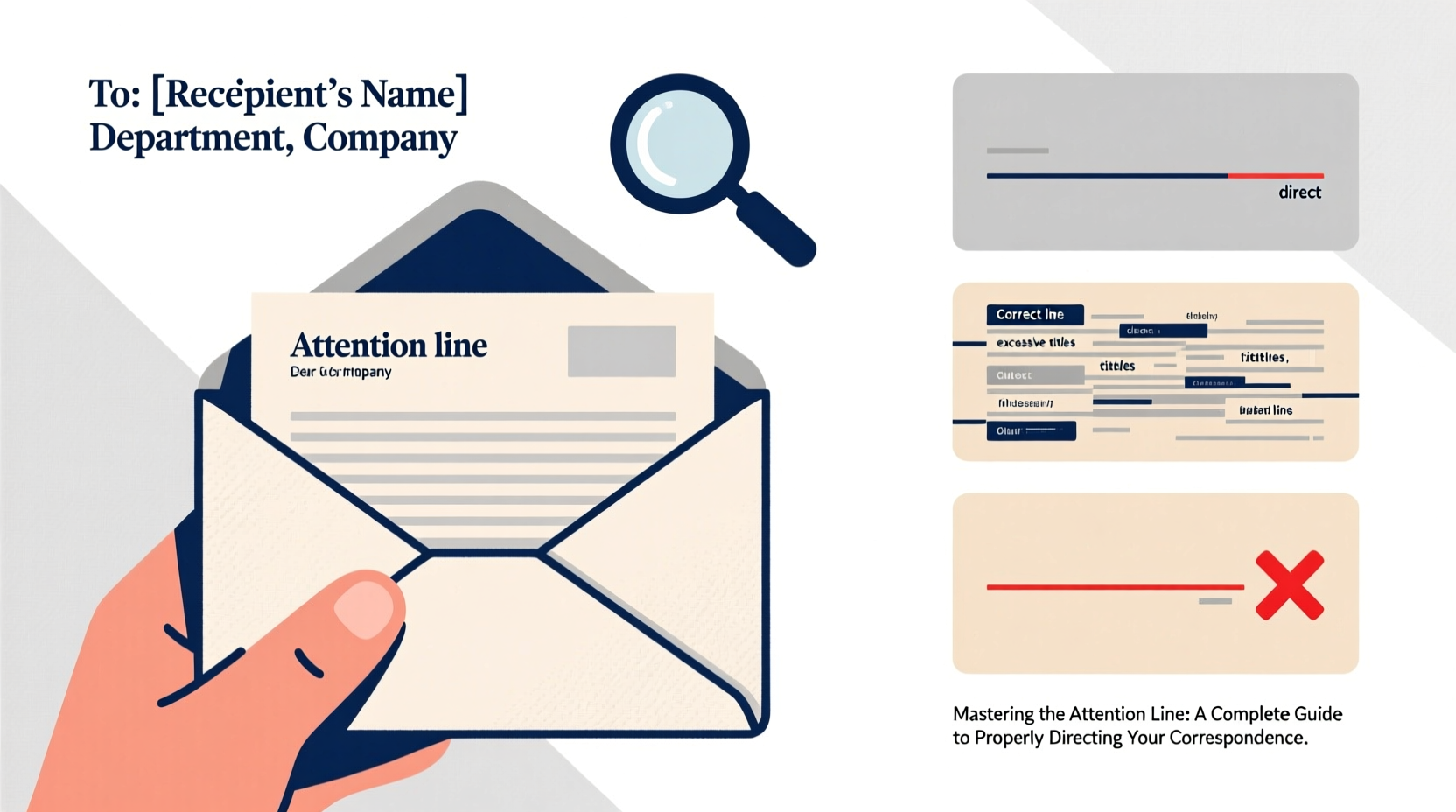
The attention line is a designation placed on an envelope or within the header of a letter indicating the specific individual or department responsible for handling the contents. It acts as a directional signal for receptionists, administrative assistants, or automated sorting systems. Without it, your mail becomes part of general correspondence, which often takes longer to process or may be overlooked entirely.
In corporate environments, especially larger companies with multiple departments and layers of staff, the attention line functions like a GPS coordinate for internal delivery. It prevents bottlenecks at the front desk and increases the likelihood that your document will be opened by the intended recipient without unnecessary delays.
“An incorrectly addressed letter doesn’t just slow things down—it signals a lack of professionalism.” — Laura Simmons, Executive Communications Consultant at ClearPath Messaging
Where and How to Place the Attention Line
The placement of the attention line depends on the format of your correspondence: physical mail, email, or formal business letters. While the principle remains consistent—to highlight who should receive the message—the execution varies slightly.
For Physical Mail (Envelope)
On a standard envelope, the attention line appears directly above the main recipient's name or company name. It should be aligned left and formatted clearly:
Attn: Sarah Chen, Accounts Payable Manager
Greenfield Industries
1250 Commerce Drive
Portland, OR 97201
For Business Letters (Inside Address)
In formal business letters, the attention line appears in the inside address block, just before the salutation. Example:
[Your Name]
[Your Address]
[City, State, ZIP]
[Date]

Attn: Dr. Marcus Reed, Director of Research
BioGen Labs Inc.
480 Innovation Way
Cambridge, MA 02142

Dear Dr. Reed,
For Email Correspondence
In emails, the attention line isn't typically written out but is instead handled through proper addressing. Use the “To” field for the primary recipient and the “Subject” line to reinforce purpose. However, when sending to a general inbox (e.g., info@company.com), include “Attention: [Name/Department]” in the subject line:
- Subject: Invoice #INV-8842 – Attention: Finance Department
- Subject: Partnership Proposal – Attn: Marketing Director
Best Practices for Writing an Effective Attention Line
An effective attention line balances specificity with brevity. Too vague, and it defeats its purpose; too long, and it becomes cluttered. Follow these guidelines to maximize impact:
- Be Specific: Include both the person’s name and their relevant title when possible. “Attn: John Miller” is better than “Attn: Accounts Dept,” but “Attn: John Miller, Senior Accountant” is ideal.
- Avoid Abbreviations Unless Standardized: Use full titles unless the abbreviation is widely recognized (e.g., “CEO,” “HR”). Avoid informal shortenings like “Mgr” instead of “Manager.”
- Double-Check Spelling and Titles: A misspelled name or incorrect title undermines credibility and may delay processing.
- Use Consistent Formatting: Stick to one style throughout all your communications—either “Attn:”, “Attention:”, or “ATTN” in caps. “Attn:” is most commonly accepted.
- Update Contact Information Regularly: Personnel changes frequently. Confirm the current holder of a role before sending time-sensitive mail.
Common Mistakes to Avoid
Even experienced professionals make errors when formatting the attention line. These seemingly minor oversights can have real consequences.
| Mistake | Why It’s Problematic | Correct Approach |
|---|---|---|
| Omitting the attention line entirely | Mail goes into general distribution; risk of being ignored or delayed | Always include “Attn:” followed by name/title when sending to organizations |
| Using outdated names or titles | Recipient may have left; message could be discarded | Verify contact details via website or phone call before sending |
| Overloading with multiple names | Creates confusion about primary responsibility | List only the key decision-maker unless coordination is required |
| Placing “Attn:” at the bottom of the envelope | Easily missed during sorting | Always place attention line near the top of the address block |
Real-World Example: How One Company Improved Response Time
A mid-sized software firm, NexaTech Solutions, noticed a growing backlog in vendor payments. Invoices were arriving correctly but taking weeks to process. Upon investigation, they found that over 60% of incoming invoices lacked a proper attention line or used generic labels like “Accounts Department.” As a result, mailroom staff didn’t know whom to route them to, causing delays.
The finance team issued a simple directive: all future invoices must include “Attn: [Name], Accounts Payable” on the envelope and in the email subject line. Within two months, invoice processing time dropped from an average of 18 days to just 6. The change required no new technology—only clearer direction.
“We underestimated how much clarity impacts speed. A two-second addition to an envelope saved us thousands in late fees.” — Diane Tran, CFO, NexaTech Solutions
Step-by-Step Guide to Using the Attention Line Correctly
Follow this five-step process every time you prepare important correspondence:
- Identify the Intended Recipient: Determine exactly who needs to receive the message—by name and role.
- Verify Current Contact Details: Check the organization’s website, LinkedIn, or call the office to confirm the person is still in that position.
- Format the Attention Line Properly: On envelopes and letters, write “Attn: [Full Name], [Job Title]” above the company name.
- Reinforce in Digital Formats: For emails sent to general addresses, include “Attention: [Title]” in the subject line.
- Proofread Before Sending: Ensure spelling, punctuation, and job titles are accurate.
Frequently Asked Questions
When should I use “Attention” versus “Attn:”?
Both are acceptable, but “Attn:” is more concise and widely used in business contexts. Choose one format and remain consistent across your communications.
Can I use the attention line for personal mail?
Rarely necessary. Personal letters usually go directly to an individual. However, if sending something to a household where multiple adults reside (e.g., wedding invitations), you might use “Attn: James and Maria Thompson” to clarify.
What if I don’t know the recipient’s name?
If the name is unknown, use the department or role: “Attn: Human Resources Department” or “Attn: Customer Service Manager.” Avoid overly broad terms like “To Whom It May Concern” when possible.
Final Checklist for Perfect Attention Lines
- ☐ Recipient’s full name included (if known)
- ☐ Correct job title or department specified
- ☐ “Attn:” placed above the company name on envelopes
- ☐ No spelling errors in names or titles
- ☐ Subject line reflects attention information for emails
- ☐ Contact verified as up-to-date
Conclusion: Precision Leads to Results
The attention line is a small element with outsized influence. It bridges the gap between intention and action—between sending a letter and ensuring it’s read. In a world where attention is the scarcest resource, guiding yours wisely isn’t just courteous; it’s strategic. Whether you’re following up on a job application, submitting a legal document, or closing a sales deal, mastering the attention line gives your message the advantage it deserves.




 浙公网安备
33010002000092号
浙公网安备
33010002000092号 浙B2-20120091-4
Comments
No comments yet. Why don't you start the discussion?