
Go is one of the oldest board games in the world, originating over 2,500 years ago in China. Despite its simple rules, Go offers profound depth, making it a favorite among strategic thinkers, mathematicians, and AI researchers alike. Unlike chess, where aggression often wins, Go rewards patience, balance, and long-term vision. This guide breaks down the fundamentals, explains core strategies, and provides actionable steps to help you grow from a novice into a confident player.
Understanding the Rules: Simplicity with Depth
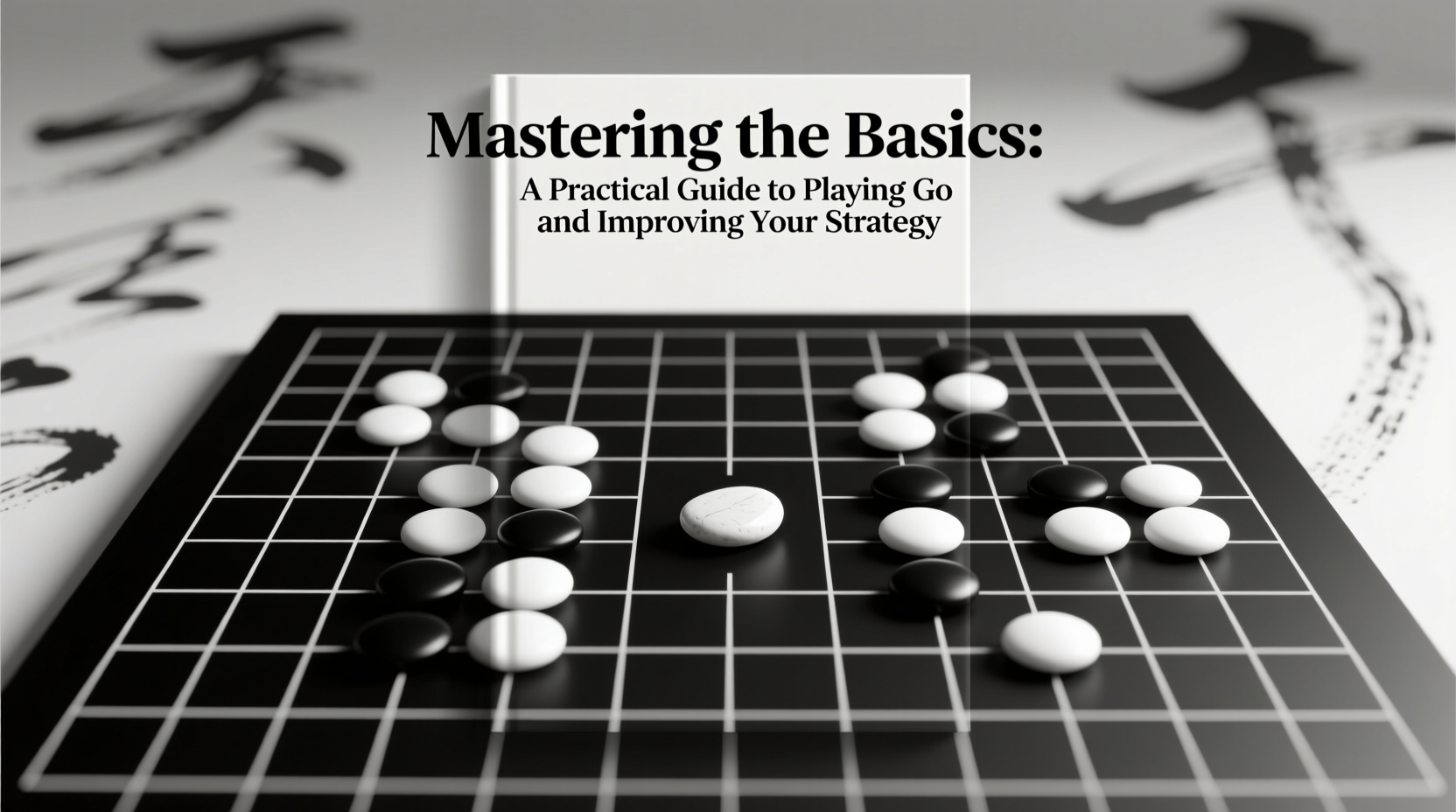
The Go board is a grid—typically 19x19, though beginners often start on 9x9 or 13x13. Two players take turns placing black and white stones on the intersections. The goal is to surround more territory than your opponent by the end of the game.
Stones are placed on the lines' intersections, not inside the squares. Once placed, they don’t move unless captured. A stone or group of connected stones is captured when all its liberties (adjacent empty points) are occupied. Captured stones are removed from the board.
Players can pass their turn at any time. The game ends when both players pass consecutively. Afterward, territory is counted—empty points surrounded by a player’s stones—and captured stones are added as points. The player with the higher total wins.
Core Concepts Every Beginner Should Know
Before diving into advanced tactics, internalize these foundational ideas:
- Liberties: Empty adjacent points that keep a stone or group alive.
- Groups and Connectivity: Stones of the same color on adjacent points form a group. Connected groups share liberties and are harder to capture.
- Life and Death: A group is “alive” if it cannot be captured, usually because it has two separate internal spaces (eyes). A group without eyes is vulnerable.
- Sente and Gote: Sente refers to a move that forces a response, allowing you to keep initiative. Gote moves require a reply from the opponent but cede control.
“Go is not about winning battles; it’s about winning the war through influence and timing.” — Cho Chikun, 9-dan professional
Step-by-Step Guide to Your First Game
Follow this sequence to play your first full game confidently:
- Choose the Board Size: Start with 9x9 for faster games and quicker learning.
- Determine Color: Let the weaker player take Black, who moves first. In even games, flip a stone to randomize.
- Opening Moves: Begin near the corners (3-4 or 4-4 points), then move to sides, and finally the center. Corners are easiest to secure.
- Build Frameworks: Connect stones loosely to claim space rather than filling every point immediately.
- Respond to Threats: If an opponent invades your area, decide whether to attack, reduce, or abandon based on efficiency.
- Recognize Life and Death: Before attacking or defending, assess if a group can form two eyes.
- Endgame (Yose): Fill in small boundary moves that add one or two points. These often decide close games.
- Score the Game: Remove dead stones, count surrounded territory, and compare totals.
Common Strategic Mistakes and How to Avoid Them
New players often fall into predictable traps. Recognizing them accelerates improvement.
| Mistake | Why It’s Problematic | Better Approach |
|---|---|---|
| Overconcentrating stones | Wastes influence and reduces flexibility | Spread out; use light, efficient shapes |
| Chasing weak groups relentlessly | Loses sente and allows opponent to build elsewhere | Assess value; sometimes profit from reduction instead |
| Ignoring the center | Limits potential and influence | Balancing corner/side with central presence |
| Failing to read ahead | Leads to unexpected captures or losses | Always ask: “What will my opponent do next?” |
Mini Case Study: Turning Around a Losing Position
Consider a 9x9 game where White has secured the lower-left and upper-right corners. Black, feeling behind, launches a direct attack on a floating White group near the center. White responds calmly, sacrificing two stones to connect outward and threaten Black’s own thin position on the left side.
Instead of pressing the attack, Black shifts focus, reinforcing their left-side framework. White, now overextended, struggles to make life. Black uses sente moves to limit White’s escape, eventually surrounding the group. Though White gained points early, Black’s flexible response turned the game by prioritizing stability over aggression.
This illustrates a key lesson: sometimes, letting go of a fight is the most powerful move.
Improving Your Strategy: From Novice to Intermediate
Progress in Go isn’t linear—it comes in bursts after periods of confusion. Use these methods to advance steadily:
- Review your games: Replay your matches and identify where you lost efficiency or misjudged territory.
- Solve tsumego (life-and-death problems): Spend 10–15 minutes daily on puzzles to sharpen reading skills.
- Study joseki (standard patterns): Learn common corner sequences, but understand the principles behind them—not just memorization.
- Play regularly: Consistency matters more than intensity. Aim for 2–3 focused games per week.
- Learn from stronger players: Watch commentated games or join a local club to receive feedback.
“The mark of a strong player isn’t avoiding mistakes, but recognizing them quickly and adapting.” — Andrew Jackson, American Go Association Instructor
Checklist: Building a Daily Go Practice Routine
Use this checklist to structure your improvement journey:
- ✅ Play one game (9x9 or 13x13) with full concentration
- ✅ Review the game: Identify one overplay and one missed opportunity
- ✅ Solve 3–5 tsumego problems
- ✅ Study one joseki and its variations
- ✅ Read a short article or watch a pro game commentary (10 minutes)
Frequently Asked Questions
How long does a typical Go game last?
A 19x19 game between experienced players takes 1–2 hours. On 9x9, games last 10–20 minutes. With clocks, time controls vary from blitz (under 10 minutes) to multi-hour matches.
Is Go harder than chess?
In terms of possible moves and board complexity, yes. Go has more branching possibilities per move, making brute-force calculation impossible. However, the rules are simpler to learn. Mastery in either game requires deep study and pattern recognition.
Can I get better without a teacher?
You can, but progress will be slower. Self-study with quality resources—books like *Lessons in the Fundamentals of Go* by Kaku Takagawa, online platforms like OGS or Tygem, and puzzle apps—can take you far. However, personalized feedback from a mentor dramatically accelerates growth.
Conclusion: Your Journey Begins with One Stone
Go is more than a game—it’s a discipline that cultivates patience, foresight, and adaptability. The basics are easy to grasp, but the path to mastery is rich with challenges and insights. By focusing on sound principles, consistent practice, and thoughtful review, you’ll steadily climb the ranks. Don’t aim for perfection; aim for progress. Each move, win or lose, teaches something valuable.




 浙公网安备
33010002000092号
浙公网安备
33010002000092号 浙B2-20120091-4
Comments
No comments yet. Why don't you start the discussion?