
Writing is not a talent reserved for a select few—it’s a skill anyone can develop with intention and practice. Whether you’re crafting emails, blog posts, reports, or personal essays, the ability to express ideas clearly and persuasively is one of the most valuable competencies in both professional and personal life. Yet many people hesitate, believing they “can’t write.” The truth is, effective writing follows patterns, principles, and processes that can be learned. This guide breaks down those fundamentals into actionable steps, helping you move from uncertainty to confidence—one sentence at a time.
1. Understand What Effective Writing Really Means
Effective writing isn’t about using complex vocabulary or long sentences. It’s about clarity, coherence, and purpose. A well-written piece communicates its message efficiently, engages the reader, and achieves its intended goal—whether that’s to inform, persuade, entertain, or instruct.
At its core, effective writing includes:
- Clarity: The reader understands your point without confusion.
- Conciseness: You say what needs to be said—no more, no less.
- Cohesion: Ideas flow logically from one to the next.
- Correctness: Grammar, punctuation, and spelling support readability.
- Tone: Your voice matches the context and audience.
“Writing is thinking on paper. Anyone who thinks clearly can write clearly, about anything at all.” — William Zinsser, author of *On Writing Well*
2. Build a Foundation with Daily Practice
Like any skill, writing improves through consistent effort. The myth of the “inspired writer” waiting for motivation leads to inconsistency and frustration. Instead, treat writing like training a muscle—short, regular sessions yield better results than occasional marathons.
Start with low-pressure exercises that focus on fluency over perfection:
- Freewriting: Set a timer for 10 minutes and write continuously without stopping, editing, or judging. The goal is to bypass self-criticism and generate raw material.
- Journaling: Reflect on your day, summarize articles you’ve read, or respond to prompts like “What surprised me today?”
- Imitation: Choose a paragraph from a writer you admire and rewrite it in your own words. This builds awareness of sentence rhythm and structure.
Over time, these habits train your brain to organize thoughts quickly and reduce the fear of the blank page.
A Simple Weekly Writing Routine
| Day | Activity | Duration |
|---|---|---|
| Monday | Freewriting (stream of consciousness) | 10 min |
| Wednesday | Summarize a news article | 15 min |
| Friday | Write a short opinion paragraph | 12 min |
| Sunday | Edit one past entry | 20 min |
3. Master the Structure: From Sentence to Paragraph
Great writing rests on strong building blocks. Even powerful ideas fall flat if they’re poorly structured. Begin by focusing on two levels: the sentence and the paragraph.
Sentences should be clear and varied. Avoid long, tangled constructions. Use active voice where possible (“She wrote the report”) instead of passive (“The report was written by her”).
Paragraphs should center on one main idea. Start with a topic sentence, then support it with evidence, examples, or explanation. End with a transition or concluding thought that leads into the next point.
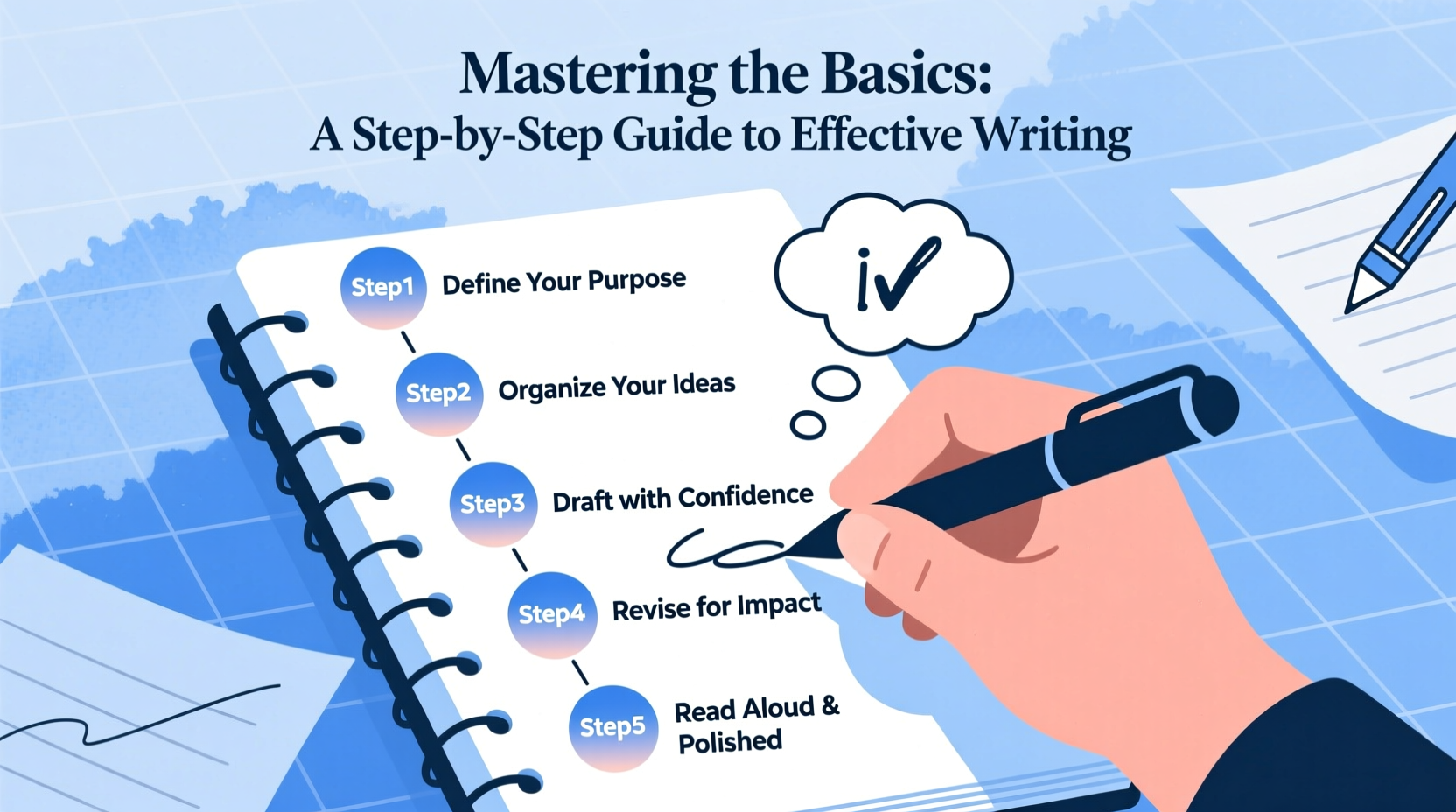
4. Step-by-Step Guide to Writing Any Piece
No matter the format, most writing tasks follow a similar process. Follow this five-step framework to approach any assignment with confidence:
- Clarify the Purpose and Audience
Ask: Who will read this? What do they already know? What action should they take after reading? - Gather and Organize Ideas
List key points, research facts, or outline arguments. Use bullet points or mind maps to visualize connections. - Write a Rough Draft
Focus on getting ideas down, not perfection. Silence your inner editor during this phase. - Revise for Structure and Clarity
Reorder paragraphs, cut redundancies, strengthen transitions, and ensure logical flow. - Edit for Language and Mechanics
Check grammar, punctuation, word choice, and tone. Read backward (sentence by sentence) to catch small errors.
This process separates creation from refinement, reducing pressure and improving quality.
5. Learn from Real Examples: A Mini Case Study
Sophia, a junior marketing associate, struggled with internal reports. Her manager returned them with comments like “Unclear” and “Needs more focus.” Frustrated, she decided to apply structured writing principles.
She began by outlining each report with a clear objective: “This document explains why Q3 campaign engagement dropped by 18%.” She used bullet points to organize contributing factors—timing, messaging, platform reach—then expanded each into a paragraph with data.
After drafting, she revised by reading each section aloud and asking, “Does this directly support my main point?” She removed tangents and clarified jargon. Within three weeks, her reports were approved on the first try—and even shared as templates.
Sophia didn’t become a different writer overnight. She became a more intentional one.
Common Pitfalls and How to Avoid Them
Even experienced writers fall into traps that weaken their work. Recognizing these early helps you stay on track.
| Pitfall | Why It Hurts | How to Fix It |
|---|---|---|
| Vagueness | Leaves readers guessing the main point | Use specific details: “sales dropped 18%” vs. “sales weren’t great” |
| Overcomplication | Makes simple ideas hard to follow | Replace jargon with plain language; shorten sentences |
| Skipping revision | Misses logic gaps and errors | Always allow time to revise—ideally after a break |
Essential Checklist for Every Draft
Before sharing any piece of writing, run through this checklist:
- ✅ Does the opening clearly state the purpose?
- ✅ Is each paragraph focused on one idea?
- ✅ Are transitions smooth between sections?
- ✅ Have I eliminated unnecessary words or repetition?
- ✅ Is the tone appropriate for the audience?
- ✅ Did I proofread for spelling and grammar?
- ✅ Would someone unfamiliar with the topic understand this?
Frequently Asked Questions
How long does it take to become a good writer?
There’s no fixed timeline, but noticeable improvement typically occurs within 3–6 months of consistent practice. Mastery is ongoing, but clarity and confidence grow steadily with deliberate effort.
Do I need to memorize grammar rules?
You don’t need to recall every rule by name, but understanding common structures—subject-verb agreement, comma usage, sentence fragments—helps. Tools like Grammarly can assist, but developing your ear through reading and feedback is more sustainable.
What if I hate what I write?
Nearly every writer feels this way at times. Remember: the first draft is supposed to be imperfect. Give yourself permission to write badly. Editing is where good writing happens.
Conclusion: Start Where You Are
Mastering the basics of writing doesn’t require a degree or natural flair. It requires curiosity, consistency, and the willingness to revise. Every expert writer started with awkward sentences and uncertain phrasing. What set them apart was persistence.
Begin today. Write one clear paragraph. Revise one email before sending. Ask for feedback on a document. Small actions compound into real skill. Writing isn’t just about producing text—it’s about learning to think with precision and share ideas with impact.




 浙公网安备
33010002000092号
浙公网安备
33010002000092号 浙B2-20120091-4
Comments
No comments yet. Why don't you start the discussion?