
The abbreviation \"etc.\" appears frequently in everyday writing, from emails to academic papers. Yet, despite its common use, it is often misapplied—sometimes overused, incorrectly punctuated, or misunderstood. Used correctly, \"etc.\" can streamline your prose by indicating that a list is incomplete without exhausting every item. Misused, it weakens clarity and undermines professionalism. Understanding how to spell, punctuate, and apply \"etc.\" properly is essential for polished, precise communication.
What Does “etc.” Stand For?
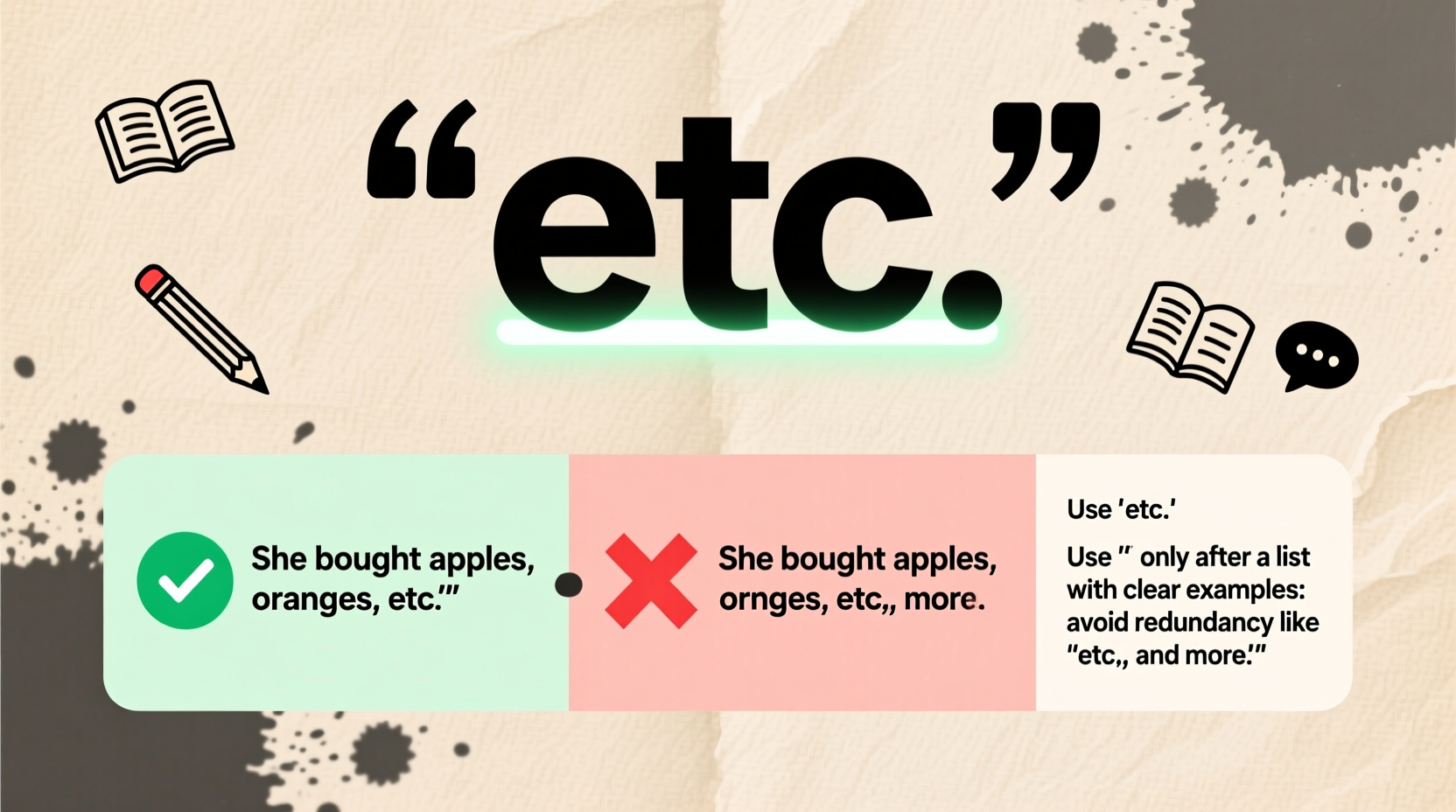
\"Etc.\" is short for the Latin phrase *et cetera*, which translates to “and the rest,” “and so forth,” or “and other things.” It signals that additional items could be listed but are intentionally omitted for brevity. While useful, it should never serve as a crutch for vague or lazy writing. The phrase applies only to lists of similar items—never to people (use *et al.* instead) and never when what follows is implied but entirely different in nature.
“Precision in language begins with precision in abbreviation. 'Etc.' isn’t an escape hatch—it’s a tool for efficiency.” — Dr. Lydia Chen, Linguistics Professor at Boston University
Spelling and Punctuation: Common Errors to Avoid
One of the most frequent mistakes with \"etc.\" is incorrect spelling or punctuation. Below are key guidelines:
- Always include a period after \"etc.\" because it is an abbreviation.
- When used mid-sentence, follow it with a comma: Apples, oranges, bananas, etc., were on sale.
- In American English, if \"etc.\" ends a sentence, do not add a second period: We need pens, paper, tape, etc.
- Avoid using \"etc. etc.\" or \"and etc.\"—both are redundant.
- Never use \"etc.\" at the end of a bulleted or numbered list; the format already implies incompleteness.
Do’s and Don’ts of Using “etc.”
| Do | Don't |
|---|---|
| Use \"etc.\" after two or more specific examples in a category: Bring warm clothes: a jacket, scarf, gloves, etc. | Use \"etc.\" after a single item: Bring a jacket, etc. (incomplete context) |
| Use it only for non-human nouns in a homogeneous list. | Use it to refer to people: My team includes Sarah, Tom, etc. (Incorrect—use *et al.*) |
| Place it at the end of a list, before closing punctuation. | Combine it with \"and\" or \"such as\": Fruits such as apples, oranges, etc. (redundant) |
| Use sparingly in formal writing to maintain clarity. | Overuse it in place of full explanations, especially in academic or technical texts. |
Alternatives to “etc.” for Stronger Writing
While \"etc.\" has its place, stronger alternatives often enhance readability and professionalism. Consider these substitutes depending on context:
- and others: “We studied several species—wolves, foxes, coyotes, and others.”
- among others: “The conference featured speakers from Harvard, Yale, Princeton, among others.”
- including: “The exhibit features works by Renaissance artists, including Botticelli and da Vinci.”
- and so on: More conversational, suitable for informal writing.
- and more: Common in marketing or casual contexts: “Get accessories like cases, chargers, screen protectors, and more.”
Replacing \"etc.\" with a more descriptive phrase often adds clarity. For example, instead of writing “I enjoy outdoor activities: hiking, biking, swimming, etc.,” try “I enjoy various outdoor activities such as hiking, biking, and swimming.” This version feels more complete and intentional.
Real-World Example: When “etc.” Undermines Clarity
Consider this excerpt from a fictional business proposal:
“We need supplies: paper, printer ink, stapler, etc.”
While concise, this sentence lacks specificity. A client reviewing the budget might wonder: Is a shredder included? File folders? Pens? By relying on \"etc.,\" the writer leaves room for ambiguity. A better approach:
“We need standard office supplies, including paper, printer ink, staplers, tape dispensers, and notebooks.”
This revision removes vagueness while still avoiding an exhaustive list. In professional communication, precision builds trust.
Step-by-Step Guide to Using “etc.” Correctly
- Identify a clear list: Ensure you’re listing items of the same category (e.g., fruits, tools, software).
- List at least two concrete examples: Never use \"etc.\" after just one item.
- Determine necessity: Ask if the reader will understand what’s implied. If not, expand the list or rephrase.
- Apply proper punctuation: Use \"etc.\" with a period. If mid-sentence, add a comma after: etc.,
- Edit for redundancy: Remove phrases like “and etc.” or “such as… etc.”
- Limit frequency: In a single document, avoid repeating \"etc.\" more than once or twice.
- Review tone: In formal writing, consider replacing \"etc.\" with a more polished alternative.
FAQ: Common Questions About “etc.”
Can I use “etc.” in academic writing?
Yes, but sparingly. Academic writing values precision. Use \"etc.\" only when the pattern is unmistakable and further examples are unnecessary. Many style guides, including APA and Chicago, permit it in parenthetical lists or tables, but discourage overuse in main text.
Is “etc.” the same as “et al.”?
No. “Etc.” refers to things (*et cetera* = “and other things”), while “et al.” abbreviates *et alii* (“and other people”) and is used in citations involving multiple authors. For example: “Smith, Jones, Brown, et al. conducted the study.” Never use \"etc.\" for people.
Should I italicize “etc.”?
No. Although it originates from Latin, \"etc.\" is considered naturalized in English and does not require italics in modern usage. This rule applies across major style guides, including MLA and AP.
Final Checklist Before Using “etc.”
- ✅ Have I listed at least two specific items before using “etc.”?
- If not, add another example or remove “etc.”
- ✅ Are all items in the same category?
- Mixing types (e.g., “apples, cars, books, etc.”) confuses readers.
- ✅ Is the meaning clear without further explanation?
- If the omitted items aren’t obvious, rephrase.
- ✅ Have I avoided combining “etc.” with “and,” “such as,” or “including”?
- These combinations are redundant.
- ✅ Is this appropriate for the tone of my writing?
- In formal or persuasive writing, consider a stronger alternative.
Conclusion: Write with Confidence and Clarity
Mastering the use of \"etc.\" is more than a grammar lesson—it’s about respecting your reader’s time and intelligence. When applied correctly, it enhances flow and conciseness. When overused or misapplied, it signals imprecision. The goal is not to eliminate \"etc.\" entirely, but to wield it with intention. By following established rules, considering context, and opting for clarity over convenience, you elevate the quality of your writing across emails, reports, essays, and creative work.




 浙公网安备
33010002000092号
浙公网安备
33010002000092号 浙B2-20120091-4
Comments
No comments yet. Why don't you start the discussion?