
The word \"social\" appears constantly in everyday communication—whether in emails, academic papers, or casual conversation. Despite its frequency, it's surprisingly common to see misspellings like \"socal,\" \"soshul,\" or even \"sociale.\" More than just a spelling issue, incorrect usage can undermine credibility, especially in professional or academic contexts. This guide breaks down the correct spelling, common mistakes, grammatical roles, and real-world applications of \"social\" to help you use it confidently and accurately.
Understanding the Correct Spelling: Why “Social” Is Often Misspelled
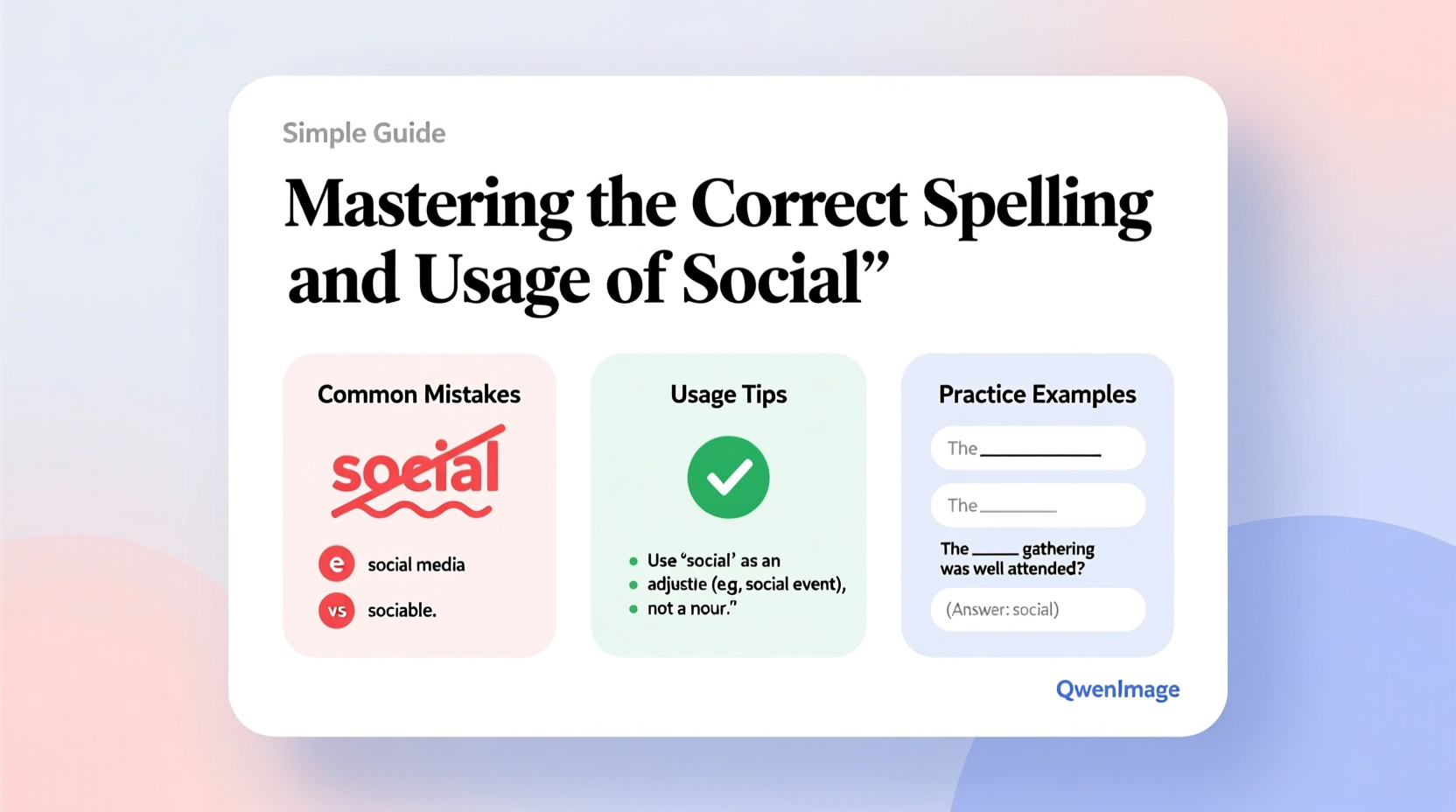
The word \"social\" comes from the Latin *sociālis*, meaning \"of companionship\" or \"friendly,\" rooted in *socius* (companion or ally). In modern English, it’s pronounced /ˈsoʊʃəl/—two syllables, with emphasis on the first. The most frequent misspellings stem from mishearing the pronunciation. For example:
- Socal – dropping the second 'i'
- Soshul – misrepresenting the soft 'sh' sound
- Sociall – doubling the 'l' unnecessarily
- Sociale – adding an extra silent 'e' at the end
These errors often occur due to phonetic assumptions. Because the 'c' and 'i' together produce a 'sh' sound, some assume the spelling should reflect that with 'sh'. But English spelling isn’t always phonetic, and \"social\" follows a consistent pattern seen in words like \"official,\" \"special,\" and \"crucial.\"
Common Grammatical Roles of “Social”
\"Social\" functions primarily as an adjective, but understanding its various uses ensures proper application across different contexts.
| Role | Definition | Example |
|---|---|---|
| Adjective | Relating to society, interaction, or community | She organized a social event for local artists. |
| Noun (rare) | An informal gathering | The retirement home hosted a weekly social. |
| Part of compound terms | Used in phrases like \"social media\" or \"social justice\" | He studied social psychology at university. |
While \"social\" is almost always an adjective, it occasionally appears as a noun in British English to describe a party or informal meeting. However, this usage is declining in formal writing.
“Social” vs. Common Confusions
It's easy to confuse \"social\" with similar-sounding words or misuse it in compound expressions. Below are clarifications:
- Social vs. Societal: \"Social\" refers to human interaction; \"societal\" describes broader structures or systems. Example: \"Social habits differ by region\" vs. \"Societal norms influence policy.\"
- Social vs. Solely: Homophones like \"solely\" are sometimes mistaken in speech-to-text tools. Always proofread.
- Social Media vs. Social Media’s: Avoid possessive forms unless referring to ownership. Incorrect: \"Social media’s impact is huge.\" Correct: \"The impact of social media is huge.\"
Step-by-Step Guide to Using “Social” Correctly
To ensure accurate spelling and contextual usage, follow this five-step process whenever you write or edit content involving the word \"social\":
- Pause before typing – Especially when using auto-correct-heavy devices, take a moment to recall the correct spelling: S-O-C-I-A-L.
- Check syllable breakdown – Say it aloud: \"so-ci-al.\" Three distinct parts help prevent omissions.
- Verify context – Ask: Am I describing interaction, relationships, or community? If yes, \"social\" fits.
- Avoid overuse – Don’t default to \"social\" when more precise terms exist. Instead of \"social problems,\" consider \"interpersonal conflicts\" or \"community challenges.\"
- Edit with focus – During proofreading, scan specifically for instances of \"social\" to catch typos early.
Real-World Example: A Professional Email Gone Wrong
Consider this scenario: Maya, a marketing coordinator, sends a campaign proposal to her team. She writes:
\"To increase engagement, we should boost our socal media presence through influencer collabs.\"
The message is clear, but two issues stand out: \"socal\" is misspelled, and \"collabs\" is too informal. Her manager replies politely but notes that such errors reduce perceived professionalism. After reviewing this guide, Maya revises the sentence:
\"To increase engagement, we should strengthen our social media presence through strategic influencer collaborations.\"
The revised version uses correct spelling and more polished language, reinforcing her competence. Small details like accurate spelling contribute significantly to workplace credibility.
Expert Insight on Language Precision
Dr. Laura Bennett, linguistics professor at Cambridge University, emphasizes the importance of accuracy:
“Spelling might seem minor, but consistent errors erode trust. In digital communication, where tone is already hard to convey, getting basics like 'social' right signals attention to detail and respect for the reader.” — Dr. Laura Bennett, Linguistics Expert
This insight underscores that mastering simple words isn’t about perfectionism—it’s about clarity and professionalism.
Checklist: Mastering “Social” in Your Writing
Use this checklist before publishing any written work:
- ✅ Spell \"social\" correctly: S-O-C-I-A-L
- ✅ Confirm it’s used as an adjective (e.g., social skills, social network)
- ✅ Avoid unnecessary possessives (e.g., don’t write “social’s role”)
- ✅ Double-check compound terms like “social media,” “social distancing,” or “social enterprise”
- ✅ Proofread aloud to catch misheard or mistyped versions
- ✅ Replace vague uses with more specific alternatives when possible
Frequently Asked Questions
Is “socal” ever an acceptable spelling?
No. “Socal” is a common typo or shorthand, often used informally online (e.g., “SoCal” for Southern California), but it should never replace “social” in standard English. Always use “social” when referring to society or interaction.
Can “social” be used as a verb?
No, “social” is not a verb. People sometimes say “I’ll social later,” but the correct phrasing is “I’ll socialize later.” The verb form is “socialize,” meaning to interact with others in a friendly way.
How do I remember the spelling?
Link “social” to other words that share its root and structure: “official,” “special,” “artificial.” They all end in “-cial” after a consonant + “i.” This pattern reinforces correct muscle memory over time.
Conclusion: Clarity Starts with Correct Spelling
Mastering the spelling and usage of “social” may seem small, but it reflects broader writing discipline. Whether you're drafting an email, posting on LinkedIn, or writing a research paper, precision builds trust. You don’t need to memorize complex rules—just stay mindful of common pitfalls and apply consistent checks. Language evolves, but accuracy remains timeless.




 浙公网安备
33010002000092号
浙公网安备
33010002000092号 浙B2-20120091-4
Comments
No comments yet. Why don't you start the discussion?