
Walking a dog should be a peaceful routine, but for many owners—especially those managing dogs with reactivity, anxiety, or strong pulling tendencies—the experience can quickly become overwhelming. Enter the double leash method: a strategic approach that uses two leads attached to different points on a dog’s harness and collar (or dual attachment harness) to improve control, reduce strain, and enhance communication. While it may seem excessive at first glance, using two leashes on one dog is a growing practice among trainers and experienced handlers. When applied correctly, it offers remarkable benefits in safety, responsiveness, and training progress.
Why Use Two Leashes on One Dog?
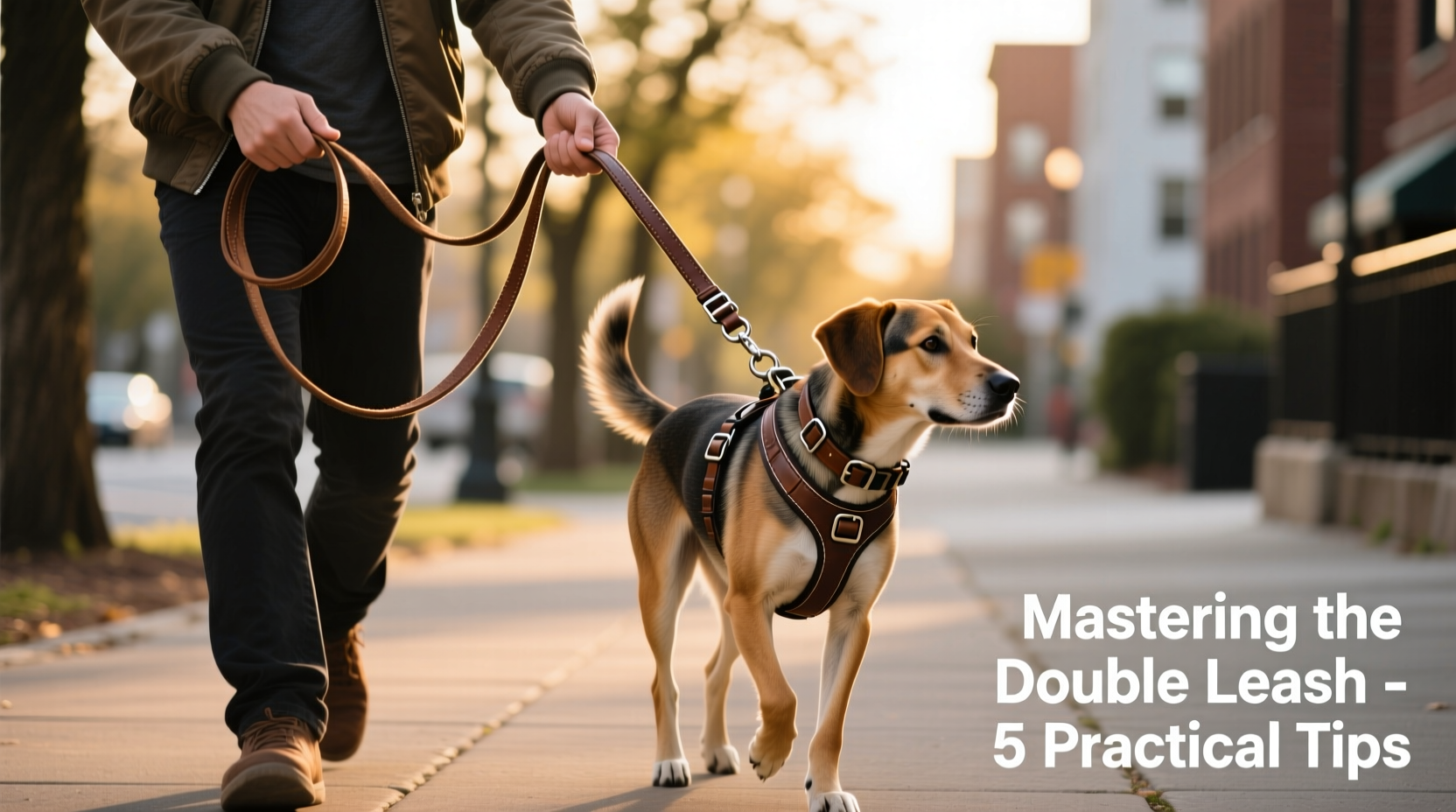
The decision to use a double leash setup isn’t about overcomplicating walks—it's about precision. A single leash often limits your ability to guide your dog effectively, especially in high-distraction environments. By incorporating two leashes, you gain multidimensional control:
- Distributed pressure: Reduces neck strain by splitting tension between a front-clip harness and a flat collar or head halter.
- Directional guidance: Allows subtle corrections without jerking, helping redirect attention before reactions escalate.
- Training reinforcement: Enables real-time feedback during behavioral training, such as teaching loose-leash walking or impulse control.
This method is particularly effective for dogs prone to lunging, barking at other animals, or pulling toward stimuli. It’s not a substitute for training, but rather a supportive tool that makes training more manageable.
Choosing the Right Equipment
Success begins with proper gear. Not all collars and harnesses are suited for dual-leash setups. Using incompatible equipment can cause discomfort or even injury.
| Attachment Point | Purpose | Recommended Gear | Avoid |
|---|---|---|---|
| Front-clip harness | Steering and stopping momentum | Balance harness, Sensible Harness, or similar no-pull design | Rear-clip harnesses if used as primary control point |
| Flat collar or martingale | Secondary guidance and backup security | Nylon or biothane collar with D-ring | Choke chains or prong collars unless advised by a trainer |
| Head halter (optional) | Head direction control for strong pullers | Gentle Leader or Snoot Loop | Using both head halter and front harness together without training |
Leashes should be lightweight but durable—typically 4 to 6 feet long. Consider using a thinner secondary leash (like a 3/8-inch biothane line) to minimize tangling. Some owners prefer one standard leash and one traffic lead (shorter, sturdier) for urban settings.
“Dual-leashing isn’t about dominance—it’s about giving the dog clearer boundaries and reducing stress for both ends of the leash.” — Dr. Karen Overall, Veterinary Behavioral Specialist
Step-by-Step Guide to Implementing the Double Leash System
Transitioning to a double leash requires patience and consistency. Follow this timeline to integrate the system safely:
- Day 1–3: Introduce gear separately. Let your dog wear the harness and collar indoors without leashes. Reward calm behavior.
- Day 4–5: Attach one leash at a time. Practice walking with just the harness leash, then just the collar leash. Observe how your dog responds to each.
- Day 6–7: Combine both leashes, but hold only one. Use the harness leash for control; let the collar leash dangle loosely. This acclimates your dog to the sensation.
- Week 2: Hold both leashes together. Grip them as a single unit near the clips. Keep slack minimal. Focus on short, low-distraction walks.
- Week 3 onward: Begin active handling. Use the harness leash to steer (e.g., turn left), and the collar leash to gently remind of position (e.g., “back to heel”).
Never yank both leashes simultaneously. The goal is coordination, not correction. Over time, you’ll develop muscle memory for releasing tension on one leash while applying gentle pressure on the other.
Real-World Application: A Case Study
Max, a three-year-old Australian Shepherd, had a history of lunging at bicycles and squirrels. His owner, Sarah, struggled with traditional leash methods—retractable leashes gave Max too much freedom, while standard six-foot leashes didn’t offer enough control during reactive moments.
After consulting a certified dog behavior consultant, Sarah adopted a double leash system: a front-clip Balance Harness connected to a 4-foot nylon leash, and a padded martingale collar with a lightweight 3-foot secondary leash. Initially, she walked Max in quiet neighborhoods, holding both leashes in one hand. When a cyclist approached, she used the harness leash to pivot Max away while lightly lifting the collar leash to regain focus.
Within four weeks, Max’s reaction distance decreased from 50 feet to under 15. The dual-leash method didn’t fix his reactivity alone—but it created the physical framework needed for successful desensitization training.
Common Mistakes and How to Avoid Them
- Tangling leashes: Keep both leashes routed through the same hand or clipped to your belt loop when stopped. Cross-body carrying (one leash over shoulder) increases tangle risk.
- Over-correcting: Using both leashes to pull back aggressively can increase fear or resistance. Apply pressure like a conversation—one leash speaks, the other listens.
- Misplaced attachments: Never attach two leashes to a single D-ring. Distribute load appropriately: harness for movement control, collar for positioning.
- Ignoring body mechanics: Keep elbows slightly bent, shoulders relaxed. Use your core to absorb pulls, not your arms.
Frequently Asked Questions
Can I use a double leash on any dog?
Most dogs can adapt to a double leash system, but it’s best suited for medium to large breeds with strength or reactivity issues. Small dogs may find the added hardware cumbersome unless using ultra-light materials. Always consult a trainer if your dog has spinal, respiratory, or joint conditions.
Won’t two leashes confuse my dog?
Not if introduced gradually. Dogs respond to pressure and release cues, not the number of leashes. Confusion usually stems from inconsistent handling, not the setup itself. Clear, calm signals matter more than equipment count.
Do I need special training to use two leashes?
No formal certification is required, but working with a positive-reinforcement trainer for a few sessions can dramatically improve technique. Misuse can lead to discomfort or worsened behavior, so education is key.
Checklist: Setting Up Your Double Leash System
- ☑ Choose a front-clip harness designed for control
- ☑ Select a well-fitted flat or martingale collar
- ☑ Use two durable, non-stretch leashes (4–6 ft)
- ☑ Introduce gear indoors with positive reinforcement
- ☑ Practice handling both leashes in low-distraction areas
- ☑ Monitor your dog’s gait and comfort during initial walks
- ☑ Schedule follow-up evaluations with a trainer if reactivity persists
Conclusion: Walking with Confidence and Control
Mastering the double leash isn’t about restraining your dog more tightly—it’s about communicating more clearly. With the right tools and techniques, you transform chaotic walks into structured, confidence-building experiences. Whether you're managing reactivity, building focus, or simply seeking greater peace on the pavement, the double leash method offers a practical path forward.




 浙公网安备
33010002000092号
浙公网安备
33010002000092号 浙B2-20120091-4
Comments
No comments yet. Why don't you start the discussion?