
A strong beginning is not just an invitation—it’s a command. It determines whether a reader continues or closes the tab, turns the page or sets the book aside. In fiction and nonfiction alike, the opening lines set tone, raise stakes, and establish trust. Yet many writers falter here, defaulting to exposition, backstory, or vague descriptions that fail to ignite interest. The difference between a memorable story and one forgotten lies in the first 100 words. This guide breaks down the anatomy of a compelling opening and provides actionable strategies to craft one with precision.
The Power of the First Impression
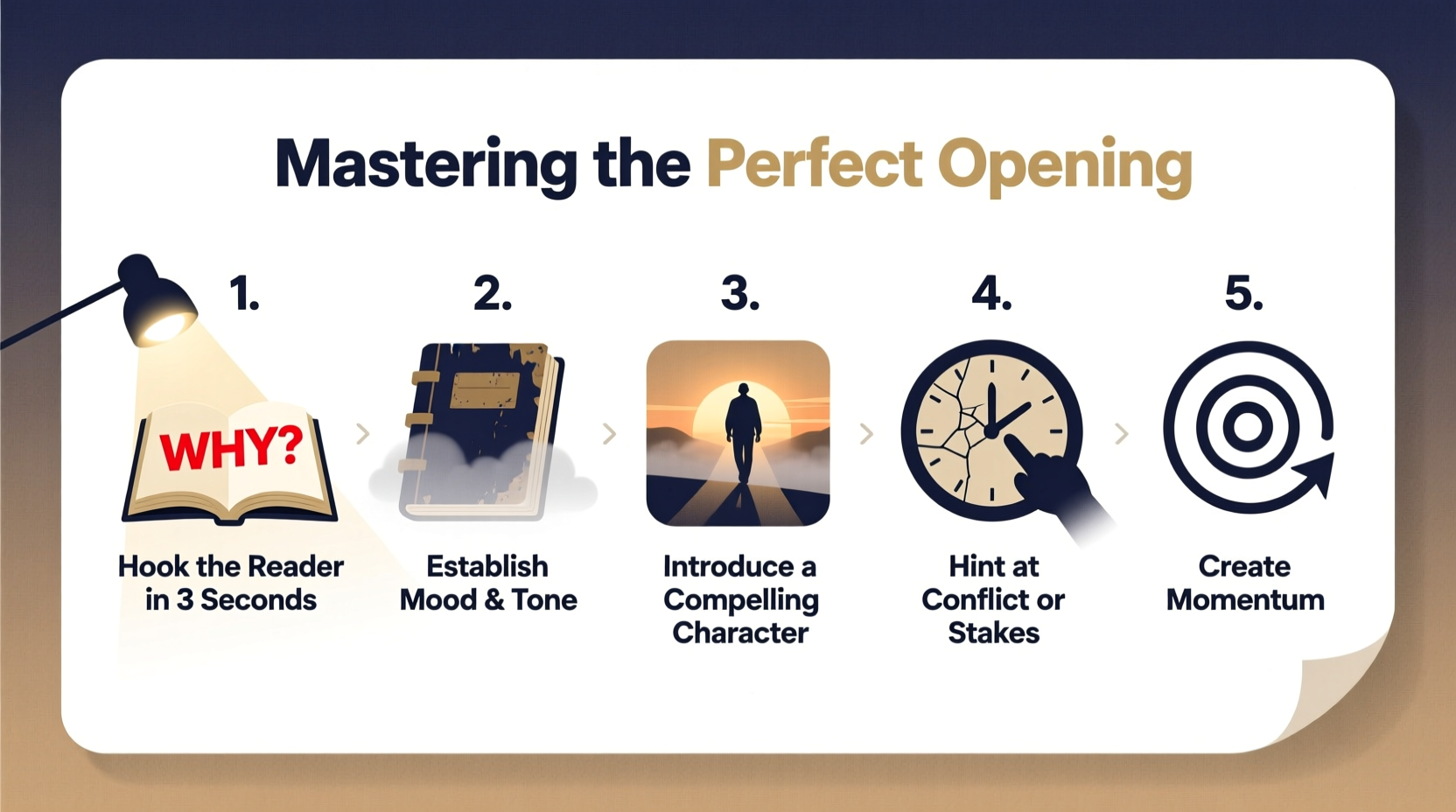
Readers form judgments within seconds. A study by the Nielsen Norman Group found that web users decide whether to stay on a page in less than 50 milliseconds. While literature allows slightly more leeway, the principle remains: attention is fragile and must be seized immediately. An effective opening does more than introduce characters or setting—it creates momentum. It poses implicit questions that compel the reader forward: Who is this person? Why are they running? What happens if they don’t make it?
Consider the opening of Gabriel García Márquez’s *One Hundred Years of Solitude*: “Many years later, as he faced the firing squad, Colonel Aureliano Buendía was to remember that distant afternoon when his father took him to discover ice.” Within one sentence, time bends, stakes emerge, and curiosity is triggered. The moment is both specific and mysterious—exactly what a powerful opener should achieve.
Elements of a Strong Opening
A successful first paragraph balances clarity with intrigue. It avoids overloading information while still grounding the reader in something tangible. The following elements, when used deliberately, create openings that resonate:
- Voice and tone: Establish a distinct narrative voice early. Is the narrator wry, urgent, nostalgic? Voice builds intimacy.
- Immediate conflict or tension: Not necessarily physical—emotional, moral, or psychological tension works just as well.
- Sensory detail: One vivid image can anchor the reader more effectively than three paragraphs of description.
- A question (explicit or implied): Readers continue reading to find answers. Pose one early.
- Character agency: Show someone making a choice, even a small one. It signals that events matter.
“The most important sentence in any piece of writing is the first. If it doesn’t work, nothing else has a chance.” — Gary Provost, author and writing instructor
Step-by-Step Guide to Crafting Your Opening
Writing a powerful opening doesn’t have to be left to inspiration. Follow this structured process to build one with purpose:
- Identify the core promise of your story: What will change by the end? What emotional journey awaits the reader? The opening should echo this promise subtly.
- Start with action, not explanation: Instead of describing a character’s past, show them doing something revealing. A woman tightening her grip on a suitcase says more than a paragraph about her divorce.
- Limit context: Avoid front-loading backstory. Trust readers to tolerate ambiguity for a few paragraphs.
- Use precise language: Replace generic verbs like “walked” with “staggered” or “slipped.” Each word should carry weight.
- Test for momentum: Read the first paragraph aloud. Does it flow? Does it leave you wanting to read the next? If not, revise for rhythm and implication.
Real Example: From Weak to Strong
Consider a draft opening: “Sarah had always been afraid of water. Ever since she nearly drowned as a child, she avoided pools, lakes, and oceans. Now, standing at the edge of the pier, she knew she had to face her fear.”
This version explains too much too soon and delays action. Here’s a revised version: “The pier groaned under Sarah’s sneakers. One step. Then another. The lake below didn’t ripple—it waited.”
The revision eliminates exposition, uses active verbs, introduces tension, and leaves questions unanswered. It invites the reader into the moment rather than summarizing it.
Common Pitfalls and How to Avoid Them
Even skilled writers fall into traps when starting a story. Recognizing these patterns helps prevent disengagement from the outset.
| Do | Don’t |
|---|---|
| Begin with a character in motion or making a decision | Open with weather, dreams, or alarm clocks |
| Introduce a unique voice or perspective | Use clichéd phrases like “It was a dark and stormy night” |
| Create mystery through selective detail | Overload with names, places, or backstory |
| Anchor the reader with a concrete image | Start with abstract philosophizing |
Checklist: Evaluating Your Opening
Before finalizing your first 100–150 words, use this checklist to ensure impact:
- ✅ Does the first sentence grab attention?
- ✅ Is there a clear sense of voice or tone?
- ✅ Is a character taking action or facing a decision?
- ✅ Are sensory details present but not overwhelming?
- ✅ Does it raise a question the reader wants answered?
- ✅ Have I avoided exposition dumps or backstory?
- ✅ Would a stranger keep reading after this paragraph?
Frequently Asked Questions
Can I start with dialogue?
Yes, but only if it’s charged with subtext or reveals character. Avoid generic exchanges like “Hi, how are you?” Start with something consequential: “You weren’t supposed to see that.”
Should every story begin with conflict?
Not necessarily physical conflict—but some form of tension is essential. It could be internal (a dilemma), relational (a strained conversation), or situational (an impending deadline). Without tension, there’s no propulsion.
Is it okay to rewrite the opening after finishing the draft?
Not just okay—it’s recommended. Many writers discover the true tone and direction of their story only after reaching the end. Revisit the opening during revision to align it with the story’s essence.
Conclusion: Begin With Intention
The perfect opening isn’t about poetic prose or dramatic explosions—it’s about intention. Every word should serve a purpose: to engage, orient, and impel. Whether you’re writing a novel, short story, memoir, or article, the principles remain the same. Start where the energy begins. Cut what delays momentum. Trust your reader to follow you into uncertainty, as long as you lead with confidence.
Mastery comes not from perfection but from practice. Write ten different openings for the same story. Test them. Read them aloud. See which one pulls you in. Because the right beginning doesn’t just start a story—it ignites it.




 浙公网安备
33010002000092号
浙公网安备
33010002000092号 浙B2-20120091-4
Comments
No comments yet. Why don't you start the discussion?