
Introducing yourself is one of the first social interactions in any language. In American Sign Language (ASL), saying “My name is” goes beyond mere translation—it’s a gesture rooted in visual grammar, body awareness, and cultural etiquette. For beginners, mastering this foundational phrase opens the door to deeper communication within the Deaf community. This guide breaks down the mechanics, variations, and nuances of signing “My name is,” ensuring you build confidence from day one.
The Foundation: Understanding ASL Name Signs
In spoken English, names are auditory identifiers. In ASL, names function differently. Most native ASL users have both an English name and a unique name sign, typically assigned by members of the Deaf community. These name signs often combine a specific handshape with a location near the body—commonly the forehead, cheek, or shoulder—and may include movement. However, when beginning, learners start with fingerspelling their name and pairing it with the sign for “My name is.”
This initial phrase sets the stage for introductions and is used consistently across ASL conversations. Unlike English, where “My name is…” can be shortened or implied, ASL relies on clear visual markers. Omitting “My name is” before fingerspelling your name can confuse the receiver, as there’s no grammatical cue indicating what follows is a personal identifier.
“Signing ‘My name is’ properly teaches learners the importance of visual clarity and sentence structure in ASL.” — Dr. Lillian Hughes, ASL Linguistics Researcher, Gallaudet University
Step-by-Step Guide to Signing “My Name Is”
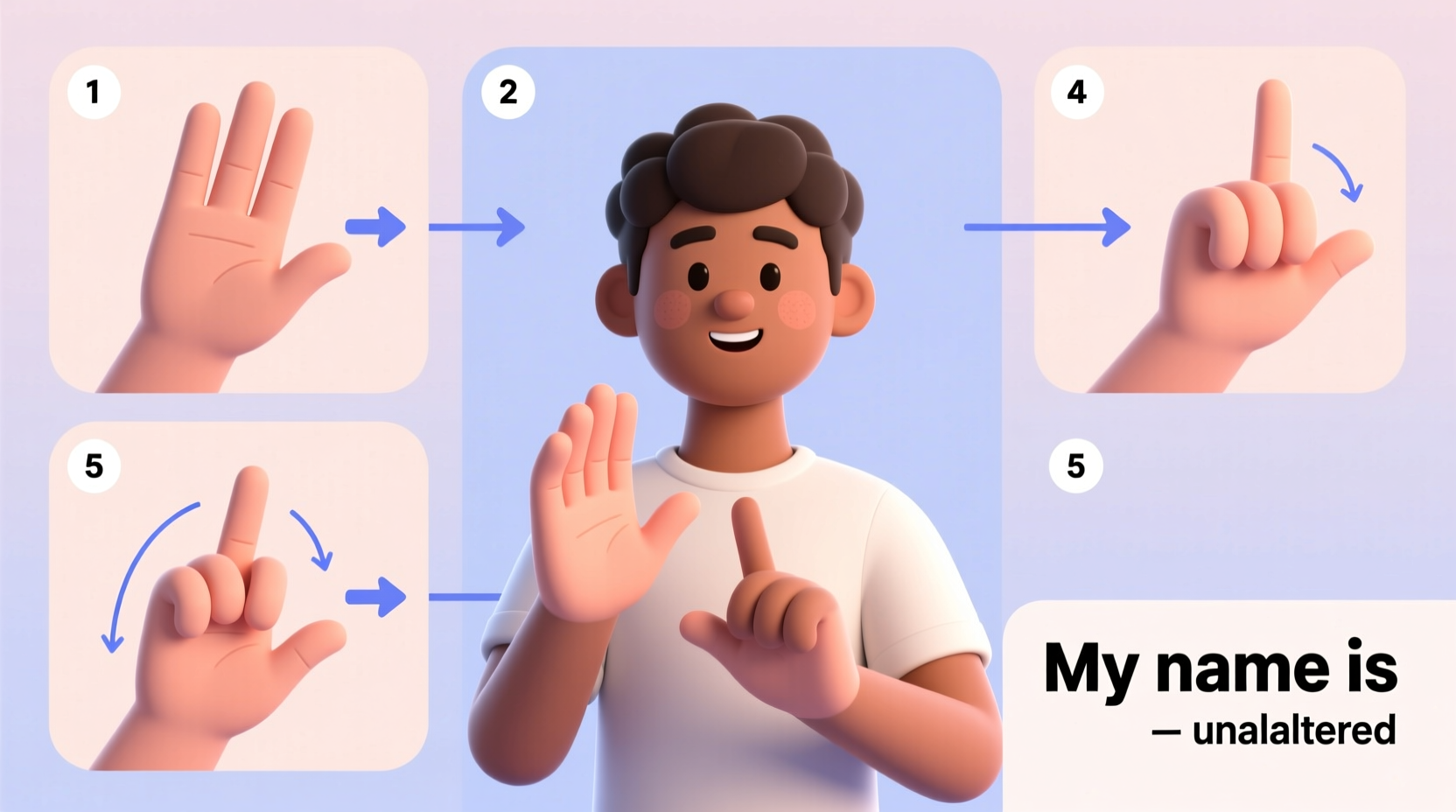
To sign “My name is” correctly in ASL, follow these steps precisely. Each motion should be smooth, deliberate, and placed in the correct signing space—roughly from shoulders to forehead, centered in front of your body.
- Start with “MY”: Form both hands into an “A” handshape (fist with thumb extended). Touch the tip of your thumbs to your chest, one after the other. This indicates possession—“my.”
- Transition to “NAME”: Change both hands to the “Y” handshape (thumb and pinky extended, others curled). Bring both hands up to chin level, palms facing each other. Move them in a small downward arc, ending with palms slightly forward. This mimics the idea of labeling or identifying oneself.
- Connect with “IS”: In ASL, “is” isn’t signed separately. Instead, the entire phrase “My name is” flows into the next element: your name via fingerspelling. After completing “name,” pause briefly and begin fingerspelling your name clearly.
Practice the sequence slowly at first: “MY” → “NAME” → [fingerspell name]. As fluency improves, the transition becomes smoother, almost like a single continuous gesture leading into your identity.
Common Mistakes and How to Avoid Them
Even simple phrases can be mislearned if attention isn’t paid to detail. Here are frequent errors beginners make when signing “My name is,” along with corrections:
| Mistake | Why It’s Incorrect | Correction |
|---|---|---|
| Using only one hand for “MY” | ASL often uses symmetrical two-handed signs for clarity; using one hand reduces visibility and may not be recognized. | Use both hands simultaneously, touching the chest with each thumb. |
| Signing “NAME” too high or too low | Placing the sign near the forehead or neck alters meaning or makes it unclear. | Keep “NAME” at chin level, with a gentle downward motion. |
| Fingerspelling too fast or unclearly | Rushing letters makes them indistinguishable, especially common ones like D/N or M/N. | Pause slightly before spelling and articulate each letter deliberately. |
| Omitting “MY NAME IS” before spelling | Without the lead-in, the receiver may not realize you’re introducing yourself. | Always precede your name with the full phrase for clarity. |
Practical Application: A Real-Life Scenario
Imagine attending your first Deaf community event. You approach a small group engaged in animated signing. One person turns and smiles, fingerspells “YOU?” You recognize this as an invitation to introduce yourself.
You respond by signing “MY” (thumbs to chest), then “NAME” (Y-hands moving down from chin), followed by clearly fingerspelling “S-A-R-A-H.” The group nods, one person repeats your name back correctly, and then introduces themselves in return. That moment of connection—rooted in accurate, respectful signing—builds trust and inclusion.
This scenario underscores why precision matters. Clear signing ensures you’re understood immediately, reducing frustration and fostering meaningful interaction.
Checklist: Mastering “My Name Is” in 7 Days
Consistent practice accelerates learning. Use this daily checklist to build muscle memory and confidence over one week:
- Day 1: Learn the “MY” and “NAME” signs individually. Practice each 10 times in front of a mirror.
- Day 2: Combine “MY” and “NAME” into a fluid sequence. Repeat 15 times.
- Day 3: Add fingerspelling of your first name after the phrase. Focus on clean transitions.
- Day 4: Practice with a friend or virtual partner. Ask for feedback on clarity.
- Day 5: Record yourself and review. Adjust hand placement or speed as needed.
- Day 6: Simulate a real introduction—stand, make eye contact, sign the full phrase.
- Day 7: Use the phrase in a real or imagined conversation. Visualize success.
FAQ: Common Questions About Signing “My Name Is”
Do I always need to sign “My name is” before spelling my name?
Yes, especially as a beginner. In ASL grammar, the phrase acts as a topic marker, preparing the viewer for what comes next. Skipping it can cause confusion, particularly in group settings or noisy environments where visual cues are essential.
Will I get a name sign later?
Possibly—but not right away. Name signs are traditionally given by Deaf individuals within the community, not self-assigned. They often reflect personality, appearance, or a shared experience. Until then, fingerspelling with “My name is” is the appropriate and respectful method.
Can I use this phrase in other sign languages?
No. While many sign languages share similar concepts, the exact handshapes and movements differ. British Sign Language (BSL), for example, has a different construction for “My name is.” Always learn the local sign language when communicating in a new region.
Conclusion: Your First Step Into a Visual Language
Mastering “My name is” in ASL is more than memorizing a gesture—it’s adopting a new way of expressing identity. This phrase embodies the core principles of ASL: clarity, spatial awareness, and intentionality. Once you’ve internalized it, you’ll find yourself using it naturally, paving the way for more complex sentences and deeper conversations.




 浙公网安备
33010002000092号
浙公网安备
33010002000092号 浙B2-20120091-4
Comments
No comments yet. Why don't you start the discussion?