
The word \"white\" is deceptively simple. At first glance, it appears straightforward—just five letters, one syllable, and a color most people learn early in life. Yet, for language learners and even native speakers refining their articulation, mastering the correct pronunciation and understanding its full range of meanings can be more nuanced than expected. Mispronunciations like “wight” or “hwite” are common, and confusion arises when \"white\" extends beyond color into cultural, emotional, or idiomatic contexts. This guide breaks down how to pronounce \"white\" accurately, explores its layered meanings, and offers practical exercises to embed both sound and sense into natural speech.
The Correct Pronunciation of “White”
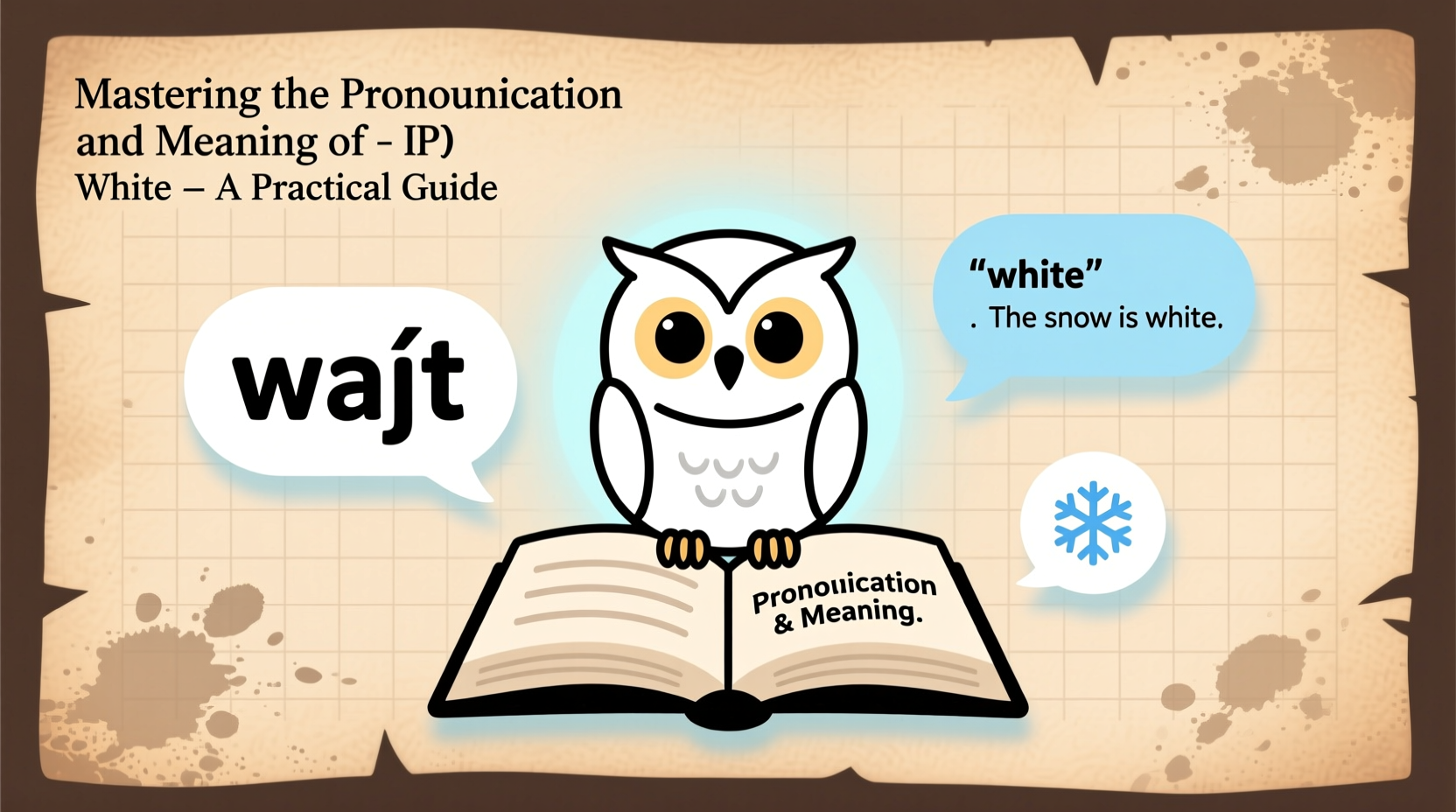
The standard pronunciation of \"white\" in General American and British Received Pronunciation (RP) is /waɪt/. It consists of two distinct phonetic components: the diphthong /waɪ/ followed by the unvoiced alveolar plosive /t/. The mouth begins in a neutral position, then glides from an open /w/ sound into a rising /aɪ/, similar to “why,” ending with a crisp /t/ release.
Common mispronunciations include:
- Adding an aspirated /h/ at the beginning (“hwite”), often influenced by spelling or regional dialects.
- Overemphasizing the /t/, resulting in a clipped or exaggerated stop.
- Merging the diphthong into a single vowel, making it sound like “wait” without the glide.
Phonetic Breakdown
| Sound | IPA Symbol | Description |
|---|---|---|
| /w/ | w | Lip-rounded glide, voiced, starting point of the diphthong |
| /aɪ/ | aɪ | Diphthong: starts low-central, glides toward high-front |
| /t/ | t | Crisp, unvoiced stop; tip of tongue against alveolar ridge |
Common Pronunciation Errors and How to Fix Them
Many learners struggle with \"white\" due to spelling-sound mismatches. The silent ‘h’ in \"white\" tempts some to voice it, while others confuse it with homophones like “wait” or “weight.” These errors may seem minor but can affect clarity in professional or academic settings.
To correct these issues, focus on three key areas:
- Eliminate the /h/ sound: Begin with your lips rounded for /w/, not constricted at the glottis for /h/. Record yourself saying “white wine” and listen for any breathy onset.
- Control the diphthong: Avoid flattening /waɪ/ into /eɪ/ (as in “day”). Use minimal pairs: practice “white” vs. “wait” to distinguish the starting point.
- Soft-t release: In connected speech, the /t/ should not be overly emphasized. Try phrases like “white table” and ensure the /t/ blends smoothly into the next word.
“Pronunciation accuracy isn’t about perfection—it’s about intelligibility. A well-placed /waɪt/ builds confidence in communication.” — Dr. Lena Patel, Applied Linguist and ESL Specialist
Understanding the Meaning of “White” Beyond Color
While \"white\" primarily refers to the color at the visible light spectrum’s high end, its semantic range is broad and context-dependent. Recognizing these layers enhances both comprehension and expressive precision.
In literal terms, “white” describes:
- Light reflection: objects that reflect all wavelengths of visible light.
- Natural phenomena: snow, clouds, milk, paper.
- Designation in classification systems: white blood cells, white noise.
Figuratively, “white” carries symbolic weight:
- Purity and innocence: “white dress” at weddings, “white lie” (a harmless falsehood).
- Neutrality: “white room” in design, “white label” products.
- Racial and social identity: used as a demographic category, though this usage requires contextual sensitivity.
Step-by-Step Guide to Mastering “White” in Speech
Becoming confident with \"white\" involves deliberate practice across listening, repetition, and contextual use. Follow this daily routine for one week to internalize both sound and meaning:
- Day 1–2: Isolated Pronunciation
Repeat “white” 20 times slowly, focusing on the /w/ to /aɪ/ transition. Use a mirror to check lip rounding. - Day 3: Minimal Pair Drill
Practice contrasting “white” with “wait,” “wheat,” and “while.” Record and compare. - Day 4: Phrase Integration
Say aloud: “white shirt,” “white board,” “white sand.” Focus on rhythm and linking. - Day 5: Sentence Practice
Use in sentences: “She wore a white coat.” “The screen displays white text.” - Day 6: Idiomatic Exposure
Study phrases: “white lie,” “white-collar job,” “white elephant.” Say them aloud with correct stress. - Day 7: Real-World Application
Describe your surroundings using “white” in conversation or journaling. Example: “The walls are white, and there’s a white lamp on the desk.”
Checklist: Can You Confidently Use “White”?
After completing the guide, verify your mastery with this checklist:
- ✅ I can pronounce “white” as /waɪt/ without adding an /h/ sound.
- ✅ I distinguish “white” from “wait” and “wheat” in speech.
- ✅ I understand the difference between literal and figurative uses of “white.”
- ✅ I can use “white” correctly in common idioms like “white lie” or “white noise.”
- ✅ I feel confident using “white” in professional or casual conversation.
Mini Case Study: Maria’s Progress with Pronunciation
Maria, a non-native English speaker from Brazil, consistently pronounced “white” as “wate” (/weɪt/), causing confusion during team meetings when discussing “white papers” or “whiteboards.” Her colleagues sometimes misunderstood her as saying “wait” or “weight,” leading to awkward pauses.
She began using the step-by-step guide above, recording herself daily and comparing her output to native speakers on pronunciation apps. After five days, she practiced in mock presentations, emphasizing the /waɪ/ diphthong. By day seven, her manager complimented her improved clarity during a project review. “Now when you say ‘white paper,’ we all know exactly what you mean,” he said. Maria’s experience shows that targeted, consistent practice yields tangible results.
Do’s and Don’ts: Quick Reference Table
| Do | Don’t |
|---|---|
| Pronounce the /w/ clearly with rounded lips | Add an /h/ sound at the start (“hwite”) |
| Allow the /aɪ/ to glide smoothly from low to high tongue position | Flatten the diphthong into /eɪ/ (“wayt”) |
| Use “white” appropriately in idioms like “white lie” | Assume “white” always means positive (context matters) |
| Practice in connected speech: “white table,” “bright white” | Over-enunciate the /t/ so it disrupts fluency |
FAQ
Is “white” pronounced differently in British and American English?
The core pronunciation /waɪt/ is consistent across both dialects. However, some British speakers may slightly reduce the /t/ in casual speech (e.g., glottal stop in “white cup”), whereas Americans typically maintain a clearer alveolar /t/.
Why do people confuse “white” with “wheat”?
Both words are homophones in standard English (/waɪt/), meaning they sound identical. The distinction lies only in spelling and context. Regional accents may differentiate them slightly, but in most cases, listeners rely on surrounding words to interpret meaning.
Can “white” have negative connotations?
Yes, depending on context. While “white” often symbolizes purity, in phrases like “white power” or certain historical references, it carries loaded political or racial implications. Sensitivity to context is essential when using or interpreting such terms.
Conclusion: Speak with Clarity and Confidence
Mastering a single word might seem minor, but precision in pronunciation and understanding deepens overall communication. “White” is more than a color—it’s a linguistic building block that appears in technical, emotional, and cultural expressions. By refining how you say it and expanding how you interpret it, you equip yourself to speak more clearly and think more critically about language. Whether you're preparing for a presentation, learning English, or simply aiming to articulate better, the effort you invest in small details compounds over time.




 浙公网安备
33010002000092号
浙公网安备
33010002000092号 浙B2-20120091-4
Comments
No comments yet. Why don't you start the discussion?