
The word “efficacy” appears frequently in academic, medical, business, and public speaking contexts. Despite its common use, many people hesitate when saying it—uncertain whether they’re pronouncing it correctly. Mispronouncing such a key term can undermine credibility, especially in formal or professional environments. The good news: mastering the pronunciation of *efficacy* is simpler than it seems. With a few targeted strategies, anyone can say it clearly, confidently, and consistently.
Understanding the Word: Meaning and Context
Before focusing on how to say “efficacy,” it’s essential to understand what it means. Efficacy refers to the ability of something to produce a desired or intended result. It’s often used in fields like medicine (“the efficacy of the vaccine”), education (“teaching methodology and student learning efficacy”), and product development (“measuring the efficacy of a new software tool”).
Because it carries weight in high-stakes conversations, getting the pronunciation right matters—not just for clarity, but for professionalism. The confusion often arises from similar-sounding words like *efficient*, *effective*, and *sufficiency*, which share roots but differ in stress and syllable structure.
Breaking Down the Pronunciation
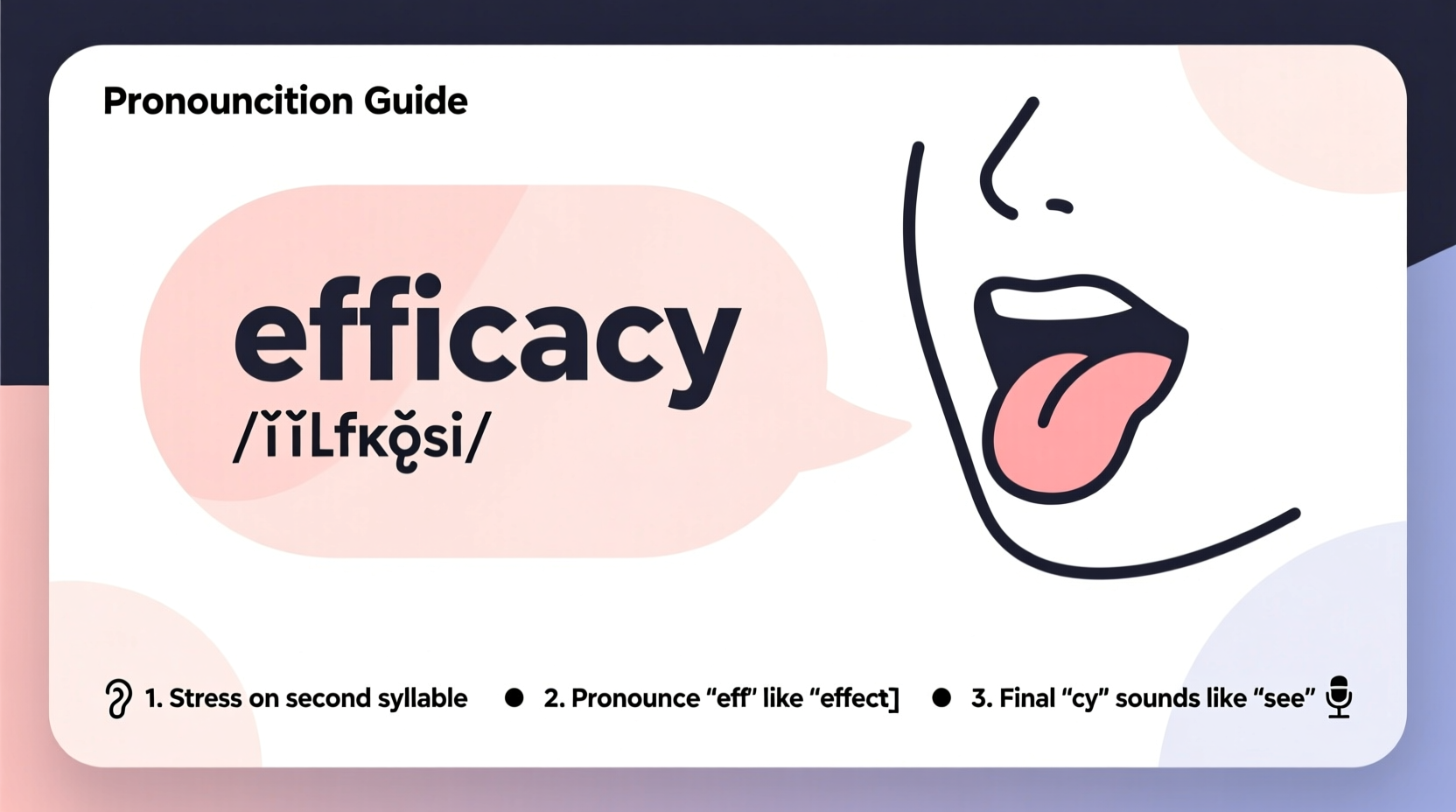
The correct pronunciation of “efficacy” is /ˈef.ə.kə.si/ (EF-uh-kuh-see). Let’s break this down into syllables:
- EF – pronounced like the letter “F,” but with a short “e” sound at the beginning.
- uh – a soft, unstressed schwa sound (like “a” in “about”).
- kuh – another schwa, followed by a hard “k” sound.
- see – rhymes with “key,” not “sigh” or “city.”
Common mispronunciations include “ef-FISH-uh-see” (confusing it with “efficient”) or “ef-FIK-a-see” (overemphasizing the third syllable). The key is to keep the second and third syllables light and unstressed, placing primary emphasis on the first syllable: **EF**-uh-kuh-see.
“Pronunciation isn’t about perfection—it’s about intelligibility. In professional settings, consistent and clear articulation builds trust.” — Dr. Lena Torres, Linguistics Professor, University of Chicago
Step-by-Step Guide to Mastering ‘Efficacy’
Follow this five-step process to internalize the correct pronunciation and use it naturally in speech:
- Listen to native models. Use trusted dictionaries like Oxford Learner’s Dictionary or Merriam-Webster, which provide audio clips of native speakers. Play the word repeatedly and shadow (repeat immediately after) to train your ear and mouth.
- Syllabify and mark stress. Write the word as “EF-fi-ca-cy” and underline the first syllable. Visual cues reinforce auditory patterns.
- Practice slowly. Say each syllable distinctly: “EF… uh… kuh… see.” Gradually increase speed while maintaining clarity.
- Use it in sentences. Embed the word in realistic phrases: “The study measured the drug’s efficacy,” or “We need to assess the long-term efficacy of this policy.”
- Record yourself. Use your phone to record your voice. Compare your pronunciation to the dictionary audio. Note differences and adjust accordingly.
Common Pitfalls and How to Avoid Them
Even advanced English speakers trip over “efficacy” due to phonetic interference from related words. Below is a comparison table highlighting frequent errors and corrections:
| Mispronunciation | Why It’s Wrong | Correct Version |
|---|---|---|
| ef-FISH-uh-see | Confusion with “efficient” (/ɪˈfɪʃ.ənt/) | EF-uh-kuh-see |
| ef-FIK-a-see | Overemphasis on the third syllable | EF-uh-kuh-see (stress on first syllable) |
| eh-FISH-uh-see | Incorrect vowel in first syllable | EF-uh-kuh-see (short “e” as in “bed”) |
| ef-uh-KY-see | Misplaced stress and incorrect final syllable | EF-uh-kuh-see (final syllable like “key”) |
Real-World Example: A Professional Setting
Consider Maria, a junior analyst presenting findings to her team at a pharmaceutical company. She prepared thoroughly but stumbled when discussing clinical trial results: “We observed high ef-FISH-uh-see in the patient group.” A senior colleague gently corrected her: “Just to clarify, we typically say EF-uh-kuh-see in this context.” Though embarrassed, Maria used the feedback constructively. Over the next two weeks, she practiced daily using audio resources and sentence drills. By her next presentation, she delivered the same phrase with confidence: “The treatment demonstrated strong efficacy.” Her improved clarity was noticed—and appreciated—by her manager.
This scenario illustrates that mispronunciations are common and fixable. What matters most is responsiveness and willingness to improve.
Checklist: Mastering ‘Efficacy’ in One Week
Use this actionable checklist to confidently pronounce “efficacy” within seven days:
- ✅ Listen to three reputable audio pronunciations (e.g., Cambridge, Oxford, Merriam-Webster).
- ✅ Break the word into syllables and mark stress: EF-uh-kuh-see.
- ✅ Practice aloud for 3 minutes each morning.
- ✅ Record yourself and compare to native speakers.
- ✅ Use the word in two real-life sentences (spoken or written).
- ✅ Ask a colleague or friend for feedback on your pronunciation.
- ✅ Review the word on day 7 without notes—say it correctly three times in a row.
Frequently Asked Questions
Is “efficacy” pronounced the same as “efficiency”?
No. While both begin with “ef,” they differ significantly. “Efficiency” is pronounced /ɪˈfɪʃ.ən.si/ (ih-FISH-uhn-see), with stress on the second syllable and a “sh” sound. “Efficacy” is /ˈef.ə.kə.si/ (EF-uh-kuh-see), with stress on the first syllable and a hard “k” sound.
Why do people often mispronounce “efficacy”?
The confusion stems from pattern recognition. English speakers associate the “-cacy” ending with words like “accuracy” (/ˈæk.jɚ.ə.si/) or “diplomacy” (/dɪˈplɑː.mə.si/), which end with a soft “see” but have different stress patterns. Additionally, “efficiency” is more commonly used, leading to subconscious substitution.
Does regional accent affect how “efficacy” should be pronounced?
Minor variations exist between American, British, and Australian English, but the core pronunciation remains consistent: primary stress on the first syllable, soft middle vowels, and a clear “see” ending. Regional accents may alter vowel quality slightly, but intelligibility is preserved across dialects.
Final Thoughts and Call to Action
Pronouncing “efficacy” correctly is more than a linguistic detail—it’s an act of precision and professionalism. Whether you’re writing a report, delivering a presentation, or participating in a meeting, clear pronunciation enhances your message and strengthens your presence. The strategies outlined here—listening, breaking down syllables, practicing deliberately, and applying feedback—are proven tools for lasting improvement.
Language evolves, and so can your skills. Don’t wait for a moment of hesitation to motivate change. Start today: listen to the word, say it out loud, and use it in a sentence. Mastery comes not from never making mistakes, but from learning from them.




 浙公网安备
33010002000092号
浙公网安备
33010002000092号 浙B2-20120091-4
Comments
No comments yet. Why don't you start the discussion?