
The word “mature” is deceptively simple. It appears frequently in academic, professional, and everyday conversation—yet many speakers mispronounce it without realizing. Whether you're preparing for a presentation, improving your spoken English, or refining your accent, mastering the correct pronunciation of “mature” can enhance clarity and credibility. This guide breaks down the phonetic structure, highlights frequent errors, and offers actionable strategies to help you pronounce the word confidently and accurately.
Understanding the Correct Pronunciation
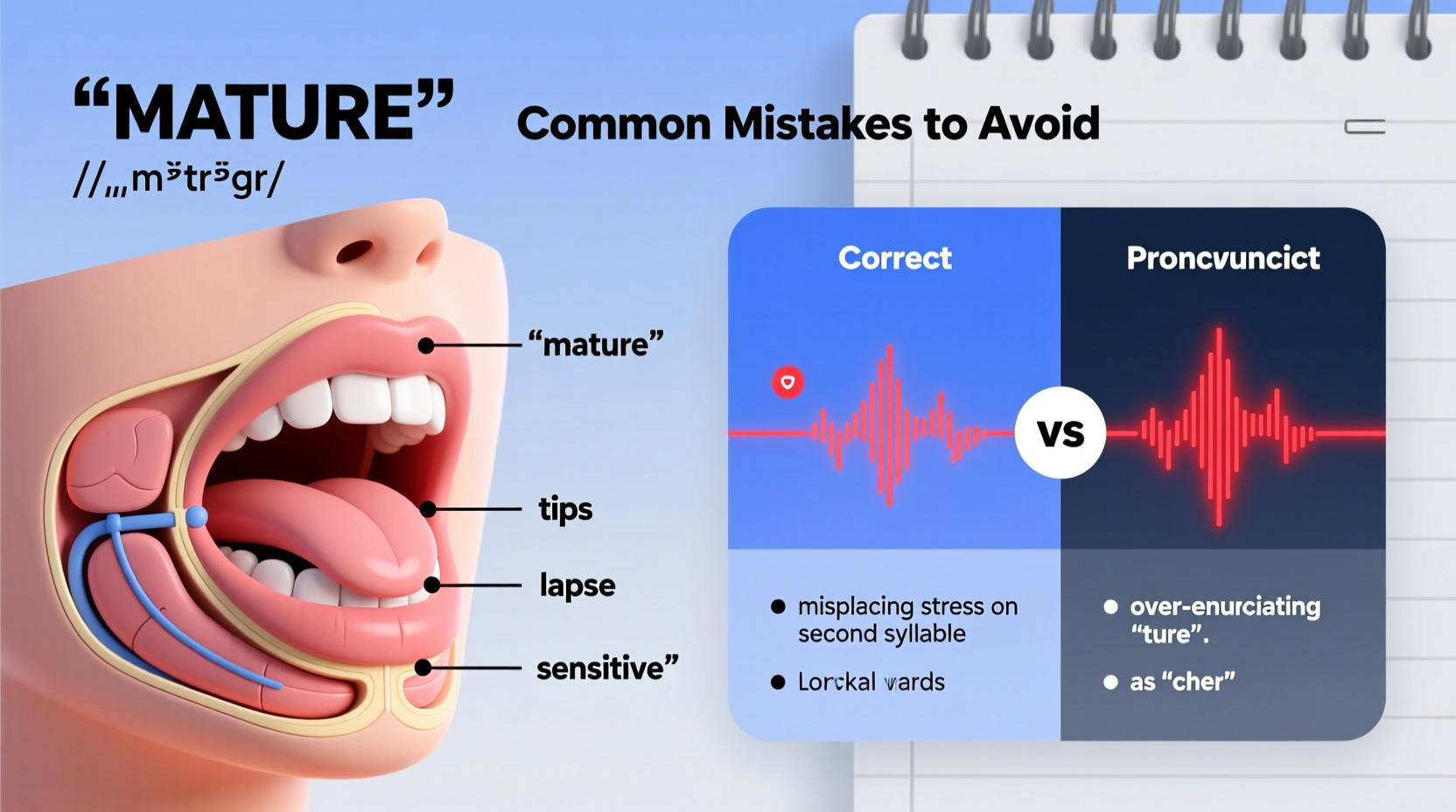
The standard pronunciation of “mature” in General American and British English is /məˈtʃʊr/ (muh-CHUR) or /məˈtjʊər/ (muh-TYOOR), depending on regional variation. The key lies in recognizing that the “-ture” ending does not sound like “ture” in “future,” but rather as “chur” or “tyoor.”
The word has three syllables: mu-a-ture, but due to elision in natural speech, it’s often reduced to two: mu-chur. The stress falls on the second syllable, which is crucial for accurate delivery.
Phonetic Breakdown
- First syllable: /mə/ – a schwa sound, unstressed and neutral, like “mu” in “support.”
- Second syllable: /ˈtʃʊr/ – stressed, with a “ch” sound as in “church,” followed by a short “ur.”
- Alternative British variant: /ˈtjʊər/ – features a palatal /tj/ onset, producing a “tyoor” sound.
Listening to native speakers on platforms like Forvo or YouGlish can reinforce auditory recognition. Repeat after audio samples until muscle memory supports consistent accuracy.
Common Mispronunciations and Why They Happen
Mispronouncing “mature” often stems from spelling-based assumptions. Because the word ends in “-ture,” many assume it should rhyme with “lecture” or “picture.” But unlike those words, “mature” evolved from Latin *maturus* through French influence, leading to a different phonetic development.
Here are the most frequent errors:
- \"May-ture\" (/meɪtʃər/) – Incorrectly emphasizing the first syllable and adding a long “a.”
- \"Muh-ture\" (/mətʃər/) – Missing the glide or palatalization, making it sound flat.
- \"My-choor\" (/maɪˈtʃʊr/) – Overemphasizing the first syllable with a diphthong, common among non-native speakers influenced by spelling.
- Three-syllable stretch: \"Ma-tu-re\" (/məˈtjuːˌrɛ/) – Artificially separating syllables that naturally blend.
“Pronunciation errors often reflect orthographic confusion. In English, spelling is a poor predictor of sound—especially in words borrowed from Latin or French.” — Dr. Lydia Chen, Linguistics Professor, University of Edinburgh
Step-by-Step Guide to Mastering the Sound
Improving pronunciation isn’t about memorization—it’s about repetition, awareness, and feedback. Follow this sequence to internalize the correct articulation of “mature.”
- Listen carefully. Find five native speaker examples online. Use headphones and isolate the word in context (e.g., “The idea was well thought out and quite mature.”).
- Break it down. Say each component slowly: /mə/ → /tʃʊr/. Exaggerate the “ch” at first to feel the tongue position.
- Practice the stress. Say “muh-CHUR” with emphasis on the second syllable. Contrast it with “MA-ture” to feel the difference.
- Use minimal pairs. Compare “mature” with “nature,” “feature,” and “capture” to sharpen auditory discrimination.
- Record yourself. Use your phone to record your attempts. Compare them to native models and adjust accordingly.
- Use it in sentences. Integrate the word into daily speech: “She gave a mature response to a difficult question.”
- Get feedback. Ask a fluent speaker or language coach to evaluate your pronunciation.
Do’s and Don’ts: Quick Reference Table
| Do | Don't |
|---|---|
| Stress the second syllable: mu-CHUR | Stress the first syllable: MA-ture |
| Use the /tʃ/ (“ch”) sound in the ending | Pronounce it like “ture” in “future” |
| Keep the first syllable soft and neutral (/mə/) | Say “may” or “my” as the first syllable |
| Blend the syllables smoothly | Over-enunciate as “ma-tu-re” |
| Match intonation to context (e.g., serious tone for maturity) | Use a sing-song or exaggerated rhythm |
Real Example: A Learner’s Journey
Raj, an IT professional from India, consistently pronounced “mature” as “MY-choor” during team meetings. His colleagues understood him, but he noticed subtle hesitations when discussing project timelines. After recording a presentation, he realized the mispronunciation stood out in phrases like “We need a more mature solution.”
He began practicing with YouTube tutorials and used the Google Translate audio function to compare his voice. Within two weeks of daily drills—focusing on the /tʃ/ sound and syllable stress—his delivery improved significantly. During his next client call, his manager complimented his clarity. Raj later shared, “It wasn’t just about one word. It changed how I approach all unfamiliar pronunciations.”
Frequently Asked Questions
Is “mature” pronounced differently in British and American English?
Yes. In American English, it’s typically /məˈtʃʊr/ (muh-CHUR). In British English, especially formal speech, it may be /məˈtjʊər/ (muh-TYOOR), with a clearer “ty” sound. Both are correct within their dialects.
Why does “mature” sound like “mature” but not rhyme with “sure” or “pure”?
Although “mature” ends in “-ure,” its pronunciation is shaped by historical French influence where “-ure” became /tʃ/ in certain contexts. Words like “figure” or “rigour” follow similar patterns.
Can I use “mature” in both adjective and verb forms with the same pronunciation?
Absolutely. Whether used as an adjective (“a mature decision”) or a verb (“the plan matured over time”), the pronunciation remains /məˈtʃʊr/ or /məˈtjʊər/. Stress and context change slightly, but the core sound stays consistent.
Final Tips for Long-Term Improvement
- Use spaced repetition. Revisit the word weekly to prevent backsliding.
- Incorporate into vocabulary journals. Write “mature” with phonetic transcription and example sentences.
- Shadow native speakers. Mimic TED Talks or news clips where the word appears naturally.
- Teach someone else. Explaining the correct pronunciation reinforces your own understanding.
Conclusion
Pronouncing “mature” correctly may seem minor, but it reflects attention to detail and linguistic precision—qualities that resonate in professional and academic settings. By understanding the phonetic foundation, avoiding common traps, and practicing deliberately, you gain more than a single word. You develop a method for mastering others like it. Language evolves through use, and every accurate utterance strengthens your voice.




 浙公网安备
33010002000092号
浙公网安备
33010002000092号 浙B2-20120091-4
Comments
No comments yet. Why don't you start the discussion?