
Learning American Sign Language (ASL) begins with understanding foundational signs that connect ideas, express relationships, and build sentences. Among these essential building blocks is the sign for and. While it may seem simple, mastering its correct form, context, and variation is crucial for clear communication. This guide breaks down every aspect of signing and in ASL, from hand positioning to common mistakes and practical applications. Whether you're a student, educator, or someone beginning their journey into Deaf culture, this resource will equip you with accurate, usable knowledge.
The Role of “And” in ASL Grammar
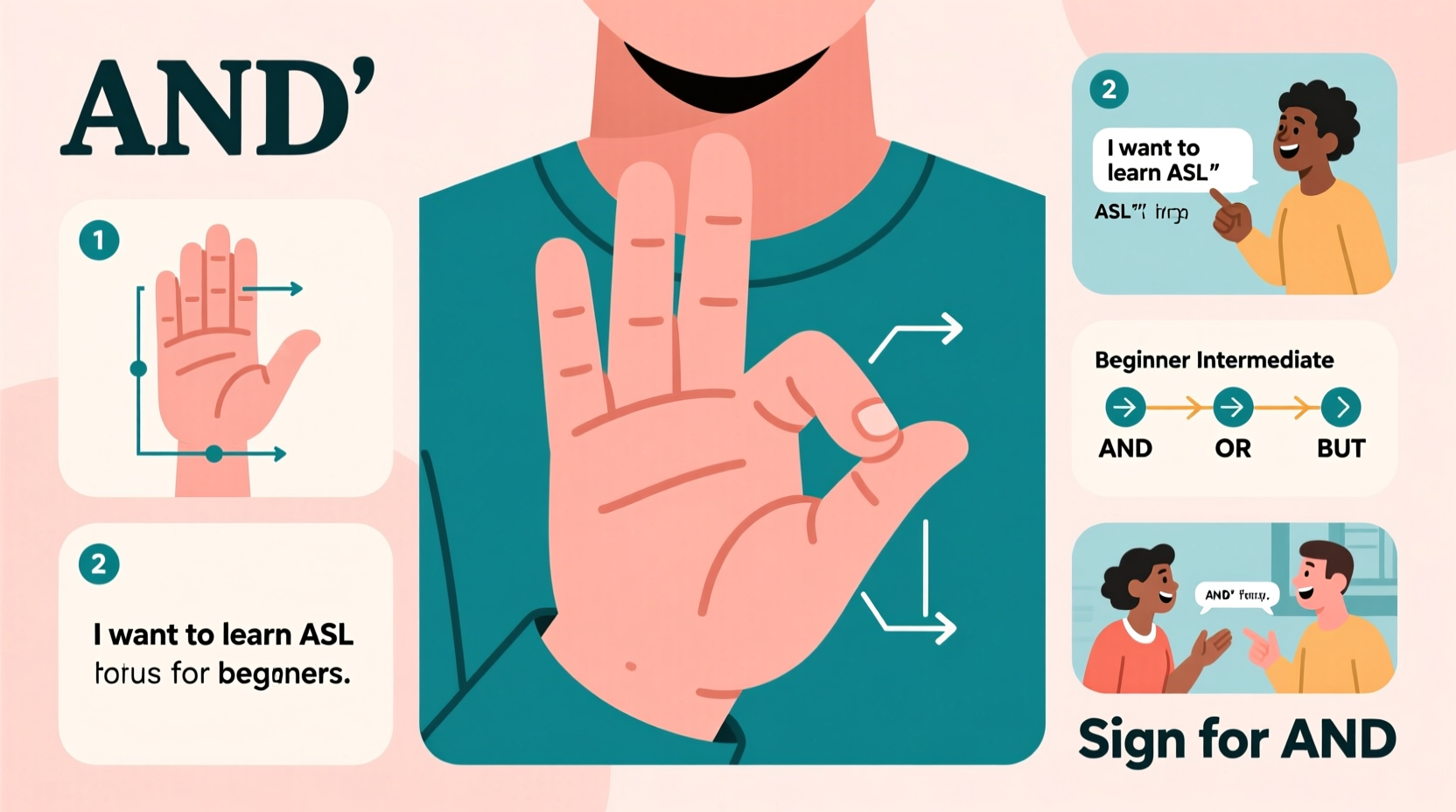
In English, “and” links words, phrases, and clauses. In ASL, the function is similar, but the method differs. ASL relies heavily on spatial grammar, facial expressions, and repetition rather than conjunctions as standalone signs in all contexts. However, there is a specific sign for and, often used when listing items or connecting two distinct concepts.
Unlike English, where “and” appears between every item in a list, ASL typically uses a single sign at the end of a sequence or relies on pauses and eye gaze to separate elements. The sign for and acts as a connector, not a filler. It’s commonly used in narratives, instructions, or when emphasizing a relationship between two nouns or actions.
“Signers don’t need ‘and’ after every item like in English. One well-placed sign can link an entire series.” — Dr. Laura Kim, Linguist & ASL Researcher
How to Sign “And”: Step-by-Step Guide
The sign for and is made using both hands in a smooth, alternating motion. Here’s how to do it correctly:
- Handshape: Use the dominant hand in a flat handshape (like a lowercase “b” – fingers together, palm facing down). The non-dominant hand mirrors this shape and remains stationary.
- Position: Place the non-dominant hand slightly lower than the dominant hand, about six inches apart, palms facing each other.
- Movement: Bring the dominant hand down to tap the side of the non-dominant hand, then lift it back up and repeat once more. The motion resembles a gentle “rocking” or “switching” action.
- Facial Expression: Maintain neutral or context-appropriate expression. No raised eyebrows or mouth movements are required unless emphasis is needed.
- Repetition: Perform the tap-lift-tap sequence twice for clarity, especially in slow or deliberate signing.
Variations and Contextual Uses
The sign for and changes subtly depending on context, region, and fluency level. Recognizing these variations helps avoid confusion and improves comprehension.
- List Connector: After signing three items (e.g., “APPLE, BANANA, ORANGE”), use and to mean “and so on” or “these things together.”
- Between Two Nouns: When linking two people or objects: “MY SISTER AND ME GO STORE.”
- Nuanced Emphasis: A slower, exaggerated and can imply contrast: “I LIKE COFFEE, AND… I ALSO LIKE TEA.”
- Fingerspelling Link: Often used between fingerspelled words: “J-O-B AND H-O-B-B-Y.”
It’s important to note that in many fluent conversations, the sign for and is omitted entirely. Instead, signers use a slight pause, head nod, or shift in eye gaze to indicate connection. This is part of ASL’s efficiency—using space and timing instead of extra signs.
Common Mistakes and How to Avoid Them
Beginners often misinterpret or overuse the sign for and. Below is a table outlining frequent errors and corrections:
| Mistake | Why It’s Wrong | Correct Approach |
|---|---|---|
| Signing “and” after every item in a list | Redundant; violates ASL’s concise structure | Use one “and” at the end or rely on pauses |
| Using a closed fist instead of flat hand | Resembles the sign for “FINISH” or “DONE” | Ensure fingers are extended and flat |
| One quick tap instead of two | May be mistaken for “SAME” or “MATCH” | Perform two clear taps for accuracy |
| Overemphasizing facial expressions | Can imply surprise or question unintentionally | Keep face neutral unless context demands otherwise |
Real-Life Example: Using “And” in Conversation
Sophia, a college student learning ASL, was practicing grocery shopping dialogue with her Deaf tutor, James. She signed: “I BUY MILK. I BUY BREAD. I BUY EGGS.” James paused, then demonstrated: “MILK, BREAD, EGGS… AND?” He pointed to her, inviting her to continue.
Sophia realized she had listed items without connecting them. She tried again: “MILK, BREAD, EGGS — AND JUICE.” James nodded approvingly. He then added: “YES. YOU BUY ALL AND GO HOME.”
This interaction highlighted how and functions not just as a word, but as a bridge between ideas. It also showed that in natural ASL, the sign often comes at the end of a set, summarizing what came before.
Checklist: Mastering the Sign for “And”
Use this checklist to ensure you’re signing accurately and confidently:
- ✅ Use flat hands (not fists or bent fingers)
- ✅ Position hands side-by-side, palms facing
- ✅ Tap dominant hand to non-dominant twice
- ✅ Keep movement small and controlled
- ✅ Avoid signing “and” between every item in a list
- ✅ Practice with real phrases: “CAT AND DOG,” “RUN AND JUMP”
- ✅ Record yourself and compare with native signers
Frequently Asked Questions
Do I always need to sign “and” between two words?
No. In ASL, context and spatial separation often replace conjunctions. For example, signing “RED BLUE” with a pause implies “red and blue.” The sign for and is used when clarity or emphasis is needed, not as a default connector.
Is the sign for “and” the same as “with”?
No. “With” is signed by forming an “A” handshape and tapping the chest twice. “And” uses flat hands and a side-tap motion. Confusing them can change meaning—for example, “I GO STORE WITH FRIEND” vs. “I GO STORE AND FRIEND,” which is grammatically incorrect.
Can children learn this sign early in ASL development?
Yes. Many parents teaching baby sign language simplify the sign for and by using one hand to tap the other once. While not fully standard, it serves as a stepping stone. As skills grow, children adopt the full two-handed version.
Final Thoughts and Call to Action
Mastering the sign for and is more than memorizing a gesture—it’s about understanding how connections work in ASL. This small sign plays a big role in making your signing fluid, natural, and grammatically sound. By focusing on correct form, avoiding common pitfalls, and practicing in real contexts, you’ll communicate with greater clarity and confidence.
Language grows through use. Try incorporating the sign for and into your daily practice: describe your meals, your plans, or your favorite activities. Share your progress with others, ask for feedback, and keep engaging with the Deaf community. Every sign you learn brings you closer to meaningful connection.




 浙公网安备
33010002000092号
浙公网安备
33010002000092号 浙B2-20120091-4
Comments
No comments yet. Why don't you start the discussion?