
Learning American Sign Language (ASL) involves more than memorizing individual signs—it’s about understanding how signs connect to form natural, fluid sentences. One of the most frequently used connectors in any language is “and,” and in ASL, it plays a crucial role in linking ideas, listing items, and creating cohesive narratives. While it may seem simple, mastering the sign for \"and\" requires attention to handshape, movement, facial expression, and context. This guide breaks down everything you need to know to use the sign accurately and naturally in everyday conversation.
The Basics of the Sign for \"And\"
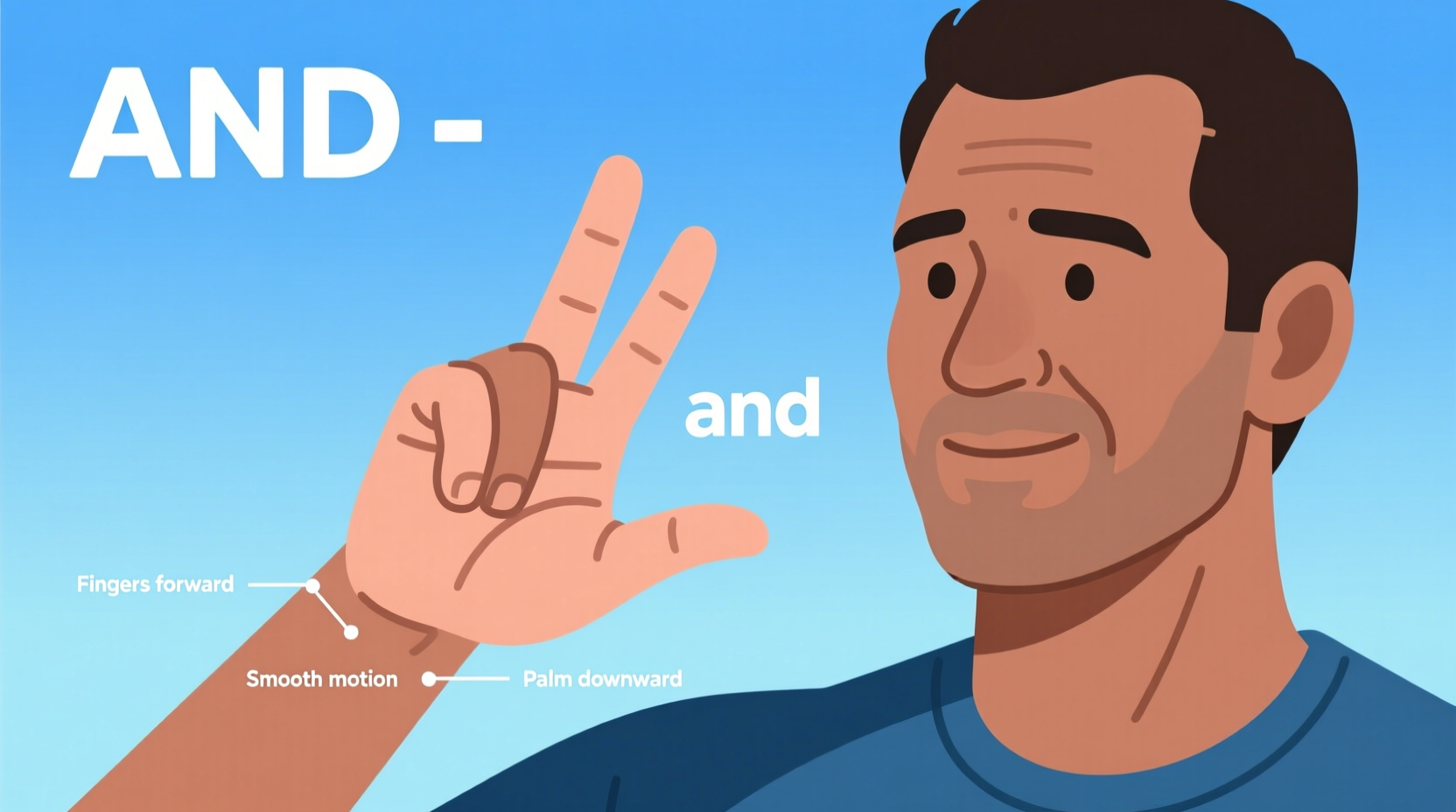
In ASL, the sign for “and” is not always required in the same way as in English. However, when used, it typically appears between two nouns, verbs, or phrases to indicate connection or addition. The most common version of the sign uses both hands in a modified “A” handshape—fingers curled into the palm, thumb extended.
To produce the sign:
- Form both hands into an “A” handshape.
- Hold your dominant hand slightly higher than your non-dominant hand.
- Tap the thumb of your dominant hand against the thumb of your non-dominant hand twice.
- Keep movements small and precise—this is not a sweeping motion.
The sign should be brief and crisp, serving as a connector rather than a focal point. It often occurs mid-sentence and blends smoothly into surrounding signs.
Variations and Contextual Uses
While the standard two-handed thumb-tap is widely accepted, regional variations and contextual factors can influence how “and” is signed. Some signers use a single-handed version, especially when the other hand is occupied or when signing one-handed for accessibility reasons. In this variation, the dominant hand taps its own thumb against the index finger or side of the palm.
More importantly, ASL relies heavily on syntax and non-manual markers (facial expressions, head movement) to convey meaning. Often, what English expresses with “and,” ASL expresses through spatial listing or pausing. For example, instead of signing “I like apples and bananas,” a fluent signer might sign “I LIKE APPLE, BANANA,” using a slight pause or head nod to link the two items.
This means that while learning the manual sign is important, knowing when *not* to use it is equally valuable. Overusing “and” can make signing appear stilted or overly literal.
When to Use the Sign for \"And\"
- When explicitly emphasizing the connection between two distinct ideas.
- In formal or instructional settings where clarity is prioritized.
- When teaching beginners who benefit from explicit connectors.
When to Omit It
- During natural listing (e.g., naming items in a series).
- When using ASL’s topic-comment structure.
- In fast-paced or conversational signing where flow matters.
“In ASL, conjunctions like ‘and’ are often implied rather than signed. Fluency comes from trusting the grammar of the language, not translating English word-for-word.” — Dr. Laura Montoya, Linguist and ASL Educator
Common Mistakes and How to Avoid Them
Learners often struggle with the sign for “and” because they approach it from an English-speaking mindset. Here are some frequent errors and corrections:
| Mistake | Why It’s Incorrect | Correction |
|---|---|---|
| Using large, exaggerated movements | Distracts from sentence flow; looks unnatural | Use small, controlled taps near the center of the body |
| Signing “and” before every item in a list | Redundant in ASL; disrupts rhythm | Sign once between first and second item, then pause for others |
| Confusing “and” with “also” or “plus” | Different signs with different grammatical roles | “Also” uses a flat hand brushing outward from the chest; “and” is a thumb tap |
| Forgetting non-dominant hand placement | Causes imbalance and unclear production | Keep non-dominant hand stable and slightly lower |
Step-by-Step Practice Routine
Building muscle memory and contextual awareness takes deliberate practice. Follow this five-minute daily routine to internalize the sign:
- Isolation Drill (1 min): Practice the thumb-tap motion slowly, focusing on clean handshapes and consistent contact. Repeat 15 times.
- Pairing Exercise (2 min): Sign simple noun pairs with “and” in between: “CAT AND DOG,” “RED AND BLUE,” “MOM AND DAD.” Say them aloud or silently to reinforce meaning.
- Sentence Integration (1 min): Use the sign in full sentences: “I EAT BREAD AND BUTTER,” “SHE WORKS MONDAY AND TUESDAY.” Focus on smooth transitions.
- Omission Practice (1 min): Re-sign the same sentences without “and,” relying on pauses and eye gaze to link items. Compare the feel of both versions.
Real-Life Example: Grocery List Conversation
Consider a common interaction at a deaf community event:
Two friends meet before a potluck. Sarah signs: “YOU BRING WHAT?” Jamal responds: “I BRING CHIPS, SALSA, AND COOKIES.” He signs “CHIPS” and “SALSA” with a slight pause, then adds “AND” before “COOKIES” to highlight the last item as a special addition.
Later, he says: “I LIKE TEA AND COFFEE.” This time, he uses the full sign for “and” to emphasize his equal preference—showing that the sign isn’t just grammatical, but expressive.
This scenario illustrates how “and” functions differently depending on intent. When listing casually, it can be omitted. When making a point, it’s included for emphasis.
Frequently Asked Questions
Do I always need to sign “and” between two items?
No. In natural ASL, “and” is often omitted in lists. Instead, signers use pausing, eye shifts, or repetition to link items. Reserve the sign for cases where you want to stress connection or contrast.
Can I use the sign for “and” with actions, not just nouns?
Yes, but sparingly. You might sign “I WALK AND RUN” to describe a workout, but in most cases, sequencing the verbs (“I WALK, THEN RUN”) feels more natural in ASL grammar.
Is there a difference between “and” and “with” in ASL?
Yes. “And” connects ideas; “with” indicates accompaniment or tool use. The sign for “WITH” uses two bent “V” hands touching at the fingertips and moving forward together. Don’t confuse the two—they serve different syntactic roles.
Checklist: Mastering the Sign for \"And\"
- ✅ Use the correct “A” handshape with thumbs extended
- ✅ Tap thumbs together twice with small, controlled motion
- ✅ Place dominant hand slightly above non-dominant hand
- ✅ Practice in short phrases before full sentences
- ✅ Learn when to omit “and” for natural fluency
- ✅ Compare your signing with native signers via videos or classes
- ✅ Avoid overusing it in lists or rapid speech
Conclusion: From Accuracy to Fluency
Mastering the sign for “and” is more than a technical achievement—it’s a step toward thinking in ASL rather than translating from English. As you grow more comfortable, you’ll begin to sense when to include the sign for clarity or emphasis, and when to let the natural rhythm of ASL carry the connection between ideas. True fluency lies in that balance: precision paired with instinct.




 浙公网安备
33010002000092号
浙公网安备
33010002000092号 浙B2-20120091-4
Comments
No comments yet. Why don't you start the discussion?