
Color signs in American Sign Language (ASL) are essential for everyday communication, especially when describing clothing, food, emotions, or classroom activities. Among the most commonly used color signs is \"green.\" While it may seem simple, mastering the correct form, placement, and context ensures clarity and fluency. Whether you're a beginner learning your first signs or an intermediate signer refining your technique, understanding how to accurately sign \"green\" builds a strong foundation for broader ASL expression.
The Importance of Accurate Color Signs in ASL
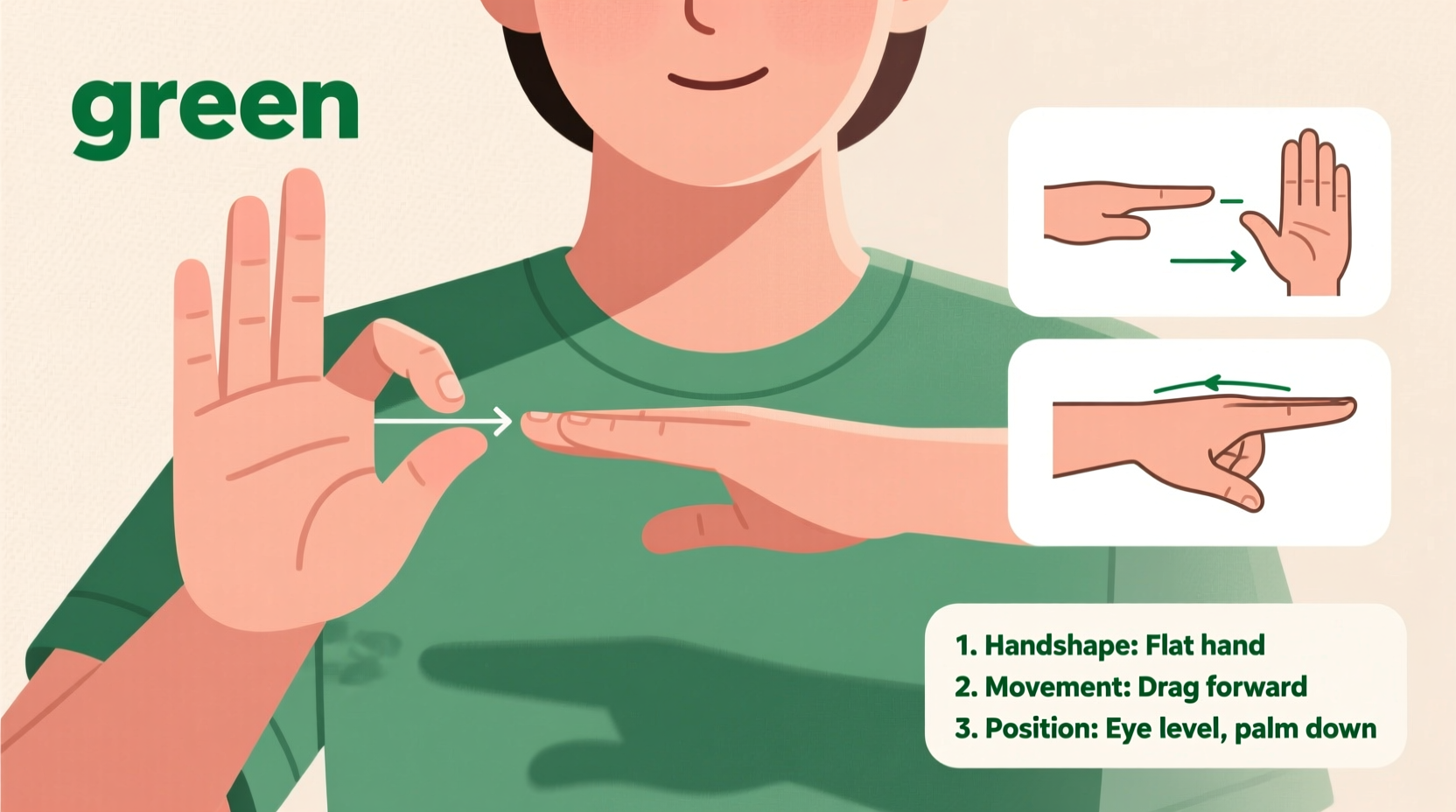
In spoken languages, mispronouncing a color might still allow comprehension through context. In ASL, however, subtle differences in handshape, movement, or location can change a sign entirely. For example, the sign for \"green\" is closely related to \"grass,\" but differs slightly in motion and intent. Using the wrong version can lead to confusion—signing \"grassy\" instead of \"green\" isn’t just inaccurate; it could alter meaning in critical situations like medical descriptions or safety instructions.
Colors also carry emotional and cultural weight. Green can symbolize nature, growth, envy, or permission (\"go ahead\"). Signing it correctly respects both linguistic precision and cultural nuance within Deaf communities.
Step-by-Step: How to Sign \"Green\" in ASL
The sign for \"green\" mimics the action of wiping something off the palm, symbolizing the idea of grass being wiped from the hand. It’s derived from the older sign for \"grass,\" which makes sense given that green is most associated with plant life.
- Handshape: Use a flat hand (also known as a \"B-hand\") with fingers extended and held together, palm facing down.
- Location: Begin with the dominant hand positioned above the non-dominant hand’s palm, which should be facing upward.
- Movement: Move the flat hand in a short, downward wiping motion across the center of the palm. The motion should be crisp and deliberate—not too long, not too forceful.
- Repetition: In some contexts, especially when emphasizing the color or teaching children, the sign may be repeated once.
- Facial Expression: Maintain neutral expression unless context requires emphasis (e.g., surprise at a green light turning red).
Common Errors and How to Correct Them
Many learners confuse the sign for \"green\" with similar signs due to overlapping movements or locations. Here are frequent mistakes and how to avoid them:
- Mistaking \"green\" for \"write\": Both involve movement on the palm, but \"write\" uses an \"A-hand\" (closed fist) making small circular motions. Keep fingers flat and spread slightly for \"green.\"
- Overemphasizing the motion: A large swipe suggests \"clean off\" or \"remove,\" not color. Stick to a short, controlled stroke.
- Using the wrong hand orientation: If the palm faces backward or sideways, the sign becomes unclear. Ensure the passive hand’s palm faces up, and the active hand moves palm-down.
Variations and Contextual Uses of the Sign for Green
While the basic sign remains consistent, its usage varies depending on context. Understanding these nuances improves both comprehension and expressive skill.
For instance, when discussing traffic lights, \"green\" is often signed near the head or eye level to indicate visibility. In contrast, when describing a shirt, the sign may be performed closer to the chest area, sometimes followed by a classifier indicating clothing.
In educational settings, teachers might combine \"green\" with numbers or categories: “Which bin is for green recycling?” Here, the sign flows into others like \"recycle\" or \"trash\" with clear spatial separation.
| Context | Sign Variation | Additional Signs Often Paired |
|---|---|---|
| Nature/Environment | Standard sign, possibly repeated | tree, leaf, grow |
| Traffic/Instruction | Signed near face or forward space | go, stop, wait |
| Clothing/Fashion | Performed near body, directional | shirt, color, like |
| Emotion/Slang | With raised eyebrows or smirk | jealous, sick, envy |
“Color signs are gateways to descriptive language in ASL. Mastering 'green' opens doors to conversations about health, environment, and emotion.” — Dr. Lillian Reyes, ASL Linguistics Professor, Gallaudet University
Building Fluency: Practice Strategies and Integration
Learning a single sign is just the beginning. True mastery comes from integrating it naturally into conversation. Below is a checklist to help reinforce proper use and retention.
- Practice the handshape in front of a mirror daily for one week
- Pair \"green\" with common nouns: apple, car, shirt, light
- Use it in full sentences: “I want the green cup,” “The light turned green”
- Record yourself signing and compare with native signer videos
- Teach the sign to someone else—teaching reinforces memory
Real-Life Example: Teaching Colors in a Classroom
Sarah, a preschool ASL instructor, noticed her students struggled to differentiate between \"blue\" and \"green.\" She introduced a weekly \"Color Day,\" where each day focused on one hue. On Green Day, she began by signing \"green\" while holding up green objects—a toy frog, a marker, a piece of paper. She then led children in mimicking the wiping motion on their palms. To reinforce meaning, she took them outside and signed \"green\" while touching leaves and grass. Within two weeks, students consistently produced the correct sign and used it spontaneously during play. This immersive approach demonstrated how contextual repetition deepens understanding far more than rote memorization.
Frequently Asked Questions
Is the sign for \"green\" the same as \"grass\"?
Historically, yes—the sign originated from \"grass.\" Today, they are considered the same sign in most ASL dialects. Context determines whether it means the color or the plant. For example, signing \"green\" while looking out a window likely refers to grass, whereas doing so while holding up a crayon clearly means the color.
Can I use the letter G to fingerspell \"green\" instead?
You can, but it's less efficient and not standard in fluent ASL. Fingerspelling is typically reserved for proper nouns, new concepts, or clarification. Native signers overwhelmingly prefer the iconic \"wiping\" motion because it’s faster and visually descriptive.
Why do some people sign \"green\" differently?
Like any language, ASL has regional variations. Some communities use a double wipe or slight twist at the end. These are acceptable as long as they’re understood locally. However, for learners, sticking to the standard single wipe ensures wider comprehension.
Expanding Beyond Green: A Path to Broader Color Mastery
Once \"green\" is mastered, it serves as a template for learning other colors. Many ASL color signs are built on similar principles—using facial expressions, location, and movement to convey meaning. For example:
- \"Red\" uses a clawed hand dragging across the cheek (like scratching)
- \"White\" involves brushing the palm with flat hand
- \"Black\" mimics smearing dirt with a bent \"X-hand\"
Noticing these patterns accelerates vocabulary acquisition. Green, with its flat-hand structure and palm contact, aligns closely with \"white\" and \"brown,\" making comparisons useful during study sessions.
Conclusion: Start Signing with Confidence
Mastering the sign for \"green\" is more than learning a gesture—it’s about connecting to a visual language rich in imagery and culture. With precise handshape, correct movement, and thoughtful context, your signing becomes clearer and more expressive. The next time you describe a forest, explain a traffic rule, or talk about how someone feels \"green with envy,\" do so with confidence and accuracy.




 浙公网安备
33010002000092号
浙公网安备
33010002000092号 浙B2-20120091-4
Comments
No comments yet. Why don't you start the discussion?