
The ability to express kindness, approval, and warmth is essential in any language. In American Sign Language (ASL), the sign for \"nice\" carries both literal and emotional weight—conveying politeness, pleasantness, and genuine appreciation. Whether you're a beginner learning basic vocabulary or an intermediate signer refining your fluency, mastering the sign for \"nice\" opens doors to more meaningful interactions within the Deaf community. This guide breaks down the mechanics of the sign, explores its contextual uses, and highlights how it fits into broader expressions of courtesy in ASL.
Understanding the Sign: Form and Mechanics
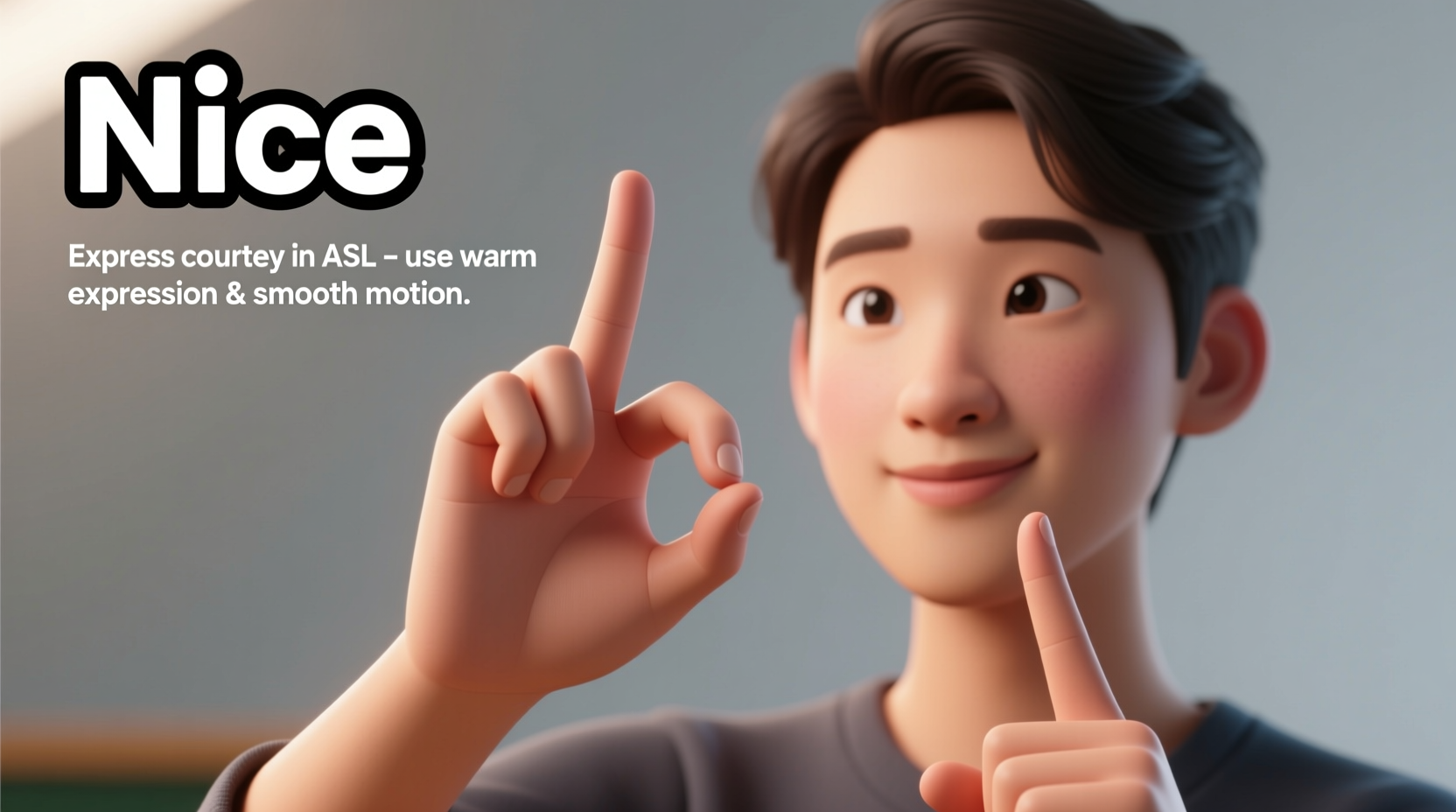
The ASL sign for \"nice\" is a two-part movement that combines touch and motion. It begins with the dominant hand in a flat handshape (like a modified \"B\" hand), palm facing in toward the chest. The fingertips gently touch the center of the sternum—just below the collarbone—and then slide smoothly downward about 4 to 6 inches along the chest.
This downward glide is smooth and deliberate, not abrupt. The facial expression typically matches the sentiment: a soft smile, relaxed eyebrows, and warm eye contact. Unlike some signs that rely solely on handshape, \"nice\" emphasizes the combination of location, movement, and non-manual markers (facial grammar) to convey sincerity.
Step-by-Step Guide to Signing \"Nice\"
- Handshape: Form a flat hand (fingers together, palm facing inward).
- Location: Place fingertips at the center of your chest, just below the neck.
- Movement: Slide the hand straight down about 6 inches with gentle pressure.
- Facial Expression: Smile slightly; keep your eyes engaged and open.
- Repetition: For emphasis (e.g., “very nice”), repeat the sign twice with increased intensity.
It’s important to avoid common errors such as using a clawed handshape, starting too high on the neck, or making a circular motion instead of a straight slide. Precision in execution ensures clarity and respect in communication.
Variations and Contextual Uses
\"Nice\" in ASL isn’t limited to describing people. It can refer to weather, food, behavior, environments, and even abstract concepts like a \"nice idea.\" The meaning shifts subtly based on context and accompanying signs.
- Nice person: Sign \"PERSON\" followed by \"NICE,\" often with a nod and positive facial expression.
- Nice day: Sign \"DAY\" + \"SUN\" + \"NICE,\" paired with a bright, open expression.
- Nice job: Used after someone completes a task; signed with a slight head tilt and approving look.
In conversational ASL, \"nice\" often appears in feedback loops—when one person shares news, another might respond with \"NICE!\" as both acknowledgment and encouragement. This mirrors verbal affirmations like \"That's great!\" in English but carries deeper cultural resonance in Deaf interactions, where visual affirmation strengthens connection.
Cultural Nuance: Courtesy Beyond Words
In Deaf culture, signing \"nice\" isn’t merely descriptive—it’s relational. A sincere \"nice\" offered after a story, a gesture, or a meeting contributes to social harmony. It reflects active listening and emotional presence. As Dr. Laura Greer, a linguist specializing in ASL pragmatics, explains:
“Polite expressions in ASL aren’t add-ons—they’re woven into the fabric of interaction. A well-timed ‘nice’ can validate someone’s experience in a way that transcends mere politeness.” — Dr. Laura Greer, ASL Sociolinguistics Researcher
Unlike spoken languages where tone of voice conveys emotion, ASL relies on facial grammar, timing, and body orientation. A rushed or mechanically executed \"nice\" may come across as insincere. Conversely, a slow, expressive version with eye contact and a natural smile reinforces authenticity.
Common Mistakes and How to Avoid Them
Learners often struggle with overgeneralizing signs or misapplying them due to English influence. Below is a comparison of correct versus incorrect usage of \"nice.\"
| Mistake | Why It’s Incorrect | How to Fix It |
|---|---|---|
| Using a \"5\" handshape (spread fingers) | Lacks precision; resembles other chest-touching signs | Use a flat hand with fingers pressed together |
| Starting at the chin or throat | May be confused with \"think\" or \"know\" | Begin at the sternum, not above it |
| Quick, jerky motion | Appears dismissive or unnatural | Smooth, flowing downward slide |
| No facial expression | Sign feels empty or robotic | Add a soft smile and engaged eyes |
Mini Case Study: Building Rapport in a Deaf Community Setting
Jamie, a hearing student in an ASL II class, attended a local Deaf coffee night for the first time. Nervous but eager, they signed, “I LEARN ASL. MEET YOU,” to a group member. One participant shared a short story about their weekend garden harvest. Jamie responded with a quick “NICE” while looking at their phone. The group paused, then politely shifted conversation away.
Afterward, Jamie’s instructor explained what went wrong: the sign was technically correct, but the lack of eye contact and minimal facial expression made it seem disinterested. The following week, Jamie returned, maintained eye contact, smiled warmly, and signed “NICE!” with full attention. This time, the group invited them into the circle, exchanged names, and even taught them a new sign.
The difference wasn’t vocabulary—it was presence. The same sign, delivered with intention, transformed a missed connection into a meaningful exchange.
Checklist: Signing “Nice” with Confidence and Respect
- ✅ Use a flat handshape (not spread or curled)
- ✅ Start at the sternum, not the chin or neck
- ✅ Slide down 4–6 inches with smooth motion
- ✅ Pair with a genuine smile and attentive eyes
- ✅ Adjust repetition for emphasis (“very nice” = two signs)
- ✅ Match the sign to context—people, events, objects
- ✅ Avoid distractions when responding to others
Frequently Asked Questions
Can “nice” be used sarcastically in ASL?
Yes, but only with clear non-manual signals. Raised eyebrows, tight lips, or an exaggerated slow motion can indicate sarcasm. Without these cues, the sign defaults to sincerity—so use caution to avoid misunderstandings.
Is there a difference between “nice” and “kind” in ASL?
Yes. “Nice” focuses on pleasantness or agreeability (signed on the chest), while “kind” involves a different motion—tapping the inside of the wrist against the chest, often repeated. “Kind” emphasizes moral character; “nice” emphasizes surface-level approval or enjoyment.
Can children learn this sign early in ASL development?
Absolutely. “Nice” is commonly taught in baby sign programs and early childhood ASL curricula because of its simple movement and positive reinforcement value. Parents report that toddlers use it spontaneously to comment on food, toys, or affectionate moments.
Conclusion: Sign with Heart, Not Just Hands
Mastering the sign for \"nice\" goes beyond muscle memory. It’s about understanding how small gestures—both linguistic and emotional—build trust and warmth in Deaf communication. When signed with care, \"nice\" becomes more than a word; it becomes an act of recognition, a moment of shared humanity.




 浙公网安备
33010002000092号
浙公网安备
33010002000092号 浙B2-20120091-4
Comments
No comments yet. Why don't you start the discussion?