
Reading a book a day may sound like an unrealistic goal—something only prodigies or retirees could achieve. But in an age of information overload, the ability to consume, understand, and retain knowledge quickly is not just impressive; it’s essential. With deliberate practice, optimized routines, and science-backed techniques, reading one full-length book per day becomes not only possible but sustainable. This isn’t about skimming or speed-reading mindlessly—it’s about mastering comprehension, maintaining focus, and building long-term retention.
The Reality of Reading One Book a Day
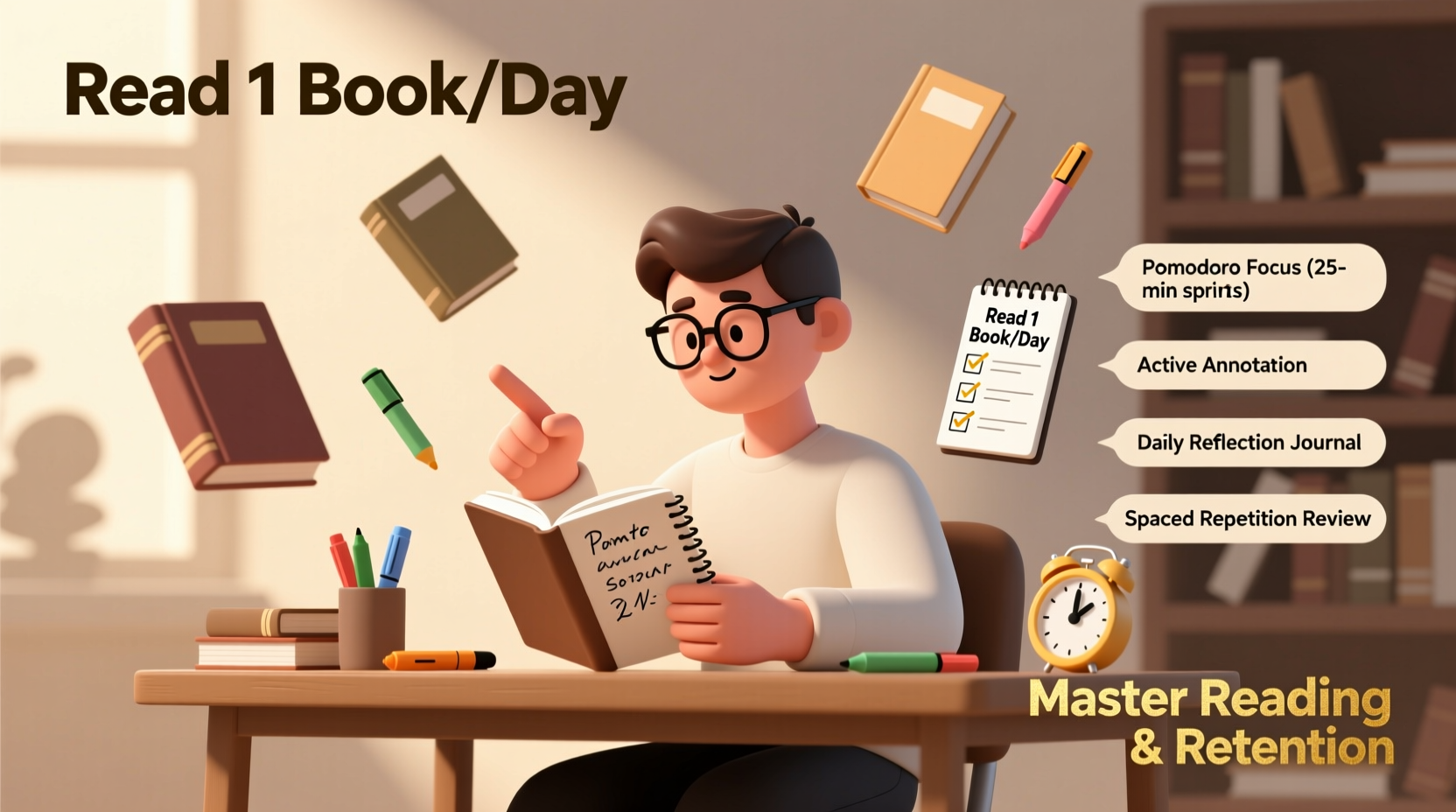
The average nonfiction book contains between 60,000 and 80,000 words. At a typical reading speed of 250–300 words per minute, that translates to roughly 4–5 hours of focused reading. While this might seem excessive, most people already spend several hours daily on digital distractions. By reallocating even half of that time, combined with improved reading efficiency, the math becomes manageable.
The real challenge isn’t time—it’s focus and retention. Many readers finish books without remembering key points days later. True mastery lies not in volume alone, but in extracting value consistently.
“Speed means nothing if you forget everything by tomorrow. The goal is intelligent acceleration.” — Dr. Linda Kim, Cognitive Psychologist and Learning Strategist
Optimize Your Reading Environment for Deep Focus
Your surroundings directly influence your ability to absorb information. A cluttered space leads to a cluttered mind. To sustain deep reading sessions, create a distraction-free zone:
- Choose a quiet area with minimal visual noise.
- Turn off phone notifications or use apps like Forest or Freedom to block distractions.
- Use ambient background sounds (e.g., white noise or instrumental music) if silence feels oppressive.
- Ensure proper lighting to reduce eye strain.
Step-by-Step Guide to Reading a Book a Day
Follow this structured approach to make daily book completion both achievable and meaningful:
- Select the Right Book: Start with shorter works (150–200 pages) or high-signal nonfiction. Avoid dense academic texts initially.
- Preview the Structure: Skim the table of contents, introduction, and conclusion. Identify core arguments and chapter summaries.
- Set Clear Objectives: Ask: What do I want to learn from this book? Having a purpose improves engagement.
- Chunk Your Time: Break reading into four 60-minute blocks with 10-minute breaks. Use a timer to stay accountable.
- Annotate Actively: Highlight key ideas, write margin notes, or use sticky tabs. Engaging physically boosts retention.
- Summarize After Each Chapter: Pause and write a 2–3 sentence summary in your own words.
- Review at Day’s End: Spend 15 minutes recapping the entire book. Use flashcards or a journal entry.
Boost Retention with Proven Cognitive Techniques
Memory is not fixed—it’s trainable. Apply these evidence-based methods to lock in what you read:
- Spaced Repetition: Revisit key concepts after 1 hour, 24 hours, and 7 days using flashcards or spaced repetition software (Anki).
- The Feynman Technique: Explain the book’s main ideas aloud as if teaching a child. Simplification reveals gaps in understanding.
- Mind Mapping: Create a visual diagram linking major themes, arguments, and examples.
- Sleep Consolidation: Review notes before bed. Sleep strengthens memory encoding.
| Technique | When to Use | Retention Boost |
|---|---|---|
| Active Recall | After finishing a section | High |
| Spaced Repetition | Daily review schedule | Very High |
| PQ4R Method | Full book study | High |
| Passive Listening | During commutes or chores | Low-Moderate |
The PQ4R method—Preview, Question, Read, Reflect, Recite, Review—is particularly effective for deep learning. It transforms passive reading into active inquiry, forcing your brain to engage rather than drift.
Mini Case Study: How Alex Read 30 Books in 30 Days
Alex, a product manager in San Francisco, wanted to accelerate his leadership knowledge. He committed to reading one book per day for a month, focusing on titles like “Atomic Habits,” “The Lean Startup,” and “Thinking, Fast and Slow.”
He began by eliminating morning social media scrolling and replaced it with 90 minutes of focused reading. During lunch, he listened to audiobook versions while walking. In the evening, he spent 20 minutes summarizing each book in a digital journal and tagged key insights by theme (decision-making, productivity, motivation).
By day 10, his reading speed increased from 280 to 410 words per minute due to reduced subvocalization. More importantly, he reported recalling over 80% of core concepts two weeks later—far above his previous retention rate of 30%. His team noticed sharper strategic thinking in meetings, directly tied to recent reads.
Alex didn’t become a superhuman reader overnight. He built systems that made consistency inevitable.
Common Pitfalls and How to Avoid Them
Even motivated readers fall into traps that sabotage progress. Here’s what to watch for:
| Do | Don’t |
|---|---|
| Set a specific reading schedule | Rely on “finding time” |
| Use a highlighter sparingly (max 10% of text) | Highlight entire paragraphs |
| Take short breaks every 50 minutes | Read for hours without pause |
| Review notes weekly | Never revisit material |
Essential Checklist for Daily Book Mastery
Use this checklist each day to ensure quality and consistency:
- ☐ Choose a book aligned with current goals
- ☐ Preview structure and set 1–2 learning objectives
- ☐ Schedule 3–4 dedicated reading blocks
- ☐ Eliminate distractions (phone on silent, apps blocked)
- ☐ Annotate or highlight key ideas
- ☐ Summarize each chapter in writing
- ☐ Perform end-of-day review (15 minutes)
- ☐ Add insights to a knowledge database or note-taking system
FAQ
Can anyone really read a book a day?
Yes—but with caveats. Most adults can achieve this with shorter books (150–200 pages), improved reading efficiency, and structured time management. It requires practice, but the skill compounds rapidly.
How do I avoid burnout from reading so much?
Burnout comes from forced consumption, not volume. Prioritize books you’re genuinely curious about. Take mental breaks, vary formats (print, audio), and allow yourself days to reflect instead of consuming new material.
Is speed reading necessary?
Not necessarily. While increasing reading speed helps, the priority should be on comprehension and retention. Many high-performing readers improve through better focus and chunking, not extreme speed.
Conclusion
Reading a book a day is less about raw speed and more about intelligent design—of your environment, habits, and cognitive tools. When you combine focused attention with active learning strategies, extraordinary output becomes routine. The benefits extend far beyond knowledge accumulation: sharper thinking, better decision-making, and greater confidence in any field.
You don’t need more time. You need better systems. Start small—aim for one high-quality book per week, then scale. Build the habit, refine the process, and let momentum carry you forward.




 浙公网安备
33010002000092号
浙公网安备
33010002000092号 浙B2-20120091-4
Comments
No comments yet. Why don't you start the discussion?