
Spelling may seem like a minor detail, but getting it right—especially with common names like \"Ashley\"—builds credibility, clarity, and professionalism in both personal and formal communication. Despite its widespread use, \"Ashley\" is frequently misspelled in emails, social media posts, official documents, and even public signage. Whether you're writing a birthday card, drafting a business message, or filling out a form, knowing how to spell \"Ashley\" correctly—and why people often get it wrong—can make a meaningful difference.
The name \"Ashley\" has English origins, originally serving as a surname derived from Old English words *æsc* (ash tree) and *lēah* (meadow or clearing), meaning “meadow among the ash trees.” Over time, it evolved into a popular given name across English-speaking countries. Its simplicity belies a surprising number of common spelling errors, many rooted in phonetic assumptions or regional pronunciation differences.
Why Spelling \"Ashley\" Matters
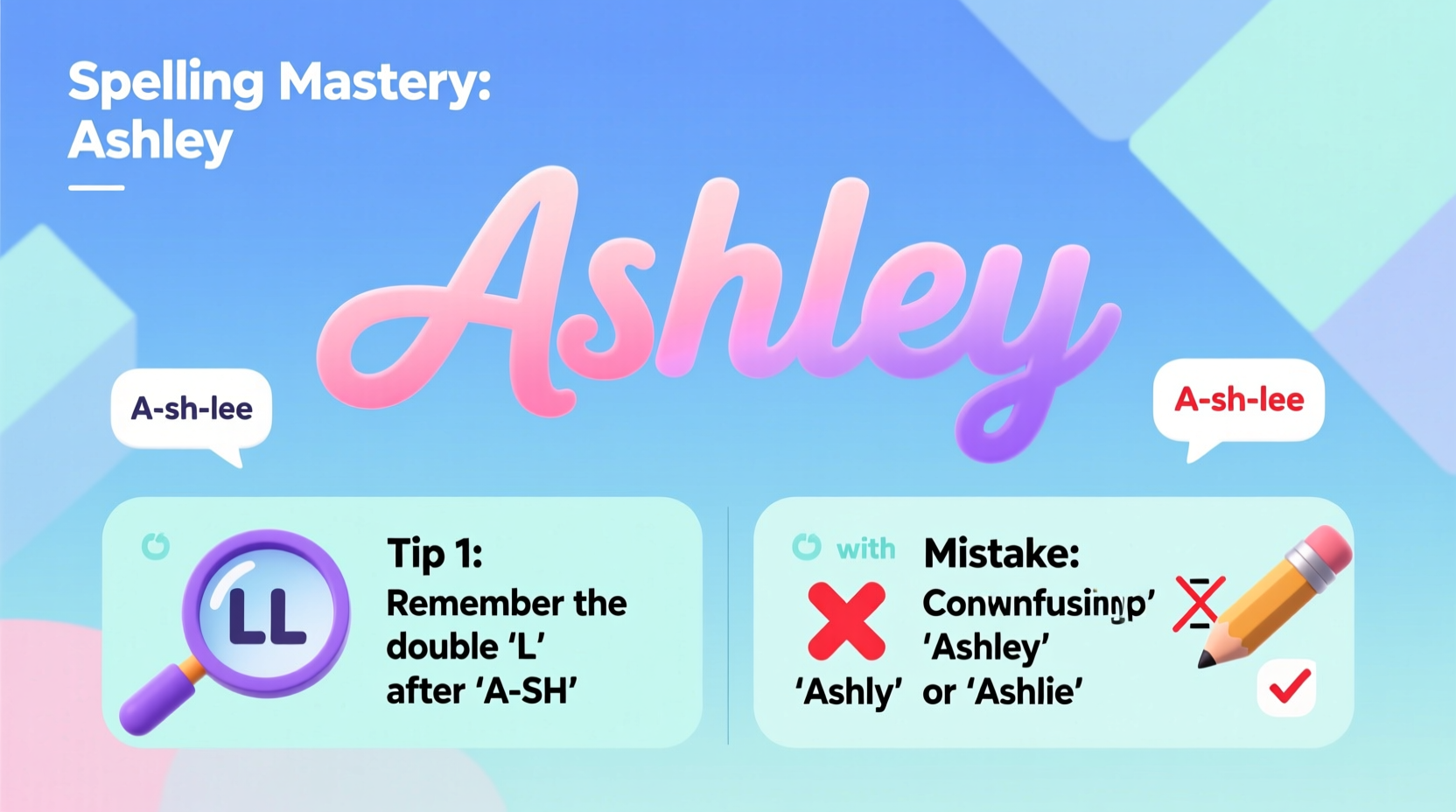
Names carry identity. Misspelling someone’s name, even unintentionally, can create an impression of carelessness or disrespect. In professional environments, accuracy in names reflects attention to detail. In educational settings, students named Ashley often report frustration when teachers or peers consistently mislabel them. Socially, a correctly spelled name fosters connection and recognition.
Moreover, digital communication amplifies the impact of spelling errors. A typo in an email subject line or a text message can delay responses or cause confusion. Search engines and databases also rely on exact matches—misspelling a name could mean failing to locate a person’s profile, record, or work.
Common Misspellings and Why They Happen
The correct spelling is A-S-H-L-E-Y. Yet variations persist due to auditory similarities and linguistic habits. Below are the most frequent misspellings and the reasons behind them:
- Asley – Dropping the 'H' is common because in rapid speech, the \"sh\" sound blends, making the 'H' less noticeable.
- Ashely – This swaps the position of 'L' and 'E', likely due to muscle memory from more common word patterns like \"really\" or \"gently.\"
- Ashlee – A phonetic reinterpretation influenced by alternative name spellings like \"Taylee\" or \"Carey,\" often used for stylistic effect.
- Ashly – A shortened form that omits the 'E', assuming the final 'Y' makes it redundant.
- Ashlie – Reflects a trend toward creative respellings, particularly in pop culture and entertainment.
Linguists note that these errors stem from what's called \"phonemic confusion\"—when people write what they hear rather than what is standard. The \"sh\" sound in \"Ash\" is a single phoneme, so some assume it requires only one letter. Others apply spelling rules from similar-sounding words incorrectly.
Step-by-Step Guide to Mastering the Spelling
Improving your spelling doesn’t require memorizing dictionaries. For \"Ashley,\" follow this simple five-step method:
- Break It Down: Divide the name into syllables—“Ash” + “ley.” Recognize that “Ash” starts with the word for the tree, and “ley” rhymes with “they.”
- Visual Anchoring: Write \"Ashley\" ten times slowly, focusing on each letter. Visual memory strengthens with repetition.
- Say It Aloud: Pronounce each letter: A-S-H-L-E-Y. Emphasize the 'H' after 'S' to reinforce the \"sh\" sound construction.
- Create a Mnemonic: Use a phrase like “A Smart Horse Likes Eating Yams” to link each letter meaningfully.
- Test Yourself: After practice, cover the name and write it from memory. Repeat daily for three days to lock it in.
This approach combines auditory, visual, and kinesthetic learning—proven techniques for long-term retention.
Do’s and Don’ts When Spelling \"Ashley\"
| Do’s | Don’ts |
|---|---|
| Double-check spelling before sending messages | Assume the spelling based on how it sounds |
| Use the full spelling: A-S-H-L-E-Y | Omit the 'H' or transpose 'L' and 'E' |
| Confirm spelling with the person if unsure | Rely solely on autocorrect—it may accept incorrect variants |
| Teach children the correct sequence early | Encourage trendy alternatives without context |
| Practice spelling aloud for reinforcement | Ignore repeated mistakes—address them promptly |
Expert Insight on Name Spelling Accuracy
“Names are the first point of human connection. Mispronouncing or misspelling them—even subtly—can erode trust. Teaching correct spelling isn’t just about grammar; it’s about respect.” — Dr. Lydia Monroe, Linguistics Professor at Oxford Brookes University
Dr. Monroe emphasizes that consistent spelling reinforces inclusivity and precision in language. She notes that educators and professionals who take care with names set a standard for thoughtful communication.
Real-Life Example: A Lesson in Attention to Detail
In 2022, a regional marketing firm sent out 500 client invitations for a product launch. One recipient, Ashley Thompson, noticed her name was spelled “Ashly” on the digital invite. Though she attended the event, she later shared her experience online: “It made me feel like an afterthought. If they couldn’t get my name right, how much effort would they put into understanding my business needs?”
The post went moderately viral, prompting the company to issue a public apology and revise their proofreading protocols. They now use a double-verification system for all client communications. This case illustrates how a single letter can affect perception and reputation.
Checklist: Ensuring You Spell \"Ashley\" Correctly
Use this practical checklist whenever you need to write or verify the name:
- ✅ Confirm the spelling: A-S-H-L-E-Y
- ✅ Check for missing 'H' between 'S' and 'L'
- ✅ Ensure 'L' comes before 'E', not after
- ✅ Avoid adding extra vowels like 'i' or 'a' at the end
- ✅ Verify against a known correct source (e.g., signature, ID, official bio)
- ✅ Read it backward: Y-E-L-H-S-A — helps catch transposed letters
- ✅ Ask yourself: Does it start with “Ash” like the tree? If yes, you’re on track.
Frequently Asked Questions
Is \"Ashley\" spelled differently for males and females?
No, the standard spelling \"Ashley\" is used for all genders. While historically more common for males in the UK, it became predominantly female in the US during the late 20th century. The spelling remains unchanged regardless of gender.
Can \"Ashley\" be spelled \"Ashleigh\" or \"Ashly\"? Are those wrong?
Those are accepted variant spellings, not errors—but they represent different name choices. \"Ashleigh\" is a deliberate respelling with roots in modern naming trends. If someone introduces themselves as \"Ashley,\" using \"Ashleigh\" would still be incorrect unless specified. Always honor the individual’s preferred spelling.
Why do so many people misspell \"Ashley\" as \"Asley\"?
Because the \"sh\" sound is a digraph (two letters producing one sound), listeners often fail to register the 'H'. Without explicit instruction, writers may omit it, especially if they rely solely on phonetic transcription. This is common with other \"sh\" words too, like \"sure\" or \"sugar.\"
Final Thoughts: Precision Builds Trust
Mastering the spelling of \"Ashley\" goes beyond memorizing six letters. It reflects a commitment to accuracy, respect, and effective communication. In a world where digital interactions dominate, small details like correct spelling shape perceptions instantly. Whether you're addressing a friend, colleague, or public figure, taking a moment to confirm the right spelling demonstrates care and professionalism.




 浙公网安备
33010002000092号
浙公网安备
33010002000092号 浙B2-20120091-4
Comments
No comments yet. Why don't you start the discussion?