
Long before smartphones and GPS devices, watchmakers embedded practical tools into timepieces to solve everyday problems. One such innovation is the tachymeter—a scale found on the bezel or dial of many analog watches, especially chronographs. While it may look like mere decoration, the tachymeter is a functional instrument capable of calculating speed based on travel time over a fixed distance, or even estimating distance when traveling at a constant speed. Understanding how to use it transforms your wristwatch from a passive timekeeper into an active measurement device.
The beauty of the tachymeter lies in its simplicity. It requires no batteries, connectivity, or apps—just a stopwatch function and basic observation. Whether you're timing a car’s speed between mile markers, gauging how fast a runner completes a lap, or estimating how far you've traveled at highway speeds, the tachymeter offers a quick, mechanical solution rooted in mathematics and precision engineering.
What Is a Tachymeter and How Does It Work?
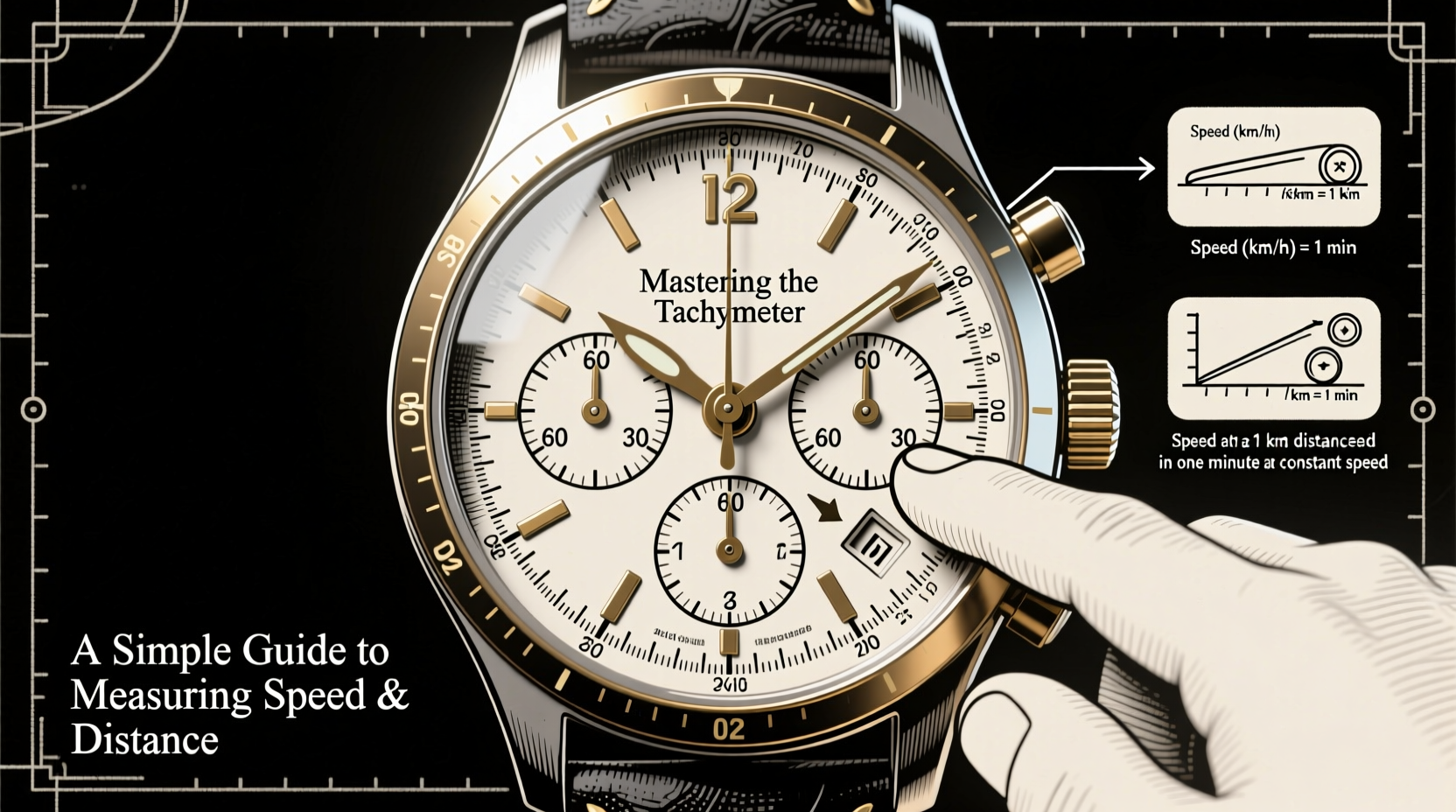
A tachymeter is a scale—usually printed on the bezel or outer edge of the watch dial—that converts elapsed time (in seconds) into units per hour, typically kilometers per hour or miles per hour. It works in conjunction with the chronograph (stopwatch) function of a watch. The underlying principle is based on the formula:
Speed = Distance / Time
The tachymeter assumes a fixed distance—commonly 1 kilometer or 1 mile—and calculates how many units of that distance could be covered in one hour if the measured pace were maintained. For example, if it takes 30 seconds to travel one mile, you are moving at 120 mph (since 3600 seconds ÷ 30 = 120). The tachymeter scale is pre-calculated so that when you stop the chronograph at 30 seconds, the second hand points directly to \"120\" on the scale.
This means the tachymeter is not a standalone tool—it only becomes useful when paired with a known distance. It cannot measure arbitrary distances without external reference points, but within those constraints, it delivers rapid, reliable results.
Step-by-Step Guide to Measuring Speed with a Tachymeter
Using a tachymeter to determine speed is straightforward once you understand the process. Follow these steps to get accurate readings:
- Identify a fixed distance: Choose a known stretch—such as a mile or kilometer marker on a road, a running track lap, or any measurable path.
- Start the chronograph: As you pass the starting point (e.g., the beginning of a mile), press the start button on your chronograph.
- Stop the chronograph: When you reach the end of the measured distance, stop the timer.
- Read the tachymeter scale: Look at where the chronograph second hand points on the tachymeter scale. That number indicates your average speed in units per hour.
For instance, if you drive exactly one kilometer and the chronograph stops at 45 seconds, the second hand will point to approximately 80 on the tachymeter—meaning you were traveling at 80 km/h.
This method works regardless of whether the scale is calibrated for kilometers or miles, as long as you’re consistent with the distance unit. Most modern tachymeters are unit-agnostic; they simply calculate “units per hour,” leaving the user to define what the unit represents.
Measuring Distance Using Constant Speed
While less commonly discussed, the tachymeter can also estimate distance when traveling at a known, steady speed. This reverse application is particularly useful in aviation, motorsports, or navigation scenarios where precise markers aren’t available.
To calculate distance:
- Maintain a constant speed: For example, cruise steadily at 90 km/h.
- Start the chronograph: Begin timing as you pass a landmark.
- Wait for the second hand to align with the speed on the tachymeter: Since 90 appears on most tachymeter scales, wait until the chronograph hand reaches that mark.
- Stop the watch: At that moment, you’ve traveled exactly one kilometer (or mile, depending on calibration).
This works because the tachymeter tells you how long it takes to cover one unit at a given speed. If you’re moving at 90 km/h, it should take 40 seconds to go one kilometer (3600 ÷ 90 = 40). So when the second hand hits 40 seconds, it aligns with \"90\" on the tachymeter—and you know you've covered one kilometer.
“The tachymeter turns every chronograph into a silent partner for pilots, drivers, and adventurers who value self-reliance over digital dependency.” — Daniel Reeves, Horological Historian
Practical Applications and Real-World Example
Consider a rally driver navigating a timed stage without GPS. Roadbooks list distances between checkpoints, but verifying pace is critical. Using a tachymeter-equipped watch, the co-driver starts the chronograph at a marked kilometer post. When the second hand lands on \"120\" on the tachymeter after stopping the timer, they immediately know their average speed was 120 km/h over that segment. This real-time feedback helps adjust driving strategy without relying on electronic systems that might fail mid-race.
Similarly, a cyclist training on a track can use the tachymeter to assess performance. Riding one full lap (400 meters), they time the effort. If the chronograph stops at 36 seconds, the tachymeter reads \"100\"—indicating a speed of 100 units per hour. Since the distance was 0.4 km, the actual speed is 40 km/h (0.4 × 100). This mental adjustment allows flexible use across fractional distances.
Common Mistakes and What to Avoid
Despite its elegance, the tachymeter is often misused due to misunderstandings about its limitations. Below is a summary of key do’s and don’ts:
| Action | Do | Don't |
|---|---|---|
| Distance selection | Use clearly marked, fixed intervals (e.g., highway mile markers) | Estimate distances without verification |
| Timing accuracy | Start and stop precisely at reference points | React late due to distraction or poor visibility |
| Speed assumption | Maintain consistent speed during measurement | Accelerate or decelerate mid-measurement |
| Scale interpretation | Remember the result is in units per hour (match to km or mi) | Assume automatic conversion between metric and imperial |
Frequently Asked Questions
Can I use a tachymeter without a chronograph?
No. The tachymeter relies on precise elapsed time measurement, which only a chronograph function can provide. Watches without stopwatch capabilities cannot utilize the tachymeter scale meaningfully.
Does the tachymeter work for distances other than one mile or kilometer?
Yes, but with manual calculation. If you measure travel over half a kilometer, double the tachymeter reading to get your speed. For example, if the hand points to \"60\" after covering 0.5 km, your actual speed is 120 km/h. The scale always assumes one unit; adjustments depend on the fraction or multiple used.
Are digital watches compatible with tachymeter functions?
Some digital chronographs include tachymeter calculations automatically. However, traditional tachymeter scales are designed for analog dials. Digital implementations often display speed numerically after inputting distance, mimicking the same logic without the circular scale.
Essential Checklist for Mastering the Tachymeter
- Ensure your watch has a functioning chronograph and a tachymeter scale
- Verify the distance you’ll be measuring (use road signs, maps, or GPS for setup)
- Practice starting and stopping the chronograph with precision
- Stay within the 7–60 second window for readable results
- Confirm whether your reference distance is in kilometers or miles
- Account for acceleration/deceleration—measure only during steady travel
- Calibrate your technique by comparing tachymeter results with known speeds (e.g., car speedometer)
Conclusion: Embrace the Mechanical Mindset
The tachymeter is more than a relic of pre-digital engineering—it’s a testament to human ingenuity in creating elegant, self-contained solutions. In an age of constant connectivity, mastering this feature reconnects you with the tactile intelligence of analog tools. It sharpens observation, improves timing, and fosters a deeper appreciation for horological craftsmanship.
Whether you're a pilot, motorsport enthusiast, or simply someone who enjoys understanding how things work, learning to use the tachymeter adds tangible value to your timepiece. It transforms your watch from a passive accessory into an instrument of insight.




 浙公网安备
33010002000092号
浙公网安备
33010002000092号 浙B2-20120091-4
Comments
No comments yet. Why don't you start the discussion?