
In Little Alchemy 2, time is more than just a concept—it's a powerful building block that unlocks dozens of advanced elements. Unlike simpler combinations like water + fire = steam, Time requires indirect logic and layered thinking. Mastering it opens doors to futuristic inventions, philosophical ideas, and even mythical entities. This guide walks you through how to create Time, what to do with it once you have it, and how to use it creatively to expand your alchemical repertoire.
How to Create the Time Element: A Step-by-Step Guide
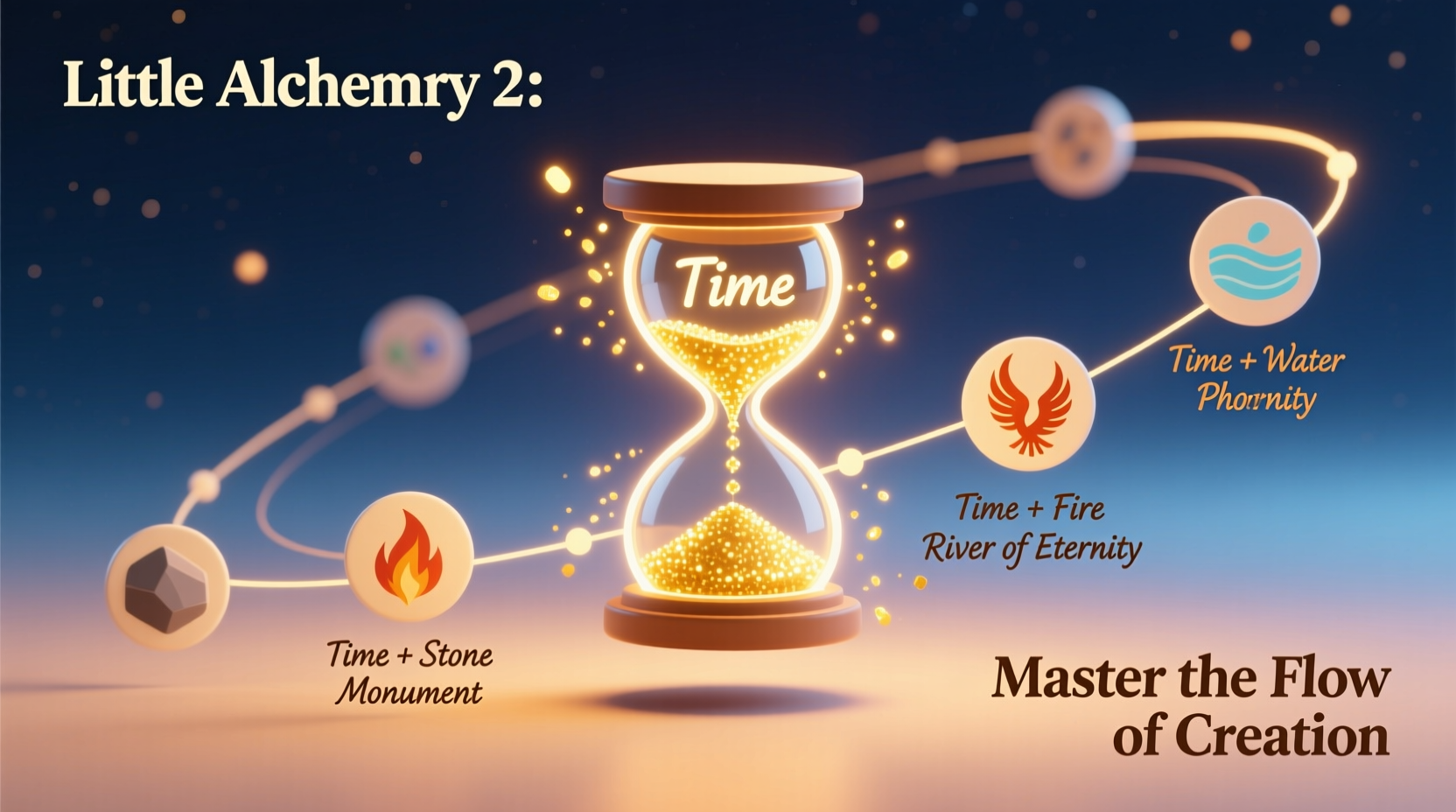
Time cannot be created directly from base elements like air or earth. Instead, it emerges through a sequence of logical combinations. The most reliable path involves first creating a Life-based element, then combining it with a celestial object. Here’s the exact progression:
- Create Life: Combine Swamp + Energy. (Swamp comes from Water + Earth; Energy from Air + Fire.)
- Create Human: Combine Life + Clay or Life + Beast. (Beast comes from Life + Forest.)
- Create Philosophy: Combine Human + Human or Human + Doubt.
- Create Universe: Combine Sky + Star or Planet + Planet.
- Create Time: Combine Philosophy + Universe.
This route may seem abstract, but it reflects the game’s thematic design—time as a human construct shaped by our understanding of the cosmos. There are alternative paths, such as combining Clock + Motion or Hourglass + Sand, but these require Time itself to already exist indirectly, making them circular without prior knowledge.
Creative Combinations Using Time
Once you’ve unlocked Time, its applications multiply rapidly. It functions both literally (as a physical force) and metaphorically (as change, aging, or history). Below are some of the most useful and imaginative combinations:
- Time + Human = Story (a narrative formed over time)
- Time + Plant = Tree (natural growth process)
- Time + Bacteria = Evolution (biological development)
- Time + Mountain = Erosion (geological transformation)
- Time + Idea = History (recorded human thought)
- Time + Tool = Machine (technological progress)
- Time + Hero = Legend (mythologized figure)
- Time + Future = Immortality (transcendence of mortality)
These combinations show how Time acts as a catalyst for transformation. It doesn’t just measure duration—it enables evolution, decay, legacy, and innovation.
Essential Do’s and Don’ts When Working With Time
Because Time interacts with so many categories—organic, mechanical, abstract—missteps can waste attempts. Use this table to avoid common pitfalls and maximize discovery.
| Do | Don't |
|---|---|
| Combine Time with living things to see evolutionary results (e.g., Time + Dinosaur = Fossil) | Try combining Time with basic elements like Water or Air—they rarely yield anything new |
| Use Time with abstract concepts like Love, Fear, or Success to generate cultural ideas | Assume Time only works with mechanical objects like clocks |
| Experiment with Time + Future or Time + Past to access philosophical layers | Ignore failed combinations—some only work after unlocking related elements |
| Pair Time with tools or machines to simulate technological advancement | Expect immediate results—some combinations require intermediate steps |
Real Example: Unlocking \"Immortality\" Through Strategic Play
Sophia, an avid Little Alchemy 2 player, had been stuck at 372 elements for weeks. She couldn’t unlock “Immortality,” which was blocking her progress toward “Elixir” and “Philosopher’s Stone.” After researching, she realized she needed both “Future” and “Time.”
She already had Future (created from Tomorrow + Tomorrow), but lacked Time. Tracing backward, she discovered she hadn’t yet made Philosophy. She focused on building that chain: first crafting Human (Life + Clay), then Philosophy (Human + Human). With Philosophy in hand, she combined it with Universe (Planet + Planet) to finally get Time.
The moment she combined Time + Future, the game revealed “Immortality.” From there, she quickly progressed to “Elixir” (Immortality + Medicine) and eventually “Philosopher’s Stone.” Her breakthrough came not from random clicking, but from understanding elemental dependencies—a lesson in patience and logic.
“Time isn’t just another element—it’s the bridge between biology and civilization. Players who master it gain access to the deepest layers of the game’s narrative structure.” — Dr. Alan Reyes, Game Design Analyst
Advanced Tips for Maximizing Time-Based Discoveries
To go beyond basic combinations, adopt a thematic approach. Think about what Time represents in each context:
- Natural World: Time + Seed = Tree; Time + River = Canyon
- Technology: Time + Wheel = Clock; Time + Computer = Artificial Intelligence
- Culture: Time + Music = Song; Time + War = Peace
- Myth & Spirituality: Time + God = Eternity; Time + Ghost = Past
A particularly rewarding path is using Time to explore existential themes. For example:
- Create Death (Life + Gun or Life + Corpse)
- Combine Death + Time = Funeral
- Funeral + Time = Memory
- Memory + Time = Nostalgia
This sequence illustrates how emotional concepts emerge from temporal experience—adding depth beyond mere gameplay mechanics.
Frequently Asked Questions
Can I make Time without creating Philosophy?
Not in the standard gameplay. While mods or glitches may offer shortcuts, the intended path requires Philosophy + Universe. Alternatives like Clock + Motion are only possible after obtaining Clock via other Time-dependent routes.
What is the most surprising combination with Time?
Time + Lizard = Crocodile. It seems odd until you consider evolution—over millions of years, reptiles adapted into crocodilians. Similarly, Time + Wolf = Dog highlights domestication over generations.
Why does Time + Human create Story instead of something like Age or Old?
The developers emphasize narrative and cultural development. “Story” reflects how humans encode experiences across time. “Old” is actually created via Human + Time + Time (or Human + Elderly, which may require additional steps).
Conclusion: Turn Minutes Into Mastery
Time in Little Alchemy 2 is not just an element—it’s a mindset. It rewards players who think in terms of processes, consequences, and long-term change. By mastering its creation and exploring its combinations, you don’t just unlock new items; you engage with the game’s deeper themes of growth, memory, and human progress.
Start with the foundational path: build Life, shape Humanity, ponder Philosophy, gaze at the Universe, and finally, harness Time. From there, let curiosity guide you. Mix Time with unexpected partners. See what evolves. The most satisfying discoveries aren’t handed out—they’re earned through experimentation and insight.




 浙公网安备
33010002000092号
浙公网安备
33010002000092号 浙B2-20120091-4
Comments
No comments yet. Why don't you start the discussion?