
The pronoun “me” is one of the most frequently used words in English, yet it’s often misused—especially in compound constructions or formal contexts. Whether you're drafting an email, speaking in a meeting, or introducing someone at a social event, using “me” correctly enhances clarity and credibility. Missteps like saying “Me and John went to the store” may seem minor, but they can subtly undermine your professionalism. Understanding when and how to use “me” properly isn’t about rigid grammar rules; it’s about communicating with precision and confidence.
Understanding Subject vs. Object Pronouns
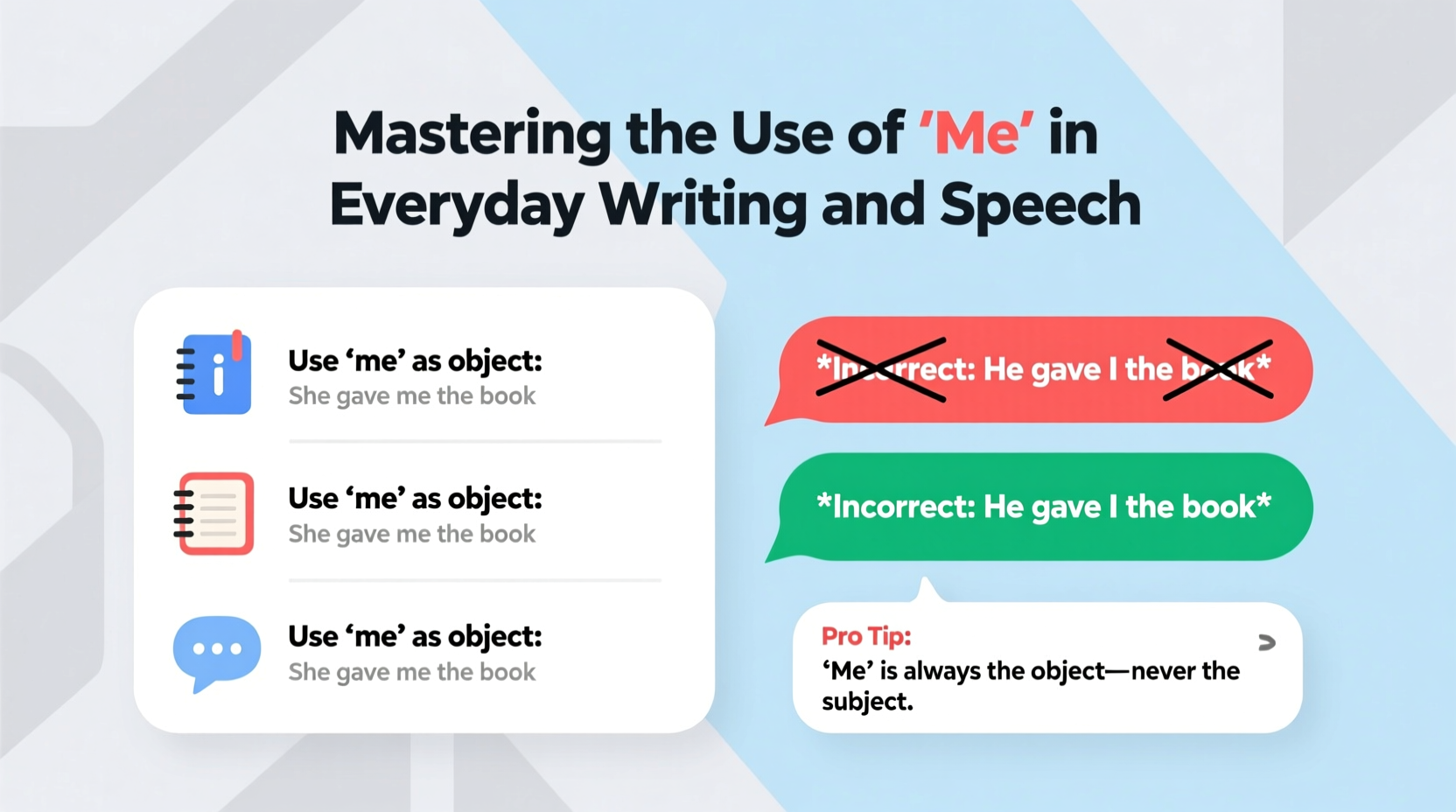
At the heart of many errors involving “me” is confusion between subject and object pronouns. In English, pronouns change form depending on their role in a sentence. “I” is a subject pronoun—it performs the action. “Me” is an object pronoun—it receives the action.
Consider these examples:
- Subject (correct): I called Sarah.
- Object (correct): Sarah called me.
- Incorrect: Sarah called I.
When multiple people are involved, the mistake becomes more common. For instance, “Me and John are going to lunch” incorrectly uses “me” as a subject. The correct version is “John and I are going to lunch.” A simple trick: remove the other person and test the sentence. Would you say “Me am going to lunch”? No—so “John and I” is correct.
Common Mistakes and How to Avoid Them
Even native speakers trip up on basic pronoun usage. Here are three of the most frequent errors involving “me,” along with strategies to avoid them.
1. Using “Me and…” at the Start of a Sentence
This is perhaps the most widespread mistake. Phrases like “Me and Sarah saw the movie” are informal and grammatically incorrect in standard English. The fix? Use “Sarah and I” instead—and place yourself last as a matter of politeness.
2. Overcorrection: Saying “Between You and I”
Some people, aware that “me” is sometimes wrong, swing too far in the opposite direction. “Between you and I” is a classic example of overcorrection. The word “between” is a preposition and requires an object pronoun. Therefore, “between you and me” is correct.
“Grammar errors aren’t just about rules—they reflect how clearly we present our thoughts. Precision with pronouns builds trust.” — Dr. Linda Harper, Linguistics Professor, University of Toronto
3. Misplacing “Me” in Compound Objects
When listing multiple recipients of an action, “me” should still be in the object form—but often gets buried. Example: “The manager gave the report to Sarah and I.” Correct: “The manager gave the report to Sarah and me.” Again, test by removing the other person: “The manager gave the report to I” sounds wrong, confirming the need for “me.”
Do’s and Don’ts: Quick Reference Table
| Context | Correct Usage | Incorrect Usage |
|---|---|---|
| Subject of sentence | My brother and I went hiking. | Me and my brother went hiking. |
| Object after verb | The teacher praised Maria and me. | The teacher praised Maria and I. |
| After preposition | This gift is for you and me. | This gift is for you and I. |
| Informal response | Yes, it’s me. | Yes, it’s I. |
Note: While “It is I” is technically correct in formal grammar, “It’s me” is widely accepted in modern spoken and written English.
Step-by-Step Guide to Using “Me” Correctly
Follow this five-step process to ensure you’re using “me” appropriately every time:
- Identify the role of the pronoun. Is it performing the action (subject) or receiving it (object)?
- Remove other people from the sentence. Test the sentence with only “I” or “me.”
- Check for prepositions. Words like “to,” “for,” “with,” “between,” and “from” require object pronouns.
- Avoid hypercorrection. Just because “I” sounds more formal doesn’t mean it’s always right.
- Read aloud. If it sounds awkward or unnatural, reconsider the structure.
Real-World Example: A Professional Email
Imagine you’re writing to a client and want to say:
“Sarah and me will be handling your account moving forward.”
This might sound natural, but it’s incorrect. “Sarah and me” is the subject of the sentence (“will be handling”), so the correct version is:
“Sarah and I will be handling your account moving forward.”
Now consider a different scenario—responding to feedback:
“Thank you for sending the notes to David and I.”
Here, “to” is a preposition, so the object pronoun is required. Correct: “Thank you for sending the notes to David and me.”
These small changes make a big difference in tone and professionalism.
Frequently Asked Questions
Is “It’s me” grammatically correct?
Technically, “It is I” follows traditional grammar rules because “I” is a predicate nominative. However, “It’s me” is universally accepted in modern English and sounds more natural in conversation. Most style guides now recognize both as acceptable, with “It’s me” preferred in everyday use.
Why do people say “Me and John” instead of “John and I”?
This stems from early language acquisition. Children often hear phrases like “Me want cookie” and later mimic compound structures without understanding grammatical roles. Additionally, some mistakenly believe that “John and I” is always correct due to overexposure in corrected speech, leading to confusion about when each form applies.
Can “me” ever be used as a subject?
In standard English, no. “Me” is strictly an object pronoun. However, in certain dialects and informal speech, “me” appears in subject position (e.g., “Me and him went out”). While this reflects linguistic variation, it’s not appropriate in formal writing or professional settings.
Final Checklist for Confident Pronoun Use
- ✅ Always test the sentence with just “I” or “me”
- ✅ Place yourself last in compound subjects/objects (e.g., “Sarah and me”)
- ✅ Remember: prepositions take object pronouns (“with me,” not “with I”)
- ✅ Avoid overcorrecting—“between you and I” is wrong
- ✅ Accept “It’s me” as standard in spoken and informal written English
Conclusion: Speak with Clarity and Confidence
Mastering the use of “me” isn’t about perfectionism—it’s about respect for your audience and pride in your communication. Whether you’re writing a cover letter, giving a presentation, or chatting with friends, choosing the right pronoun helps you express yourself clearly and authentically. Grammar isn’t a barrier to natural speech; it’s a tool that sharpens it. With practice, these rules become second nature, freeing you to focus on what really matters: your message.




 浙公网安备
33010002000092号
浙公网安备
33010002000092号 浙B2-20120091-4
Comments
No comments yet. Why don't you start the discussion?