
The letter \"w\" may seem unassuming, but its role in English writing is both subtle and significant. From shaping the rhythm of sentences to influencing tone and readability, mastering how \"w\" functions—both as a phonetic element and within word choice—can elevate your writing from functional to fluid. Whether you're drafting professional emails, crafting compelling copy, or editing long-form content, understanding how to leverage words beginning with \"w\" and the sound patterns they create leads to clearer, more persuasive communication.
This guide explores the strategic use of \"w\" through linguistic insight, structural techniques, and real-world application. You'll learn not just what works—but why it works—and how to apply these principles across different writing styles.
Understanding the Weight of Words Starting with W
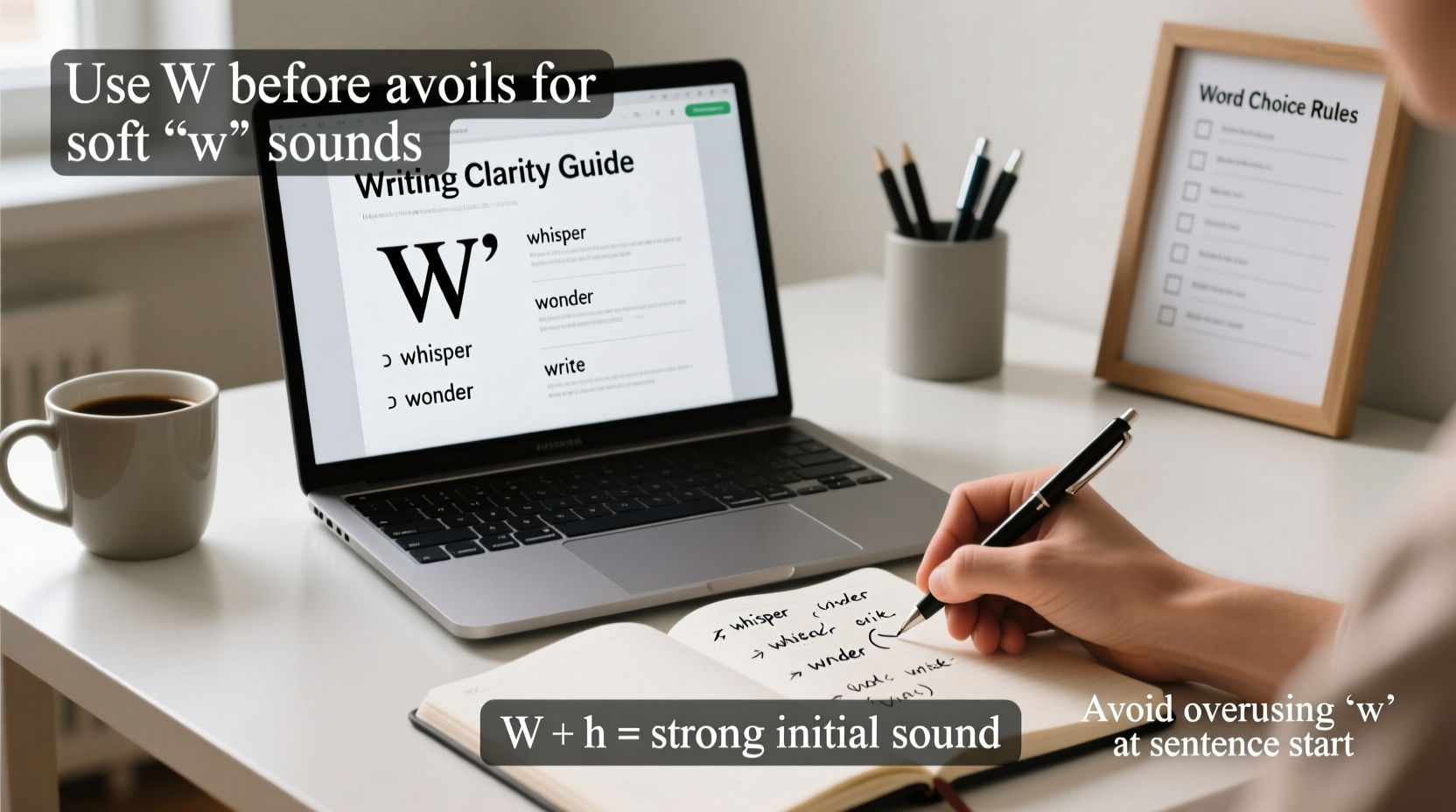
Words that begin with \"w\" often carry a soft, rolling onset that can influence the mood and pacing of your prose. Consider the difference between \"walked swiftly\" and \"wandered slowly.\" The alliteration and vowel-consonant blend in \"wandered slowly\" creates a smoother, more reflective tone. This isn't accidental—it's linguistic design.
In rhetoric and composition, writers have long used the sonic qualities of words to evoke emotion. The \"w\" sound, produced with rounded lips and a gentle airflow, tends to feel warm, welcoming, or even whimsical. That’s why brands like WhatsApp, Wikipedia, and Webflow use it prominently: it signals approachability and connectivity.
When to Lean Into the 'W' Sound
- Narrative flow: Use \"w\"-initial words to maintain a steady rhythm in descriptive passages.
- Empathy-building: In customer service or leadership communication, \"w\" words like \"we,\" \"welcome,\" \"worth,\" and \"wish\" foster inclusion.
- Call-to-action phrasing: “Want to learn more?” feels less aggressive than “Click now.”
Strategic Placement of Key 'W' Words
Certain high-impact \"w\" words serve as anchors in effective writing. These include \"what,\" \"why,\" \"when,\" \"where,\" \"who,\" and \"how\"—collectively known as the Five Ws (and one H). Mastering their use ensures completeness and clarity in reporting, storytelling, and instructional content.
| Word | Purpose | Best Used In |
|---|---|---|
| What | Defines subject or action | Problem statements, product descriptions |
| Why | Explains motivation or cause | Persuasive writing, mission statements |
| When | Specifies timing | Announcements, timelines, instructions |
| Where | Indicates location | Event details, logistical guidance |
| Who | Identifies people involved | Profiles, team introductions, accountability |
| How | Describes process or method | Tutorials, technical documentation |
“The Five Ws are the skeleton of clarity. Miss one, and your reader stumbles.” — Dr. Linda Reeves, Communication Professor at Boston University
Step-by-Step Guide to Auditing Your Use of 'W'
Improving your use of \"w\" starts with awareness. Follow this five-step audit to refine your writing for better flow and precision.
- Collect a sample: Choose a recent piece of your writing—email, blog post, report.
- Highlight all words starting with 'w': Use a digital highlighter or print and mark manually.
- Analyze frequency and placement: Are \"w\" words clustered at the start of sentences? Do they appear mostly in questions?
- Evaluate tone impact: Do these words contribute to warmth, vagueness, or redundancy? For example, overusing “well” or “wow” can weaken authority.
- Edit strategically: Replace weak \"w\" words (e.g., “was,” “were”) with stronger verbs when possible. Retain those that enhance clarity or connection.
Avoiding Common Pitfalls
- Overuse of passive voice: “The work was completed by Wednesday” vs. “We completed the work by Wednesday.” Active voice strengthens accountability.
- Vague openers: Starting multiple sentences with “While…” or “When…” can dilute focus. Vary sentence structure.
- Filler reliance: Words like “well,” “wow,” or “whatever” in formal writing reduce professionalism.
Real Example: Transforming a Weak Message
Consider this poorly constructed internal memo:
Well, we were thinking about changing the workflow, and while it might be good, we weren’t sure when it would happen or who would do what. We wanted to know if you wanted to talk about it.
The message is hesitant, lacks ownership, and avoids specifics. Now, observe the revised version using intentional \"w\" word placement:
We are updating the workflow to improve efficiency. The change begins next Monday. Each team lead will receive their responsibilities by Friday. What questions do you have? We welcome your input before finalizing.
The revision uses \"we\" to assert unity, \"when\" for clarity, and ends with an engaging \"what\" question. The tone remains collaborative but confident.
Checklist: Optimizing 'W' in Your Writing
Use this checklist before publishing any written piece:
- ✅ Have I answered all Five Ws where relevant?
- ✅ Is \"we\" used appropriately to build connection without avoiding responsibility?
- ✅ Are words like \"was,\" \"were,\" or \"will\" paired with strong verbs or context?
- ✅ Have I minimized filler words like \"well\" or \"wow\" in formal contexts?
- ✅ Do my opening lines use \"w\" words purposefully—not habitually?
- ✅ Does the rhythm of sentences benefit from the softness of \"w\" sounds where needed?
Frequently Asked Questions
Is it bad to start many sentences with 'w' words?
Not inherently, but overuse creates monotony. If three consecutive sentences begin with \"when,\" \"while,\" or \"we,\" revise for variety. Mix in shorter statements or restructure for impact.
How can I make my writing sound warmer without being unprofessional?
Incorporate inclusive \"w\" words like \"we,\" \"welcome,\" and \"want\" sparingly. Phrases such as “We appreciate your time” or “What matters to you matters to us” balance warmth and polish.
Are there industry-specific considerations for using 'w'?
Yes. In legal or technical writing, prioritize precision over phonetic appeal—favor “will” over “would” for certainty. In marketing or UX copy, the soothing quality of \"w\" can enhance user experience, e.g., “Welcome back” or “What’s new?”
Conclusion: Write with Purpose, Not Just Sound
Mastering the use of \"w\" isn’t about chasing alliteration or poetic flair alone—it’s about intentionality. Every word shapes perception, and the humble \"w\" carries disproportionate influence in setting tone, building rapport, and ensuring clarity. By auditing your usage, applying strategic replacements, and aligning word choice with purpose, you transform ordinary sentences into effective communication.




 浙公网安备
33010002000092号
浙公网安备
33010002000092号 浙B2-20120091-4
Comments
No comments yet. Why don't you start the discussion?