
Clear and accurate pronunciation is essential for effective communication, especially when it comes to sounds that are easily misarticulated. The \"v\" sound—voiced labiodental fricative—is one such phoneme that often trips up both language learners and native speakers. Whether you're refining your accent, improving public speaking skills, or overcoming a speech impediment, mastering the \"v\" sound can significantly enhance your clarity and confidence. Unlike its unvoiced counterpart \"f,\" the \"v\" requires precise coordination between the lower lip and upper teeth, along with consistent vocal cord vibration. This guide breaks down practical strategies, exercises, and real-world applications to help you produce the \"v\" sound correctly and consistently.
The Anatomy of the V Sound
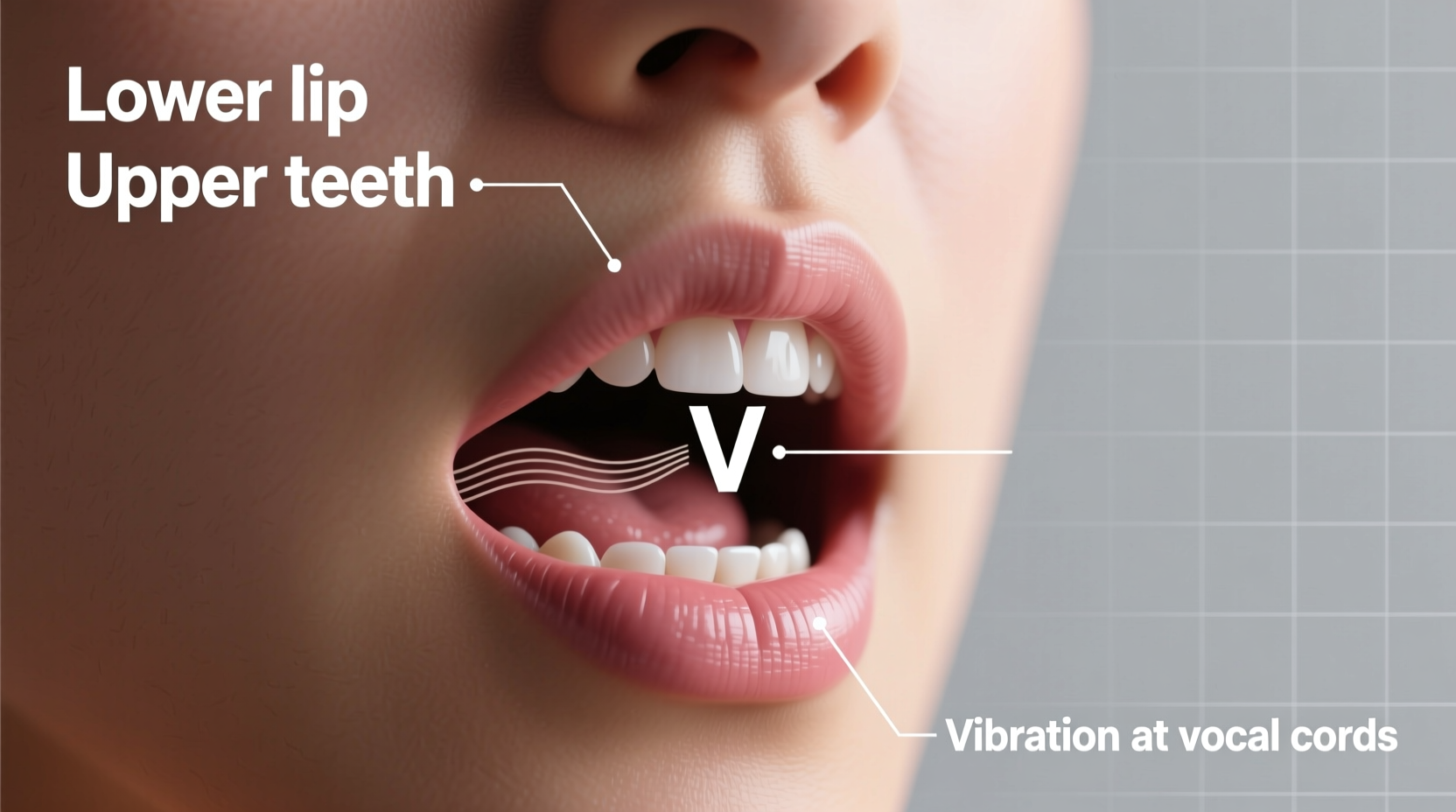
The \"v\" sound is produced by placing the bottom lip lightly against the edge of the upper front teeth. As air passes through the narrow gap, friction is created, producing a soft buzzing sound. Crucially, this sound is voiced—meaning your vocal cords must vibrate during production. A common mistake is substituting the \"v\" with an \"f,\" which uses the same mouth position but lacks vocalization.
To test whether you're voicing the sound correctly, place your fingers gently on your throat while saying \"vvvv.\" You should feel a distinct vibration. If not, your vocal cords aren't engaged, and you're likely producing an \"f\" instead.
Common Challenges and Why They Occur
Several factors contribute to difficulty pronouncing the \"v\" clearly:
- Lack of awareness: Many people don’t realize they’re substituting \"v\" with \"w\" or \"f.\"
- Dialectal influence: Regional accents may naturally soften or alter the \"v\" sound.
- Muscle coordination: Weak or untrained articulators (lips, tongue) struggle with precision.
- Hearing perception: Inability to distinguish between similar sounds hinders self-correction.
Children and non-native English speakers are particularly prone to replacing \"v\" with \"w\"—for example, saying \"wery\" instead of \"very.\" This substitution occurs because the \"w\" sound is easier to produce, requiring only rounded lips without dental contact.
“Accurate articulation begins with auditory discrimination. If you can’t hear the difference between 'vine' and 'wine,' you won’t produce it correctly.” — Dr. Lena Torres, Speech-Language Pathologist
Step-by-Step Guide to Producing the V Sound
Follow this structured approach to train your mouth and ears for correct \"v\" pronunciation:
- Position your articulators: Place your upper teeth lightly on your lower lip. Do not bite down—just make light contact.
- Breathe out steadily: Allow a stream of air to pass between your teeth and lip, creating friction.
- Engage your voice: Turn on your vocal cords. You should feel a buzz in your throat. Try transitioning from a sustained \"z\" sound into \"v\" to maintain voicing.
- Practice in isolation: Repeat \"vvvvv\" for 10 seconds, focusing on consistency and vibration.
- Blend into syllables: Add vowels: \"va,\" \"ve,\" \"vi,\" \"vo,\" \"vu.\" Keep the lip-to-teeth contact steady.
- Use minimal pairs: Contrast \"v\" with \"f\" and \"w\": “vet vs. fet,” “vote vs. wote,” “vine vs. wine.”
- Incorporate into words: Start with simple words like “van,” “love,” “drive,” then progress to complex ones like “adventure” or “revival.”
Effective Exercises and Daily Practice Routine
Consistency is key. Integrate these exercises into a short daily routine (5–10 minutes):
| Exercise | Purpose | Frequency |
|---|---|---|
| Vibration Check (hand on throat) | Ensure voicing is active | Daily warm-up |
| Minimal Pair Drills | Train ear and mouth differentiation | 3x/week |
| Tongue Twisters | Improve speed and accuracy | |
| Daily | ||
| Shadowing Native Speakers | Build rhythm and intonation | 3x/week |
| Sentence Repetition | Contextualize the sound | Daily |
Try this tongue twister to sharpen precision: “Very vivid violets vibrate vibrantly in the valley.” Repeat slowly at first, then increase speed while maintaining clarity.
Mini Case Study: Overcoming a Lifelong Substitution
Jamal, a university student from Nigeria, had always pronounced \"very\" as \"wery\" and \"voice\" as \"woice.\" Despite strong grammar and vocabulary, his peers often misunderstood him during presentations. After consulting a speech coach, he began a six-week program focused on \"v\" sound production. He used a mirror to monitor lip placement, practiced minimal pairs with audio feedback, and recorded weekly progress videos. By week four, his classmates noticed improved clarity. By week six, he delivered a presentation without a single \"v/w\" error. His confidence soared, and he later joined the debate team.
Do’s and Don’ts When Practicing the V Sound
| Do’s | Don’ts |
|---|---|
| Keep your lower lip relaxed but in contact with upper teeth | Press too hard—this causes tension and distortion |
| Feel the vibration in your throat | Confuse \"v\" with \"f\" or \"w\" |
| Practice in front of a mirror to observe lip movement | Rush through words without isolating the sound |
| Use a metronome to pace repetition drills | Practice incorrectly without feedback |
| Start slow, then build speed gradually | Ignore auditory feedback from recordings |
Checklist: Mastering the V Sound in 30 Days
- ☐ Perform lip-teeth positioning check daily
- ☐ Practice isolated \"v\" sound for 2 minutes each morning
- ☐ Complete 3 sets of minimal pair drills (e.g., vine/wine, vet/wet, fan/van)
- ☐ Record yourself reading a paragraph containing at least 10 \"v\" words
- ☐ Listen to and imitate a native speaker’s \"v\" pronunciation
- ☐ Use a hand-on-throat technique to confirm voicing
- ☐ Review progress every Sunday and adjust focus if needed
Frequently Asked Questions
Why do I keep saying “w” instead of “v”?
This substitution is common among speakers whose native languages lack the \"v\" sound or use \"w\" in similar contexts. The \"w\" requires rounded lips but no dental contact, making it easier to produce. Retraining involves building muscle memory for lip-teeth placement and reinforcing vocalization through auditory feedback.
Can adults really change their pronunciation habits?
Yes. While childhood is ideal for acquiring new sounds, adults can retrain speech patterns with consistent practice. Neuroplasticity allows the brain to adapt, especially when combining auditory training, physical articulation exercises, and regular feedback.
Is the “v” sound the same in all English dialects?
Most standard dialects (American, British, Australian) produce the \"v\" similarly. However, some regional accents may weaken or drop the sound in fast speech (e.g., Cockney dropping consonants). For clear communication, aim for the standard voiced labiodental fricative as taught in ESL and speech therapy contexts.
Final Thoughts and Call to Action
Mastering the \"v\" sound is more than correcting a single letter—it's about taking control of your spoken clarity and ensuring your message is received exactly as intended. Whether you're preparing for a job interview, giving a speech, or simply want to be better understood in daily conversation, precise pronunciation builds credibility and confidence. The techniques outlined here—positioning, voicing, minimal pairs, and consistent practice—are proven methods used by linguists, actors, and speech therapists worldwide.




 浙公网安备
33010002000092号
浙公网安备
33010002000092号 浙B2-20120091-4
Comments
No comments yet. Why don't you start the discussion?