
Understanding time is one of the first practical skills learners acquire when studying English. Whether you're teaching a new student or learning yourself, being able to read and express time correctly builds confidence and supports daily communication. The clock may seem straightforward, but its expressions in English can confuse beginners due to variations like \"half past,\" \"quarter to,\" and 12-hour formatting. This guide breaks down everything clearly, using structured explanations, real-life examples, and actionable tips to help anyone master telling time in English.
Understanding the Basics: Analog vs. Digital Clocks
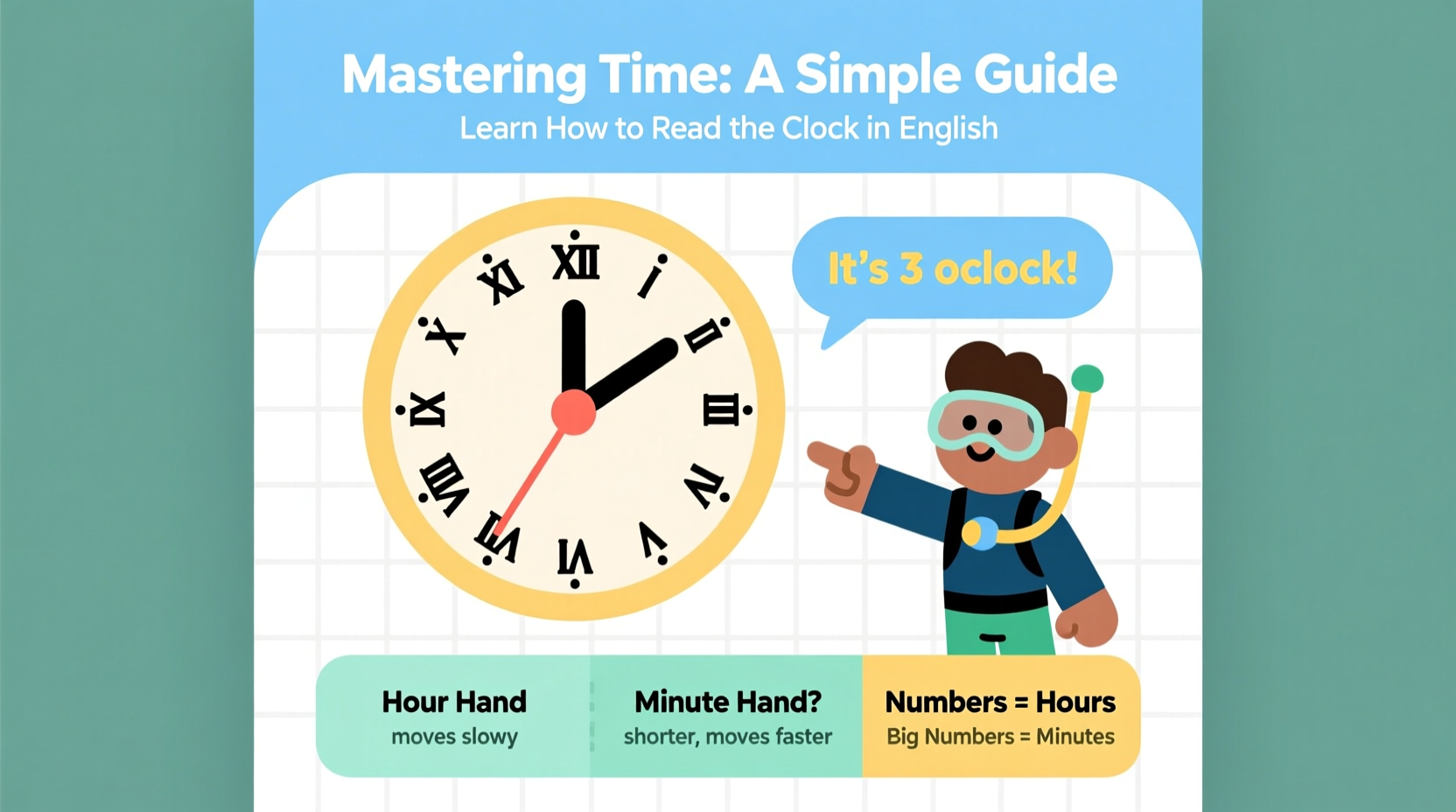
Beginners often encounter two types of clocks: analog and digital. While digital displays show time numerically (e.g., 3:45), analog clocks use hour and minute hands circling a numbered face. Most foundational English lessons start with analog clocks because they visually reinforce concepts like \"past\" and \"to\" the hour.
The clock face has numbers from 1 to 12, representing both hours and five-minute intervals. The short hand indicates the hour; the long hand shows the minutes. When the minute hand points at 12, it’s “o’clock.” At 3, it’s “quarter past” (15 minutes). At 6, it’s “half past” (30 minutes). At 9, it’s “quarter to” the next hour (45 minutes).
Common Ways to Express Time in English
English uses several formats to describe time, depending on context and formality. Here are the most common structures:
- O’clock: Used only for exact hours (e.g., 7 o’clock).
- Past: Minutes after the hour (e.g., ten past six = 6:10).
- To: Minutes before the next hour (e.g., twenty to eight = 7:40).
- AM/PM: Indicates morning (AM) or night (PM) in the 12-hour system.
- Colon format: Direct numeric expression (e.g., 4:23).
While native speakers often mix these forms, learners benefit from mastering one system at a time. For example, saying \"It's five past nine\" is more natural than \"nine zero five\" in casual speech, though both are correct.
Step-by-Step Guide to Reading an Analog Clock
- Identify the hour hand – the shorter one. Note which number it’s closest to or has just passed.
- Check the minute hand – the longer one. Count each number as five minutes (1 = 5 min, 2 = 10 min, etc.).
- Determine if it’s past or to the hour: If the minute hand is between 1–6, use “past”; between 7–11, use “to” the next hour.
- Use appropriate phrases: Apply “quarter past,” “half past,” or “quarter to” where applicable.
- Add AM or PM based on context (morning or evening).
Do’s and Don’ts When Teaching Time in English
| Do’s | Don’ts |
|---|---|
| Use consistent phrasing: “It’s half past four,” not “It’s four thirty” until later stages. | Don’t introduce 24-hour time too early—it adds confusion. |
| Practice with visual aids like blank clock faces students can draw on. | Avoid mixing British and American terms without explanation (e.g., “half four” in some dialects means 4:30, but this is rare and confusing). |
| Encourage speaking aloud: “The time is quarter to seven.” | Don’t skip AM/PM clarification—learners might say “I wake up at 7” without specifying morning. |
| Relate time to daily routines: “I eat lunch at half past twelve.” | Don’t over-correct pronunciation during initial practice—focus on meaning first. |
Real-Life Example: Maria Learns to Tell Time
Maria, a beginner ESL student from Colombia, struggled with time expressions despite knowing numbers well. Her teacher started with a paper clock she could manipulate. First, they practiced o’clock times: “It’s three o’clock.” Then, they moved to half past: “The long hand is at 6, so it’s half past three.” After a week, Maria could confidently say “It’s quarter to five” when seeing 4:45.
The breakthrough came when her teacher linked time to her routine: “You take the bus at twenty past seven. That’s 7:20.” By associating language with personal experience, Maria retained the structure naturally. Within three weeks, she was reading clocks accurately and even corrected her child’s homework in English.
“Linking time-telling to personal routines increases retention by over 60% in adult learners.” — Dr. Laura Simmons, Applied Linguistics Researcher, University of Manchester
Essential Checklist for Teaching or Learning Clock Time
Whether you’re a teacher creating a lesson plan or a self-studying learner, follow this checklist to ensure steady progress:
- ✅ Master numbers 1–60 fluently.
- ✅ Recognize clock numbers as both hours and five-minute markers.
- ✅ Learn key phrases: o’clock, past, to, half past, quarter past, quarter to.
- ✅ Distinguish between AM (midnight to noon) and PM (noon to midnight).
- ✅ Practice with real clocks or printable worksheets daily for 10–15 minutes.
- ✅ Use full sentences: “It is ten minutes past nine.”
- ✅ Review common mistakes: “It’s not ‘nine fifteen,’ it’s ‘quarter past nine.’”
Frequently Asked Questions
Why do we say “half past” instead of “thirty”?
In spoken English, especially in informal or British contexts, “half past” is more natural than stating the minutes directly. It’s part of idiomatic usage. While “nine thirty” is correct, “half past nine” flows better in conversation. Learners should know both but prioritize “half past” initially for fluency.
Is “quarter after” used in English?
Yes, particularly in American English. “Quarter after six” means the same as “quarter past six” (6:15). However, “quarter past” is more widely taught internationally and understood globally. Stick with “past” and “to” unless your environment uses “after” and “of” frequently.
How do I explain AM and PM to a beginner?
Use simple associations: AM = “After Midnight” to “Before Noon” (morning/day). PM = “Post Meridiem” (after midday) through evening/night. Visuals help: draw a sun rising for AM (6 AM = sunrise), and a moon for PM (8 PM = bedtime). Avoid Latin terms; focus on daily life cues.
Conclusion: Turn Time into a Teaching Triumph
Telling time may seem minor, but it’s a cornerstone of functional English. With clear steps, consistent practice, and real-world application, any beginner can master clock reading in weeks, not months. The key lies in simplicity—start small, build gradually, and connect every phrase to lived experience. Whether you're guiding a classroom or learning alone, remember that precision with time reflects growing confidence in the language.




 浙公网安备
33010002000092号
浙公网安备
33010002000092号 浙B2-20120091-4
Comments
No comments yet. Why don't you start the discussion?