
Time is everywhere—on walls, towers, watches, and smartphones. Yet, some clocks still use an ancient system: Roman numerals. While elegant and timeless, they can be puzzling at first glance. Unlike Arabic numbers (1, 2, 3), Roman numerals rely on letters from the Latin alphabet to represent values. Understanding them isn’t just useful for telling time—it’s a small but meaningful skill that connects you to centuries of tradition, architecture, and design.
Whether you’re standing beneath a grand clock tower or admiring a vintage wristwatch, being able to read Roman numerals confidently enhances your appreciation of craftsmanship and history. The good news? It’s easier than it looks. With a few foundational rules and consistent practice, anyone can master this skill in less than an hour.
The Basics of Roman Numerals
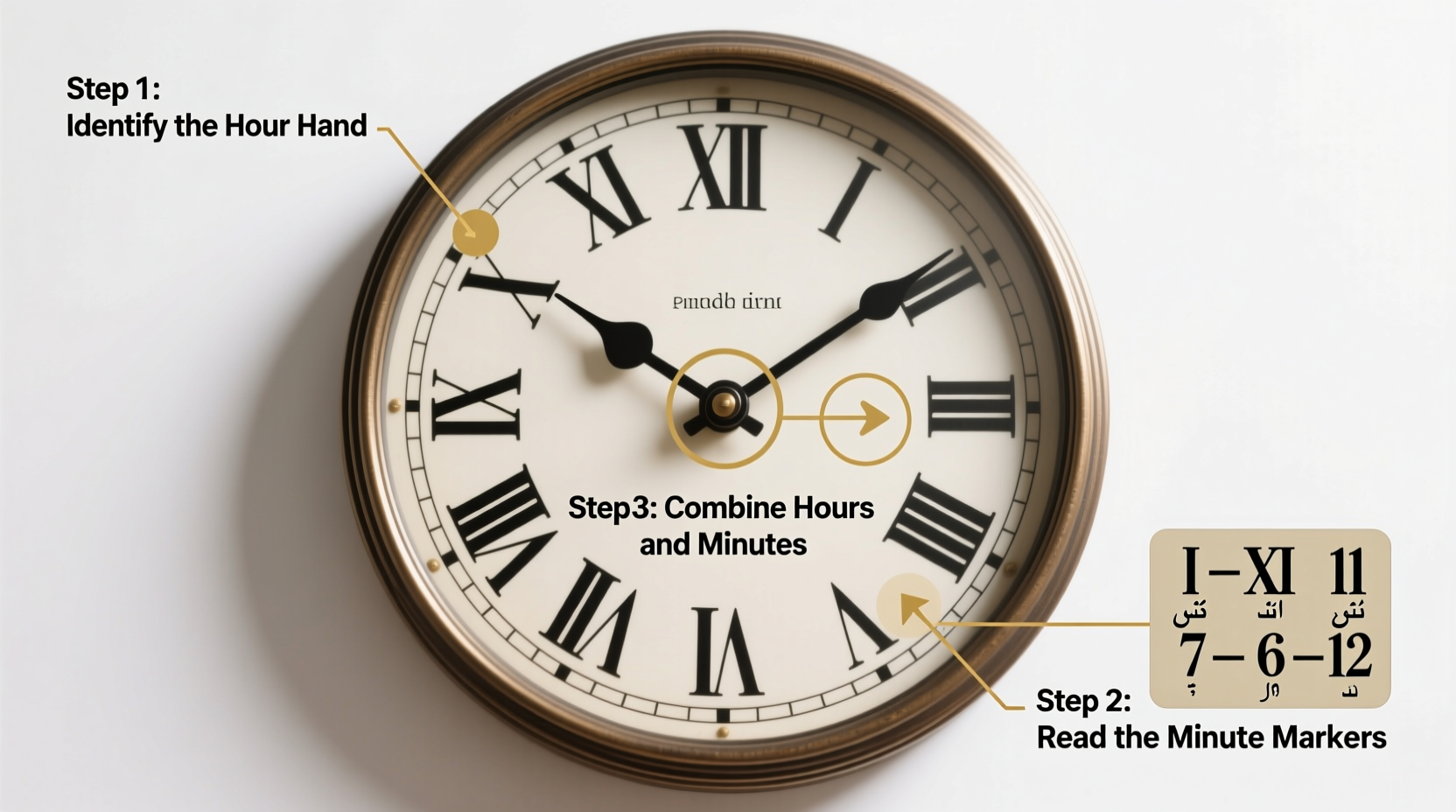
Roman numerals are built from seven basic symbols, each representing a specific value:
| Symbol | Value |
|---|---|
| I | 1 |
| V | 5 |
| X | 10 |
| L | 50 |
| C | 100 |
| D | 500 |
| M | 1000 |
On most clocks, only the first four symbols—I, V, X, and L—are used, since the numbers range from 1 to 12. These symbols follow two primary rules:
- Addition Rule: When a smaller numeral appears after a larger one, add their values. For example, VI = 5 + 1 = 6.
- Subtraction Rule: When a smaller numeral precedes a larger one, subtract it. For instance, IV = 5 – 1 = 4.
This subtraction rule explains why the number 4 is often written as IV instead of IIII on modern clocks—though historically, both forms were used. In fact, many traditional clock faces still use “IIII” for 4, possibly for symmetry or visual balance.
Step-by-Step Guide to Reading Clocks with Roman Numerals
Reading a Roman numeral clock doesn’t require memorizing complex conversions. Follow these five steps to interpret any time accurately.
- Identify the numerals around the clock face. Start by observing the layout. Most clocks place XII at the top, VI at the bottom, IX on the left, and III on the right. Use these anchor points to orient yourself.
- Learn the positions from I to XII. Memorize the Roman equivalents:
- I = 1
- II = 2
- III = 3
- IV or IIII = 4
- V = 5
- VI = 6
- VII = 7
- VIII = 8
- IX = 9
- X = 10
- XI = 11
- XII = 12
- Locate the hour hand. Determine which numeral it’s closest to. If it’s between two numerals, round down unless it’s clearly past the halfway point.
- Read the minute hand as usual. Each number represents five minutes. Multiply the numeral’s value by five to get the minute count. For example, if the minute hand points to III, it’s 15 minutes past the hour (3 × 5).
- Combine hour and minute readings. Say the hour first, then the minutes. If the hour hand is near VIII and the minute hand points to VI, the time is 8:30.
Common Pitfalls and How to Avoid Them
Even experienced readers occasionally misread Roman numerals due to subtle inconsistencies or unfamiliar formatting. Here are frequent mistakes and how to prevent them:
| Pitfall | Solution |
|---|---|
| Misreading IV as 6 (interpreting I before V as addition) | Remember: when a smaller numeral comes before a larger one, subtract. IV = 4, not 6. |
| Confusing VIII (8) with IIII (4) due to visual similarity | Count the strokes: VIII has three I’s after V; IIII has four I’s without V. |
| Assuming all clocks use IV for 4 | Be open to seeing IIII—especially on older or decorative clocks. |
Real-World Example: A Visit to Big Ben
Imagine standing in London’s Parliament Square, gazing up at the iconic Elizabeth Tower—commonly known as Big Ben. Its four clock faces display Roman numerals, and it’s currently just past the hour. The hour hand hovers slightly past the “II,” while the minute hand points directly to “X.”
You recognize “II” as 2 and “X” as 10. Since each number represents five minutes, 10 × 5 = 50. The time is 2:50. Moments later, the great bell chimes twice—confirming the hour. There’s a quiet satisfaction in decoding time using a system over two thousand years old, especially when it’s embedded in such a historic landmark.
This experience isn’t limited to travelers. Many homes, schools, and offices feature Roman numeral clocks. Once you’ve mastered the basics, reading them becomes second nature.
Expert Insight: Why Roman Numerals Still Matter
“Roman numerals may seem outdated, but they endure because they convey dignity, permanence, and craftsmanship. Learning to read them is like unlocking a hidden layer of cultural literacy.” — Dr. Alan Prescott, Historian of Timekeeping Instruments
Prescott notes that luxury watchmakers like Patek Philippe and Jaeger LeCoultre continue using Roman numerals not just for aesthetics, but to signal precision and heritage. The design also improves legibility on certain dials, where symmetrical numerals balance the visual weight of the clock face.
Quick Mastery Checklist
To build fluency quickly, follow this actionable checklist:
- ✅ Memorize I through XII and their corresponding values.
- ✅ Understand the subtraction principle (IV = 4, IX = 9).
- ✅ Recognize that IIII may be used instead of IV.
- ✅ Practice identifying numerals on actual clock images.
- ✅ Read the hour hand first, then multiply the minute numeral by five.
- ✅ Test yourself daily with a new clock face for one week.
Frequently Asked Questions
Why do some clocks use IIII instead of IV for 4?
There’s no single definitive answer, but theories include aesthetic symmetry (balancing IIII with VIII), historical precedent, and ease of reading for non-literate populations. Clockmakers in the 18th and 19th centuries often preferred IIII for visual harmony.
Is there a Roman numeral for zero?
No. The Roman numeral system does not include a symbol for zero. This reflects the ancient world’s different conceptualization of mathematics, where zero was not treated as a number in its own right.
Can Roman numerals represent minutes and seconds?
While Roman numerals denote hours on clock faces, minutes and seconds are typically measured using standard numeric divisions. The hands move continuously, so intermediate times (like 2:17) are interpreted using the same method as Arabic-numbered clocks—just with Roman numerals marking the hours.
Conclusion: Make Time Your Ally
Mastering Roman numerals on clocks is more than a quirky skill—it’s a bridge between past and present, function and form. With just a few minutes of focused learning, you gain the ability to read some of the world’s most iconic timepieces with confidence and clarity. Whether you're navigating a European city, appreciating antique furniture, or simply curious about design traditions, this knowledge enriches your daily experience.
Time waits for no one, but understanding how we measure it gives us greater control over our moments. Start today: find a Roman numeral clock, apply what you've learned, and enjoy the quiet pride of reading time the classical way.




 浙公网安备
33010002000092号
浙公网安备
33010002000092号 浙B2-20120091-4
Comments
No comments yet. Why don't you start the discussion?