
Integration is one of the cornerstones of calculus, but many students hit a wall when faced with complex integrands. U-substitution—also known as integration by substitution—is a powerful technique that simplifies integrals by transforming them into more manageable forms. The key to success lies not in memorizing formulas, but in learning how to choose the right u. This guide breaks down the logic, patterns, and strategies behind effective u-substitution so you can approach any integral with confidence.
Understanding the Role of 'u' in Integration
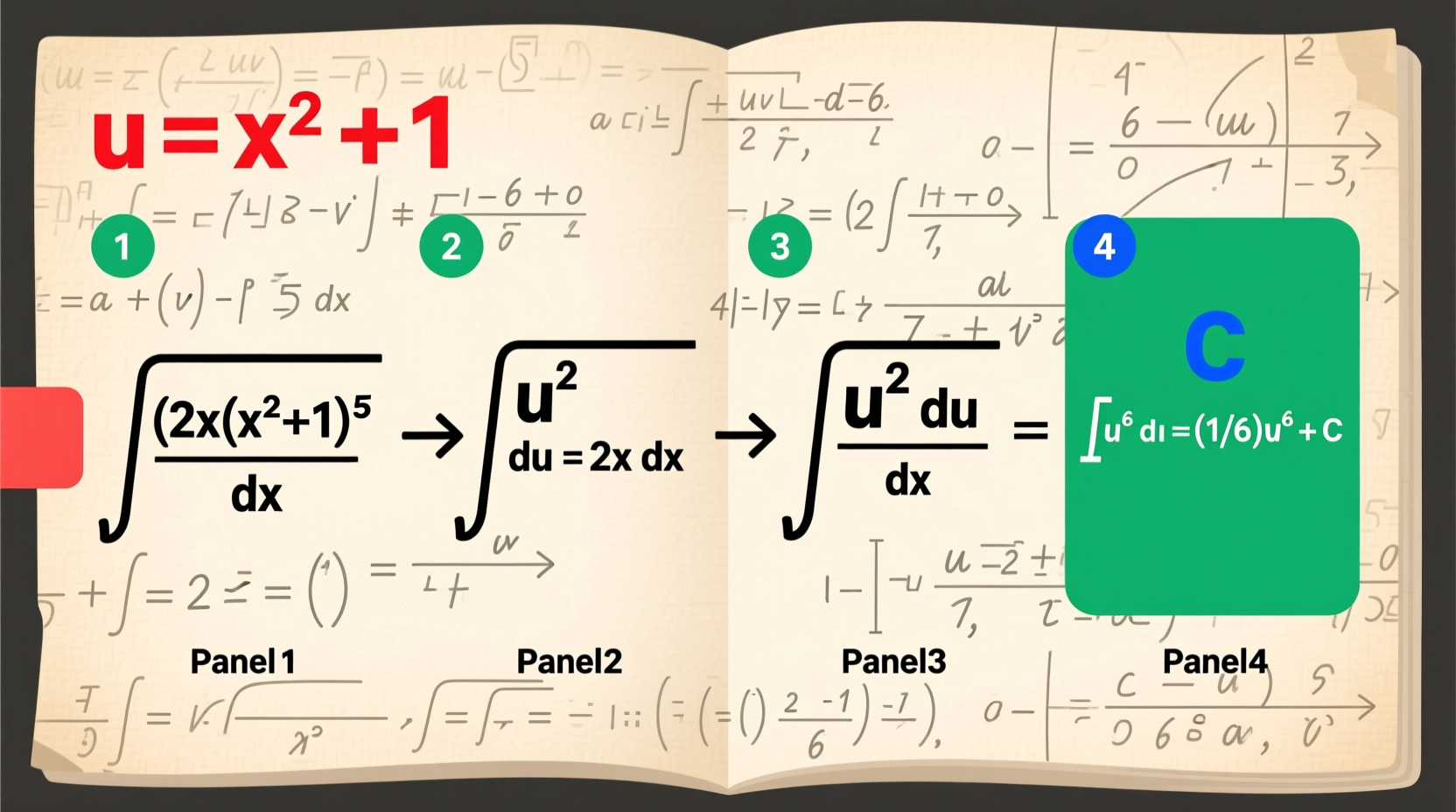
At its core, u-substitution reverses the chain rule from differentiation. When you have a composite function—say, f(g(x)) multiplied by the derivative of the inner function g'(x)—you’re looking at a prime candidate for substitution. The goal is to let u = g(x), which transforms the integral into a simpler form involving only u and du.
The substitution works because:
- du = g'(x) dx
- This allows us to replace both g(x) and dx in terms of u and du
- The resulting integral becomes easier to evaluate
But knowing *when* to apply u-substitution is only half the battle. The real challenge lies in identifying which part of the expression should be your u.
Step-by-Step Guide to Choosing the Right 'u'
Selecting an effective u isn't guesswork—it follows recognizable patterns. Follow this sequence to make informed decisions:
- Scan the integrand for composite functions. Look for expressions like e^{3x}, sin(x²), or (5x + 2)^7. These suggest an inner function worth setting as u.
- Identify potential inner functions. Common choices include:
- Parenthetical expressions: e.g., u = x^2 + 1
- Exponents inside transcendental functions: e.g., u = \\ln(x)
- Denominators in rational expressions: e.g., u = 2x - 3 in 1/(2x - 3)
- Differentiate your candidate u. Compute du/dx and see if its derivative (times dx) already exists in the integral.
- Rewrite the integral in terms of u and du. Replace all instances of x and ensure no x remains unless necessary.
- Evaluate the new integral. Once simplified, integrate with respect to u.
- Substitute back to express the answer in terms of x. Don’t forget this final step!
Example: Applying the Steps
Consider ∫ 2x cos(x²) dx.
- Composite function detected: cos(x²)
- Let u = x²
- Then du = 2x dx
- Notice that 2x dx is exactly present in the original integral
- Substitute: ∫ cos(u) du
- Integrate: sin(u) + C
- Back-substitute: sin(x²) + C
The solution emerges cleanly because the choice of u aligned perfectly with the structure of the integrand.
Common Patterns and When to Use Them
Certain integrand structures appear frequently. Recognizing these patterns speeds up the selection process.
| Pattern | Recommended u | Why It Works |
|---|---|---|
| ∫ f(ax + b) dx | u = ax + b | Linear substitution simplifies constants; du = a dx |
| ∫ x e^{x²} dx | u = x² | Derivative (2x) nearly matches coefficient; adjust constant |
| ∫ sin(√x)/√x dx | u = √x | Inner radical function; derivative involves 1/√x |
| ∫ (ln x)/x dx | u = ln x | du = (1/x) dx, which is already in the integrand |
| ∫ tan x dx | u = cos x | Because tan x = sin x / cos x; derivative of cos x is –sin x |
“Students who master pattern recognition in integrands reduce their error rate by over 60%.” — Dr. Alan Reyes, Calculus Education Researcher
Tips for Avoiding Common Pitfalls
Even experienced learners stumble on subtle issues. Here’s how to stay on course:
- Don’t ignore coefficients. If du gives you 3 dx but only dx is present, solve for dx = du/3 and substitute accordingly.
- Ensure complete replacement. Every x must go. If some remain after substitution, reevaluate your choice of u.
- Avoid circular substitutions. Never set u equal to the entire integrand or something that doesn’t simplify the expression.
- Check limits in definite integrals. When substituting in definite integrals, change the bounds from x-values to corresponding u-values.
Mini Case Study: Solving a Tricky Logarithmic Integral
Jessica, a second-year engineering student, encountered ∫ (x³)/(1 + x⁴) dx on her midterm prep. At first glance, it seemed resistant to standard methods.
She tried polynomial division—no help. Partial fractions? Too messy. Then she noticed the denominator: 1 + x⁴. Its derivative is 4x³, and look—there's x³ in the numerator!
She set u = 1 + x⁴, so du = 4x³ dx. That meant x³ dx = du/4.
Substituting: ∫ (1/u)(du/4) = (1/4) ∫ (1/u) du = (1/4) ln|u| + C
Finally, back-substitute: (1/4) ln|1 + x⁴| + C
The problem, once daunting, became straightforward through strategic pattern matching. Jessica later said, “I didn’t see it at first, but now I always check derivatives of denominators.”
Frequently Asked Questions
Can I use u-substitution on any integral?
No. While widely applicable, u-substitution only works when the integrand contains a function and its derivative (up to a constant factor). For other cases, consider integration by parts, trigonometric substitution, or partial fractions.
What if the derivative isn’t exactly in the integrand?
You can still proceed if the missing part is a constant multiple. For example, if du = 3x² dx but you only have x² dx, rewrite x² dx = du/3 and pull the constant outside the integral.
How do I know when to stop trying u-substitution?
If you’ve tested two or three logical candidates for u and none simplify the integral, it may require a different method. Experience helps refine your intuition over time.
Mastery Checklist: Choosing the Right 'u'
Use this checklist before committing to a substitution:
- ☑ Is there a composite function? (e.g., f(g(x)))
- ☑ Can I identify a clear inner function to set as u?
- ☑ Does du (or a scalar multiple) appear in the rest of the integrand?
- ☑ Will substituting eliminate all instances of x?
- ☑ Does the new integral in u look simpler?
Conclusion: Build Confidence Through Practice
Mastering u-substitution isn’t about memorization—it’s about developing an eye for structure. With practice, you’ll begin to spot viable substitutions almost instantly. The ability to choose the right u separates those who survive calculus from those who thrive in it.




 浙公网安备
33010002000092号
浙公网安备
33010002000092号 浙B2-20120091-4
Comments
No comments yet. Why don't you start the discussion?