
Trimming video clips in Adobe After Effects isn’t just about cutting out unwanted frames—it’s the foundation of precision editing. Unlike linear editors such as Premiere Pro, After Effects operates on a compositional model where every layer is treated as a dynamic element within a timeline. This offers unparalleled control but demands a different approach to trimming. Whether you're refining motion graphics, syncing VFX elements, or preparing assets for animation, mastering trimming ensures your compositions are clean, efficient, and frame-accurate.
The Role of Trimming in After Effects Workflows
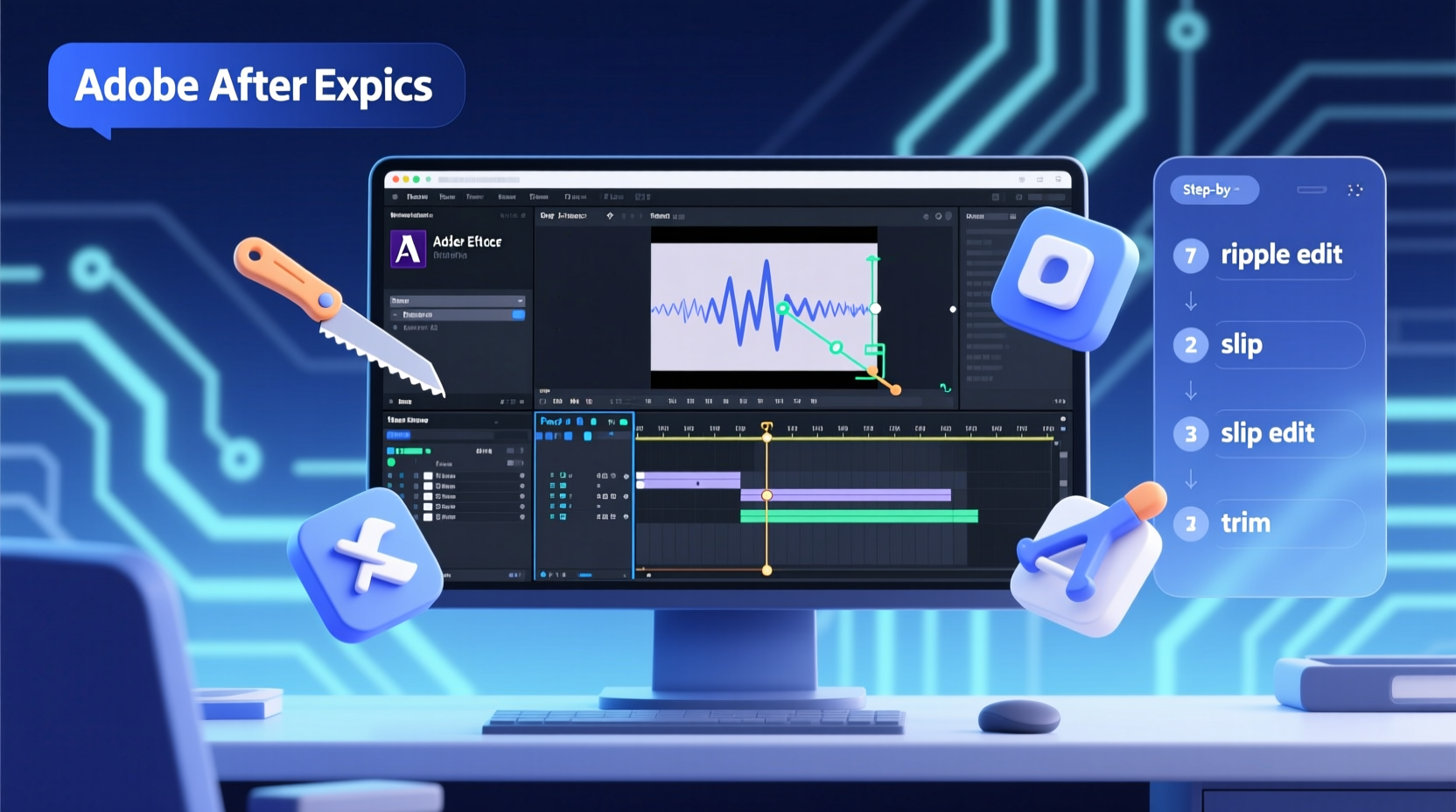
In post-production, trimming often begins in an NLE (non-linear editor), but fine-tuning happens in After Effects. Here, trimming serves multiple purposes: removing unused footage to reduce render times, aligning layers precisely for compositing, and ensuring audio-video sync remains intact during animation. Because After Effects doesn’t use traditional “in” and “out” points the way Premiere does, understanding how to manipulate layer duration and placement is essential.
Each imported clip appears as a layer in the timeline. Its visible span—how long it plays—is defined by its start point, end point, and any applied time-stretching. Trimming adjusts these boundaries without altering the source file, preserving flexibility across projects.
Precise Trimming Techniques Using Keyboard Shortcuts and Tools
Efficiency in After Effects comes from combining visual precision with keyboard fluency. While dragging layer edges works for rough cuts, professional results require frame-level accuracy. The following methods allow granular control over trimming operations:
- Drag-and-Crop Method: Click and drag the beginning or end of a layer in the timeline to shorten or extend it. Hold Alt (Windows) or Option (Mac) while dragging to slide the layer content within its trimmed boundaries—this preserves surrounding layers’ positions.
- Time-Remapping for Internal Cuts: Enable time-remapping (Ctrl+Alt+T / Cmd+Option+T) to create keyframes that define playback range within a layer. This allows non-destructive trimming while maintaining access to the full source.
- Layer In/Out Points via Menu: Select a layer and go to Layer > Time > Enable Time Remapping, then adjust in/out points numerically in the Timeline panel.
- Keyboard Shortcuts:
- [ – Set layer end point to current time indicator (CTI)
- ] – Set layer start point to CTI
- Alt+[ – Trim layer start to CTI and ripple edit forward
- Alt+] – Trim layer end to CTI and ripple edit backward
Using these tools together enables both speed and accuracy. For instance, navigate to a precise frame using the arrow keys (with Shift for 10-frame jumps), then press [ or ] to set boundaries instantly.
Step-by-Step: Trimming a Clip for Motion Graphics Integration
Imagine integrating live-action footage into a kinetic typography sequence. The clip must start exactly when a text animation begins and end before a transition. Follow this workflow:
- Import and Place: Import your video into the project, then drag it into a new composition aligned with your graphic design timeline.
- Zoom In: Use . (period) to zoom the timeline to the current time indicator, allowing frame-by-frame navigation.
- Set Start Point: Move the CTI to the exact frame where the action should begin. Press Alt+[ to trim the layer’s start and shift all subsequent layers automatically.
- Set End Point: Navigate to the last usable frame and press Alt+] to complete the trim.
- Verify Sync: Play back the section to confirm alignment with other animated elements. If needed, nudge the layer by one frame using Alt+Left/Right Arrow.
- Precompose (Optional): Once trimmed, precompose the layer (Ctrl+Shift+C) to lock edits and simplify management.
This process ensures seamless integration between live footage and animated components, minimizing jitter and timing errors.
Do’s and Don’ts of Video Trimming in After Effects
| Do’s | Don’ts |
|---|---|
| Use keyboard shortcuts for frame-accurate edits | Trim manually without zooming in—risk losing sync |
| Enable time-remapping for flexible internal trimming | Delete source files after trimming—always retain originals |
| Label and organize layers before trimming | Over-trim and lose context needed for transitions |
| Use markers to denote edit points in complex comps | Rely solely on visual estimation—use waveform/audio cues when available |
| Test playback at full resolution after trimming | Forget to check neighboring layers for ripple effects |
Expert Insight: Why Precision Matters in Professional Compositing
“Even a single-frame misalignment can break immersion in high-end visual effects. Trimming isn’t just cleanup—it’s part of the storytelling rhythm.” — Lena Torres, Senior Compositor at Frameforge Studios
Torres emphasizes that modern audiences subconsciously detect micro-timing inconsistencies, especially in fast-paced scenes. A well-trimmed layer ensures that explosions, cuts, and motion cues hit at the right psychological moment. She recommends using snapping (Ctrl+U) and markers to align edits with beat points or dialogue peaks.
Real Example: Fixing a Misaligned Drone Shot
A freelance editor was tasked with inserting a drone flyover into a travel promo. The original 30-second clip contained a shaky landing at the end that disrupted the smooth pacing. In After Effects, they:
- Identified the final stable frame using frame-by-frame scrubbing.
- Pressed Alt+] to trim the layer’s end precisely at that point.
- Applied a subtle fade-out effect starting two frames before the cut to soften the transition.
- Repositioned the trimmed layer to maintain continuity with the next scene’s entrance animation.
The result was a polished, cinematic sequence with no visible jump. By trimming accurately instead of relying on crossfades alone, the editor preserved authenticity and flow.
Checklist: Essential Steps for Clean Video Trimming
- ✅ Import only necessary footage to minimize clutter
- ✅ Zoom into the timeline for frame-level precision
- ✅ Use [ and ] to set in/out points quickly
- ✅ Apply Alt+[/Alt+] for ripple-trimming when needed
- ✅ Enable time-remapping for non-destructive internal edits
- ✅ Label trimmed layers and group related assets
- ✅ Preview trimmed sections at full quality before rendering
Frequently Asked Questions
Can I undo a trim if I make a mistake?
Yes. After Effects supports unlimited undos (Ctrl+Z). However, once you close the project, undone actions are lost. For critical edits, consider duplicating the composition before making major trims.
Is there a way to trim multiple layers at once?
You can select multiple layers and use expressions or scripts to batch-trim, but native tools don’t support simultaneous trimming. Instead, link layers in a pre-comp and trim the pre-comp layer as a single unit.
Why does my trimmed clip still affect the overall composition length?
After Effects compositions default to the longest layer unless manually adjusted. To shorten the comp duration, go to Composition > Trim Comp to Work Area after setting your desired work area bounds.
Conclusion: Elevate Your Editing with Intentional Trimming
Trimming in After Effects is more than a technical step—it's an editorial decision that shapes pacing, clarity, and visual impact. When done with intention, it removes distractions, enhances synchronization, and streamlines rendering. Mastery comes not from memorizing shortcuts alone, but from understanding how each cut contributes to the final narrative.




 浙公网安备
33010002000092号
浙公网安备
33010002000092号 浙B2-20120091-4
Comments
No comments yet. Why don't you start the discussion?