
For many watch owners, adjusting the date seems like a minor task—until it isn’t. Whether you’ve just acquired a vintage timepiece, inherited a family heirloom, or simply forgot to reset your watch after daylight saving time, knowing how to properly adjust the date is essential for accuracy and longevity. Incorrect handling can damage delicate internal mechanisms, especially in mechanical watches. This guide demystifies the process, offering clear instructions, expert insights, and practical tips to help you confidently change the date on any watch—regardless of movement type or brand.
Understanding Your Watch Movement
Before adjusting the date, it’s crucial to understand what kind of movement powers your watch. The mechanism inside determines not only how the date is set but also when it should be adjusted. There are three primary types: manual mechanical, automatic (self-winding), and quartz.
- Manual Mechanical: Powered by hand-winding; requires daily attention. Date changes occur as part of the 24-hour cycle.
- Automatic: Self-winds through wrist motion. Functions similarly to manual but stays wound longer when worn regularly.
- Quartz: Battery-powered, highly accurate. Most quartz watches allow direct date adjustment at any time.
The key difference lies in timing. Mechanical watches—both manual and automatic—are sensitive around the 9 PM to 3 AM window. During this period, the date change mechanism is actively engaging, and attempting to adjust the date manually can strain or break gears.
Step-by-Step Guide to Changing the Date
Follow this universal method for safely adjusting the date on most analog watches with a stem-based crown. While specifics vary slightly between brands like Rolex, Seiko, or Omega, the core principles remain consistent.
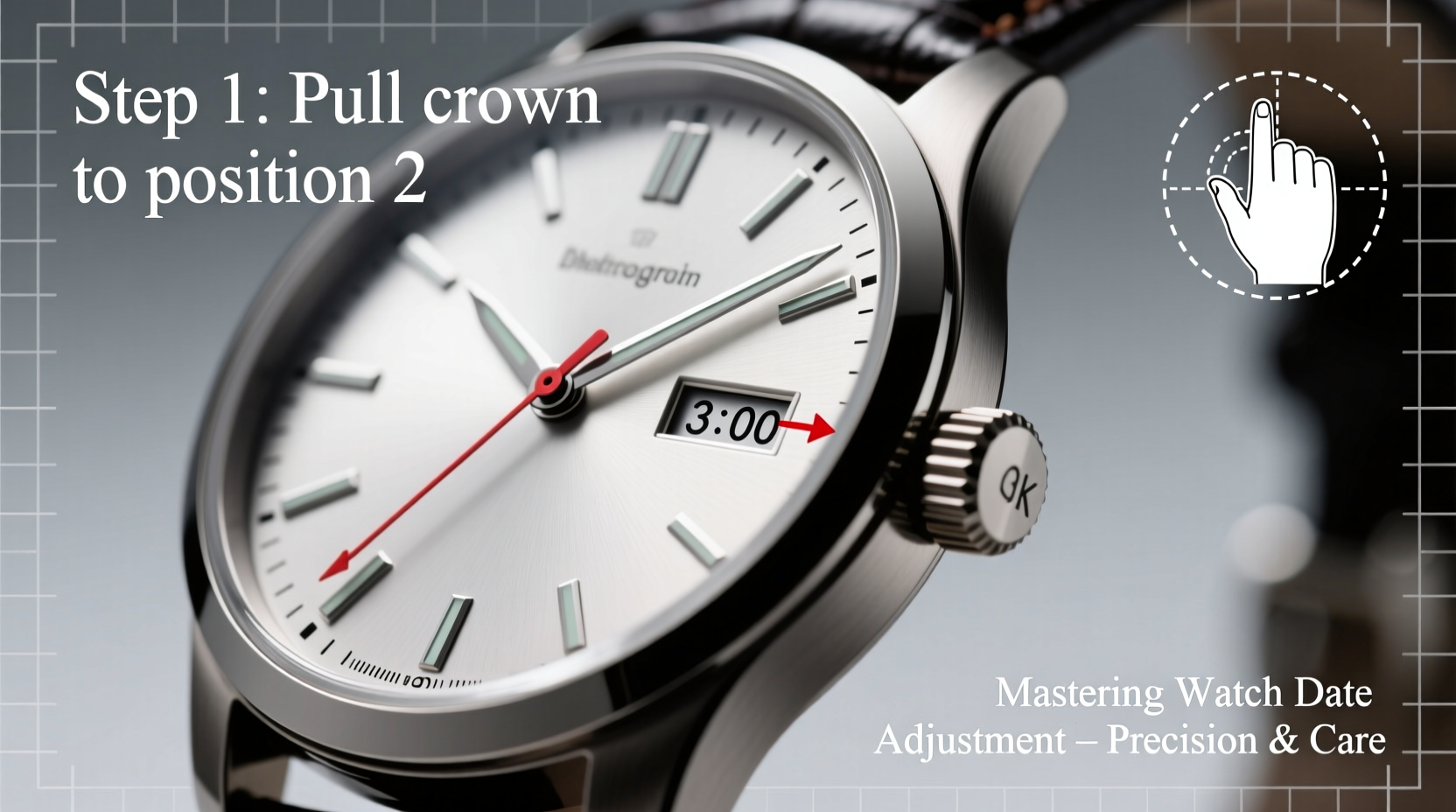
- Pull the crown to the first position. On most watches, gently pull the crown out one click. This usually activates the date function without affecting the hands.
- Rotate the crown to advance the date. Turn clockwise until the desired date appears in the window. Some watches may require counter-clockwise rotation—check manufacturer guidelines if uncertain.
- If no date-only setting exists, use the second position. If pulling the crown once doesn’t control the date, pull it fully (second position). Adjust the date by moving the hour hand forward or backward in 12-hour increments.
- Avoid the danger zone. As mentioned, do not adjust the date between 9 PM and 3 AM on mechanical watches. Instead, set the time to 6 PM before making adjustments.
- Push the crown back in securely. Once the correct date is set, gently push the crown all the way in to resume normal operation.
This method works for both quick-set (instant date) and non-quick-set models. Quick-set watches allow direct date changes via the first crown position, while older or simpler movements require cycling the time forward or backward to reach the correct date.
Do’s and Don’ts of Watch Date Adjustment
| Do’s | Don’ts |
|---|---|
| Set the time to 6 PM before adjusting the date on mechanical watches. | Adjust the date between 9 PM and 3 AM on mechanical movements. |
| Use gentle pressure when operating the crown. | Force the crown if it resists movement. |
| Check your watch manual for brand-specific instructions. | Assume all watches adjust the same way. |
| Keep the crown fully pushed in during regular wear. | Leave the crown pulled out when not in use. |
| Clean the crown periodically with a soft cloth. | Expose the crown to water unless the watch is rated for it. |
Real Example: Recovering from a Misadjusted Date
Mark, an enthusiast who recently acquired a 1970s Omega Seamaster, noticed the date jumped two days every 24 hours. Confused, he tried adjusting it late one night—around 11 PM—by rapidly turning the crown. The next morning, the date was stuck halfway between “15” and “16.” Alarmed, he took it to a local watchmaker.
The technician explained that Mark had attempted to change the date during the internal gear engagement phase. The rapid turning caused the jumper spring—a small component responsible for snapping the date wheel into place—to dislodge. The repair required partial disassembly and cost $85. With proper timing and gentler handling, the issue could have been avoided entirely.
This case underscores the importance of patience and timing. Even experienced users can make mistakes when rushing.
“Over 30% of early-service repairs on vintage automatics stem from improper date adjustment. It’s not just about convenience—it’s about preserving the integrity of the movement.” — Daniel Ruiz, Master Watchmaker, Geneva Timeworks
Tips for Specific Watch Types
Different watches demand different approaches. Here’s how to handle some common categories:
- Dress Watches: Often thinner and more delicate. Use minimal force when pulling the crown. Many lack quick-set functions, so plan to cycle the hands if needed.
- Diver’s Watches: Feature screw-down crowns for water resistance. Unscrew counterclockwise before pulling out. Always screw it back tightly after adjustment to maintain seal integrity.
- Chronographs: May have multiple pushers. Do not confuse the chronograph reset button with the crown. Adjust the main time and date via the crown only.
- Vintage Models: Older movements may have stiff crowns or worn parts. If resistance is felt, stop immediately and consult a professional.
Frequently Asked Questions
Can I change the date on a watch while it’s running?
Yes, provided you’re outside the 9 PM to 3 AM window for mechanical watches. Quartz watches generally allow date changes at any time. However, avoid adjusting during the actual transition (e.g., midnight) when the mechanism is engaged.
Why does my watch show the wrong date after adjustment?
This often happens when the 12-hour cycle is misaligned. The date changes at midnight, not noon. If your watch shows PM instead of AM, advancing the time by 12 hours will correct both the day/night indicator and ensure accurate date turnover.
My crown won’t pull out. What should I do?
First, confirm whether your watch has a screw-down crown. If so, gently turn it counterclockwise to unscrew it. If it still won’t budge, do not force it. Dirt, dried lubricant, or impact damage may be the cause—seek professional servicing.
Final Checklist Before You Adjust
- Confirm the watch type (mechanical, automatic, quartz).
- Ensure the time is set to 6 PM (for mechanical movements).
- Verify the crown pulls out smoothly (unscrew if necessary).
- Locate the correct crown position for date adjustment.
- Turn gently until the correct date appears.
- Push (and screw) the crown back securely.
- Check that the time and date advance correctly over the next 24 hours.
Conclusion
Mastering watch date adjustment is more than a convenience—it’s a form of respect for the craftsmanship behind your timepiece. Whether you own a modern diver or a decades-old dress watch, understanding how and when to adjust the date preserves its function and extends its life. These small acts of care compound over time, ensuring your watch remains reliable, accurate, and ready to accompany you through years of moments worth marking.




 浙公网安备
33010002000092号
浙公网安备
33010002000092号 浙B2-20120091-4
Comments
No comments yet. Why don't you start the discussion?