
Data accuracy in business intelligence often hinges on how well temporal filters are applied. One of the most common yet overlooked challenges is isolating weekdays while excluding weekends from date-based datasets. Whether you're analyzing sales trends, support ticket volumes, or employee productivity, including Saturday and Sunday can skew results and mislead decision-making. Power BI’s Power Query engine provides robust tools to handle this—but only if used correctly. This guide walks through practical, repeatable methods to filter out weekends and ensure your reports reflect true working-day patterns.
Why Exclude Weekends in Business Data?
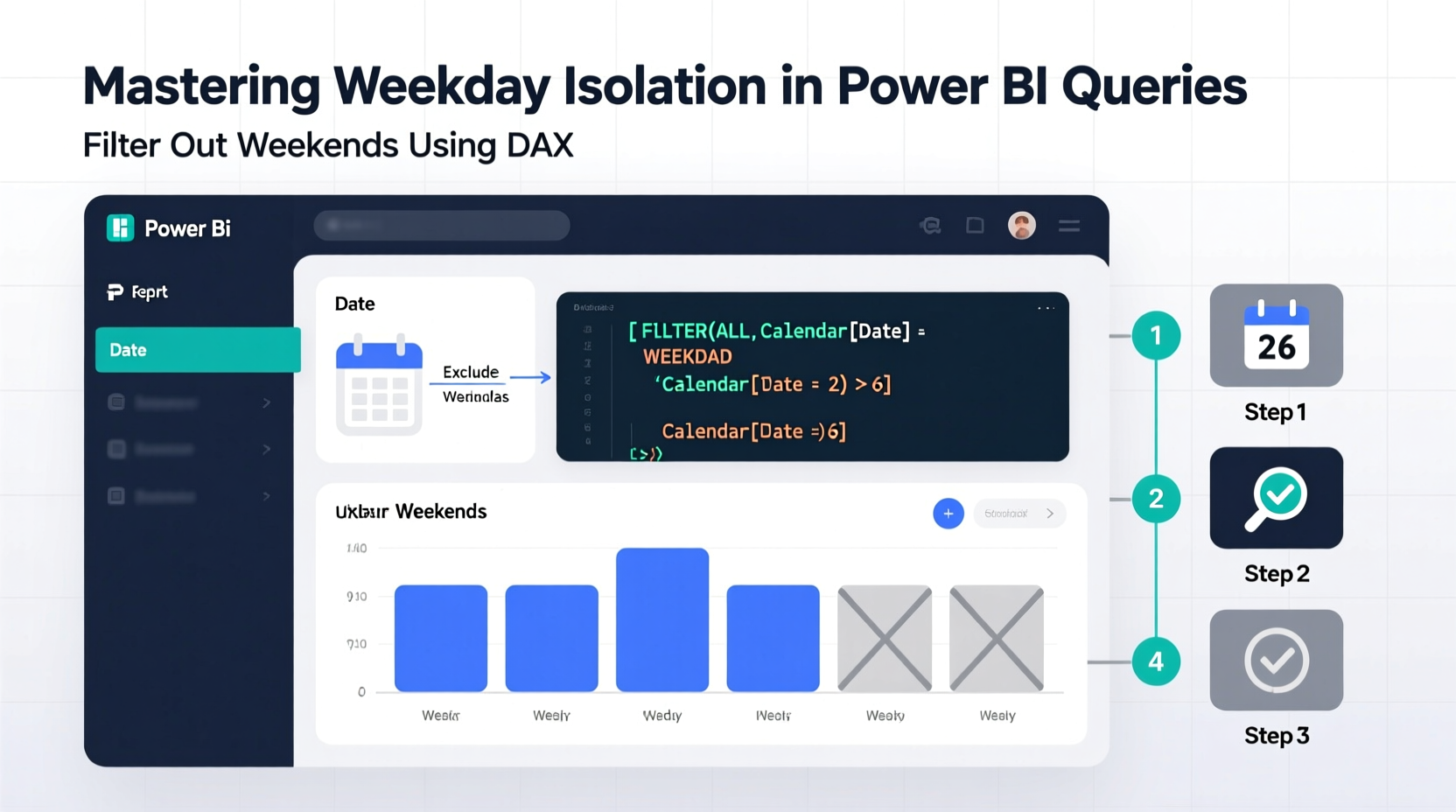
In many industries, operations follow a Monday-to-Friday rhythm. Retail foot traffic dips on weekends, customer service response times slow due to reduced staffing, and manufacturing output halts on non-working days. Including weekend data in weekday performance metrics introduces noise rather than insight. For example, calculating average daily sales across all seven days may make it appear that performance dropped midweek when in reality, the dip was caused by two low-volume weekend days.
Excluding weekends isn’t just about cleaner visuals—it’s about aligning analytics with operational reality. As data analyst Lena Torres notes:
“Time intelligence without context is misleading. If your business runs on weekdays, your data should too.” — Lena Torres, Senior BI Analyst at Nexora Analytics
Step-by-Step: Filtering Out Weekends in Power Query
Power Query, accessible through Power BI Desktop under the “Transform Data” button, allows deep manipulation of data before visualization. The process of removing weekends involves identifying the day of the week for each date and filtering accordingly. Follow these steps to isolate weekdays:
- Load your dataset into Power BI: Import any table containing a date column (e.g., Order Date, Submission Date).
- Open Power Query Editor: Select “Transform Data” from the Home tab.
- Select the date column: Click on the column header containing dates.
- Add a custom column for day of the week: Go to “Add Column” > “Date” > “Day” > “Day of Week.” This creates a numeric value where 1 = Sunday and 7 = Saturday by default.
- Rename the new column: Call it “DayOfWeekNumber” for clarity.
- Filter out weekends: Click the dropdown arrow in the new column and uncheck 1 (Sunday) and 7 (Saturday).
- Remove helper column (optional): Once filtered, you can delete “DayOfWeekNumber” if no longer needed.
- Apply & Close: Return to the report view with clean, weekday-only data.
Advanced Method: Using Custom M Code for Greater Control
While the GUI method works well, using M code in Power Query gives more flexibility—especially when integrating logic across multiple queries. You can directly filter weekdays using the Table.SelectRows function combined with Date.DayOfWeek().
Here’s an example of M code that filters out Saturday and Sunday:
Table.SelectRows(#\"PreviousStepName\", each Date.DayOfWeek([OrderDate], Day.Monday) < 5)This assumes a week starting on Monday (0) and ending on Sunday (6). By setting the comparison to less than 5, you retain Monday (0) through Friday (4). Adjust the base day as needed using the second parameter in Date.DayOfWeek().
You can insert this code via “Advanced Editor” or by adding a custom step:
- In Power Query, go to “Home” > “Advanced Editor” (or use “Insert Step After”).
- Replace the relevant step with the filtering logic above.
- Ensure the column name (e.g., [OrderDate]) matches your actual date field.
This approach is particularly useful in dynamic models where queries are reused or parameters control filtering behavior.
Best Practices and Common Pitfalls
Even experienced users make mistakes when handling date logic. Below is a summary of do’s and don’ts when filtering weekdays in Power BI.
| Action | Do | Avoid |
|---|---|---|
| Date Format | Ensure the column is recognized as type “Date” or “DateTime” | Working with text-formatted dates |
| Locale Settings | Confirm day numbering aligns with regional settings (e.g., US vs EU) | Assuming 1 = Monday universally |
| Performance | Filter early in the query to reduce row count | Applying filters after complex joins or aggregations |
| Transparency | Document filtering logic in query comments | Leaving unclear transformation steps |
Real-World Example: Support Ticket Analysis
A mid-sized SaaS company wanted to evaluate first-response times for customer support tickets. Initial reports showed a weekly average of 6.8 hours. However, analysts noticed inconsistent daily patterns. Upon closer inspection, they realized weekend tickets—handled by an automated system with delayed responses—were dragging down the average.
The team isolated weekdays using Power Query by adding a “DayOfWeek” column and filtering out values 1 (Sunday) and 7 (Saturday). After reprocessing, the true weekday average response time emerged: 4.2 hours—a much more accurate reflection of frontline team performance.
This adjustment not only corrected internal KPIs but also improved stakeholder confidence in the dashboard’s reliability.
Checklist: Ensuring Accurate Weekday Filtering
- ✅ Confirm your date column is properly typed as Date or DateTime
- ✅ Determine your organization’s definition of a workweek (e.g., Mon–Fri, Sun–Thu)
- ✅ Add a day-of-week column using Power Query’s built-in functions
- ✅ Filter out unwanted weekend numbers based on your locale
- ✅ Test the output with a small dataset before applying to large tables
- ✅ Document the transformation logic for team transparency
- ✅ Consider creating a date dimension table with pre-flagged weekdays for reuse
Frequently Asked Questions
Can I exclude holidays as well using the same method?
Yes, but not directly through day-of-week filtering. To exclude holidays, create a separate holiday calendar table and merge it with your main dataset. Then filter out any rows where the date appears in the holiday list. This requires additional data management but enhances analytical precision.
What if my business operates on a six-day week?
In cases where Saturday is a working day, adjust your filter to remove only Sunday (typically day 1 in default settings). Modify the logic to keep days 2 through 7 (Monday–Saturday), or use custom M code to reflect your operational week.
Will filtering weekends affect my time intelligence calculations?
Only if those calculations rely on continuous daily sequences. Measures like moving averages or year-over-year comparisons may need adjustment. However, for most operational metrics (e.g., average weekday sales), excluding weekends improves accuracy.
Conclusion: Build Smarter, More Honest Reports
Excluding weekends from Power BI queries isn’t a technical nicety—it’s a necessity for truthful reporting in weekday-driven environments. By mastering Power Query’s date functions and applying consistent filtering logic, you eliminate distortions and deliver insights that reflect real business rhythms. Whether you use the graphical interface or dive into M code, the goal remains the same: align your data with how your organization actually works.




 浙公网安备
33010002000092号
浙公网安备
33010002000092号 浙B2-20120091-4
Comments
No comments yet. Why don't you start the discussion?