
Navigating prepositions in English can feel like walking through a linguistic minefield. Among the most frequently confused are at and in. Though both describe location and time, using them incorrectly can make even fluent speakers sound awkward or unclear. The good news? Once you understand the underlying logic, choosing between \"at\" and \"in\" becomes intuitive. This guide breaks down the core rules, provides real-world examples, and equips you with tools to use these prepositions accurately in daily conversation and writing.
Understanding the Core Difference: Specificity vs. Containment
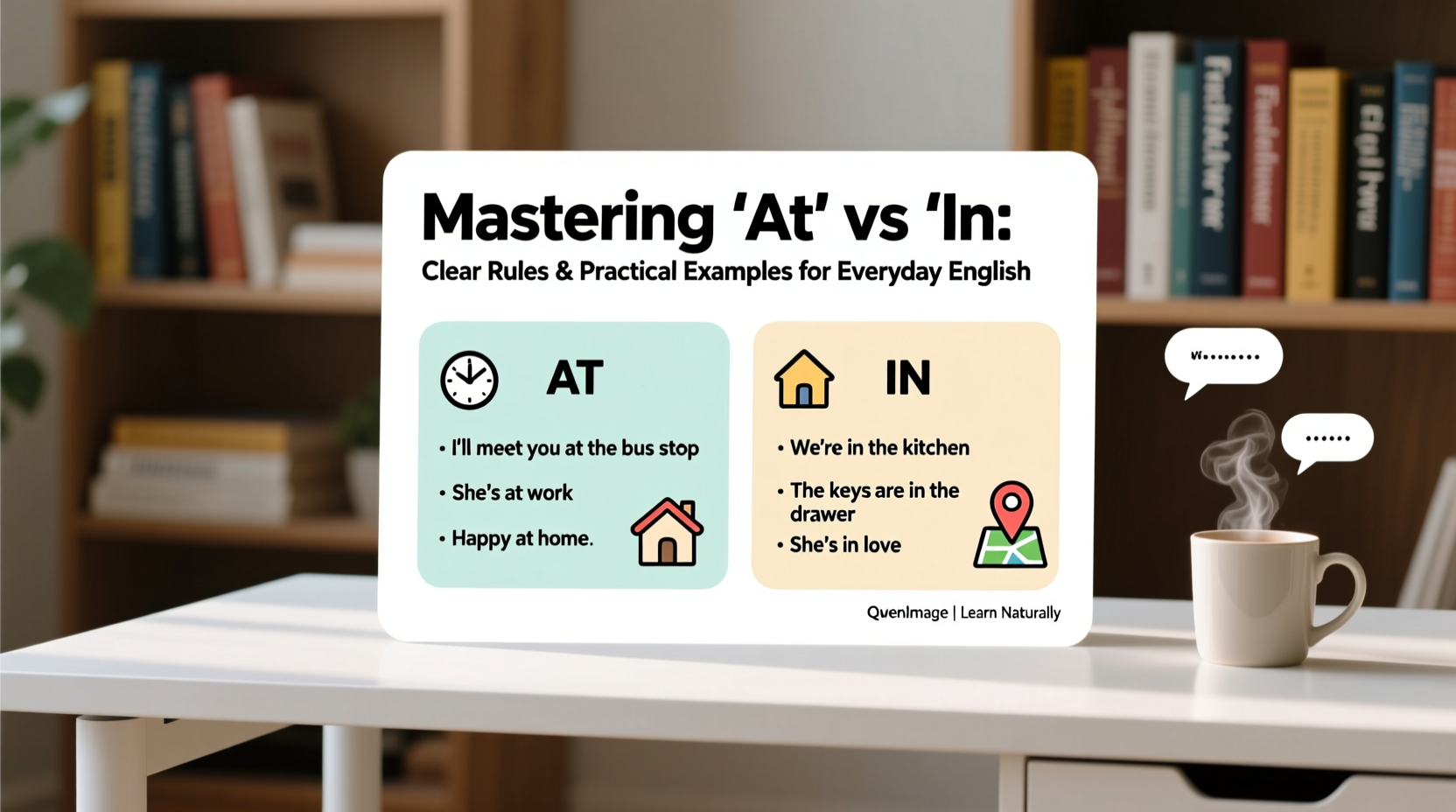
The key to mastering at and in lies in one concept: specificity versus containment.
- At is used for specific points—exact locations, precise times, or particular events.
- In indicates being inside something—enclosed spaces, broader time periods, or general areas.
Think of it spatially: “at” is like standing on a dot; “in” is like being surrounded by boundaries. Apply this principle consistently, and your usage will improve dramatically.
Using 'At' for Location: Precision Over Space
Use at when referring to a specific place without emphasizing physical entry or enclosure. It's about presence at a point, not necessarily inside.
Examples include:
- I’ll meet you at the bus stop.
- She works at Google.
- We arrived at the airport two hours early.
- There’s a sale at Macy’s this weekend.
Note that even large places can take “at” when we’re focusing on the institution or entrance rather than physical interior space. For instance, “He’s at school” means he’s attending or present there, not necessarily inside a classroom.
“Prepositions like ‘at’ anchor meaning to a point of reference—time, place, or event. They’re essential for clarity.” — Dr. Linda Harper, Linguistics Professor, University of Toronto
Using 'In' for Location: Inside and Enclosed Spaces
Choose in when someone or something is physically enclosed within boundaries—walls, borders, containers, or geographical regions.
Common uses:
- The keys are in my pocket.
- We live in Chicago.
- The documents are stored in the filing cabinet.
- Birds fly in the sky.
Geographical divisions also take “in”: countries, states, cities, neighborhoods. You wouldn’t say “I’m at France”—you’d say “I’m in France.” Similarly, “She lives in Brooklyn,” not “at Brooklyn,” unless referring to a specific venue like “a concert at Brooklyn Bowl.”
When Size Doesn't Matter: Institutional Use
Even small buildings may take “in” if the focus is on internal space:
- He’s in the bathroom.
- The baby is in the car seat.
Compare: “Wait for me at the restaurant” (outside or at the entrance) vs. “I’m already in the restaurant” (inside, seated).
Time Expressions: At for Points, In for Periods
The same logic applies to time. Use at for exact clock times and specific moments. Use in for broader spans like months, years, seasons, or parts of the day.
| Preposition | Time Context | Examples |
|---|---|---|
| At | Exact times, holidays, night | at 7:30 p.m., at noon, at Christmas, at night |
| In | Months, years, seasons, centuries, mornings/afternoons | in June, in 2025, in winter, in the 1990s, in the morning |
Note: We say “in the morning,” “in the afternoon,” but “at night.” Why? Because “night” functions as a point-like concept in English idiom, while “morning” and “afternoon” are perceived as longer durations.
Also, holidays follow a pattern: “at Christmas” (the period), but “on Christmas Day” (specific date). You might say “We exchange gifts at Christmas” but “We opened presents on Christmas morning.”
Real-Life Scenario: Navigating a Business Meeting
Consider Maria, a non-native speaker preparing for her first international client meeting. She writes:
“I’ll be at the conference room by 10 a.m. The presentation materials are in the shared folder, and I’ll send the final version at 9:45 so everyone has time to review. We’re scheduling the follow-up in the second week of July.”
Her choices reflect strong command of prepositions:
- At the conference room – she’s arriving at a specific location.
- In the shared folder – files are contained digitally within a folder.
- At 9:45 – a precise time.
- In the second week of July – a broader time frame.
A mistake like “in the conference room” could imply she’s already seated and ready, which might mislead attendees. Her precision ensures clarity and professionalism.
Common Mistakes and How to Avoid Them
Even advanced learners trip over certain phrases. Here are frequent errors and corrections:
| Mistake | Correction | Reason |
|---|---|---|
| I was born in hospital. | I was born in the hospital. | Specific institution requires article + “in” only if inside; otherwise UK English sometimes omits “the” but still uses “in.” US: always “in the hospital.” |
| Let’s meet in the park gate. | Let’s meet at the park gate. | Gate is a specific point, not an enclosed area. |
| She starts work at Monday. | She starts work on Monday. | Different preposition needed: days use “on.” |
| I’ll call you in 8 o’clock. | I’ll call you at 8 o’clock. | Exact time = “at.” |
Quick Checklist: Choosing Between 'At' and 'In'
Before speaking or writing, run through this checklist:
- Am I referring to a precise point (location/time)? → Use at.
- Is the subject inside a container, building, city, or country? → Use in.
- Is it a broad time period (month, year, season)? → Use in.
- Is it a clock time or specific moment? → Use at.
- Am I talking about participation in an event or institution? → Often at (e.g., at school, at church).
Frequently Asked Questions
Can I say “in the night” instead of “at night”?
Generally, no. “At night” is the standard phrase in modern English. “In the night” is grammatically correct but less common and usually implies something happening during a specific night, often with drama or interruption: “I heard a noise in the night.” Stick to “at night” for general statements.
Why do we say “at home” but “in the house”?
“At home” refers to being at your residence as a concept—where you belong. “In the house” emphasizes physical presence inside the structure. You can be “at home” but outside in the garden. If you're indoors, you're “in the house.” Example: “He’s at home watching TV” (implies expected location); “There’s someone in the house!” (focus on physical interior).
Is it “in the picture” or “at the picture”?
It depends on meaning. “In the picture” means part of the image: “My dog is in the picture.” “At the picture” would mean looking toward it from outside: “Look at the picture on the wall.” Different prepositions serve different verbs and meanings.
Final Thoughts: Speak with Confidence
Mastering “at” versus “in” isn’t about memorizing endless exceptions—it’s about understanding the mindset behind their use. One points to precision; the other to inclusion. With practice, these distinctions become automatic. Listen carefully to native speakers, notice patterns, and apply the point-versus-space rule consistently. Soon, you’ll choose the right preposition without hesitation.




 浙公网安备
33010002000092号
浙公网安备
33010002000092号 浙B2-20120091-4
Comments
No comments yet. Why don't you start the discussion?