
Bear Watch table clocks blend nostalgic design with functional precision, often becoming cherished pieces in homes, offices, or collections. While their vintage-inspired aesthetics stand out, the real value lies in their ability to keep reliable time—provided you know how to read and maintain them correctly. Unlike digital displays or smartphone notifications, analog clocks like the Bear Watch require a basic but essential understanding of time-telling mechanics. This guide walks you through everything from interpreting the hands to fine-tuning accuracy, ensuring your clock remains both a decorative and dependable tool.
Understanding the Anatomy of Your Bear Watch Table Clock
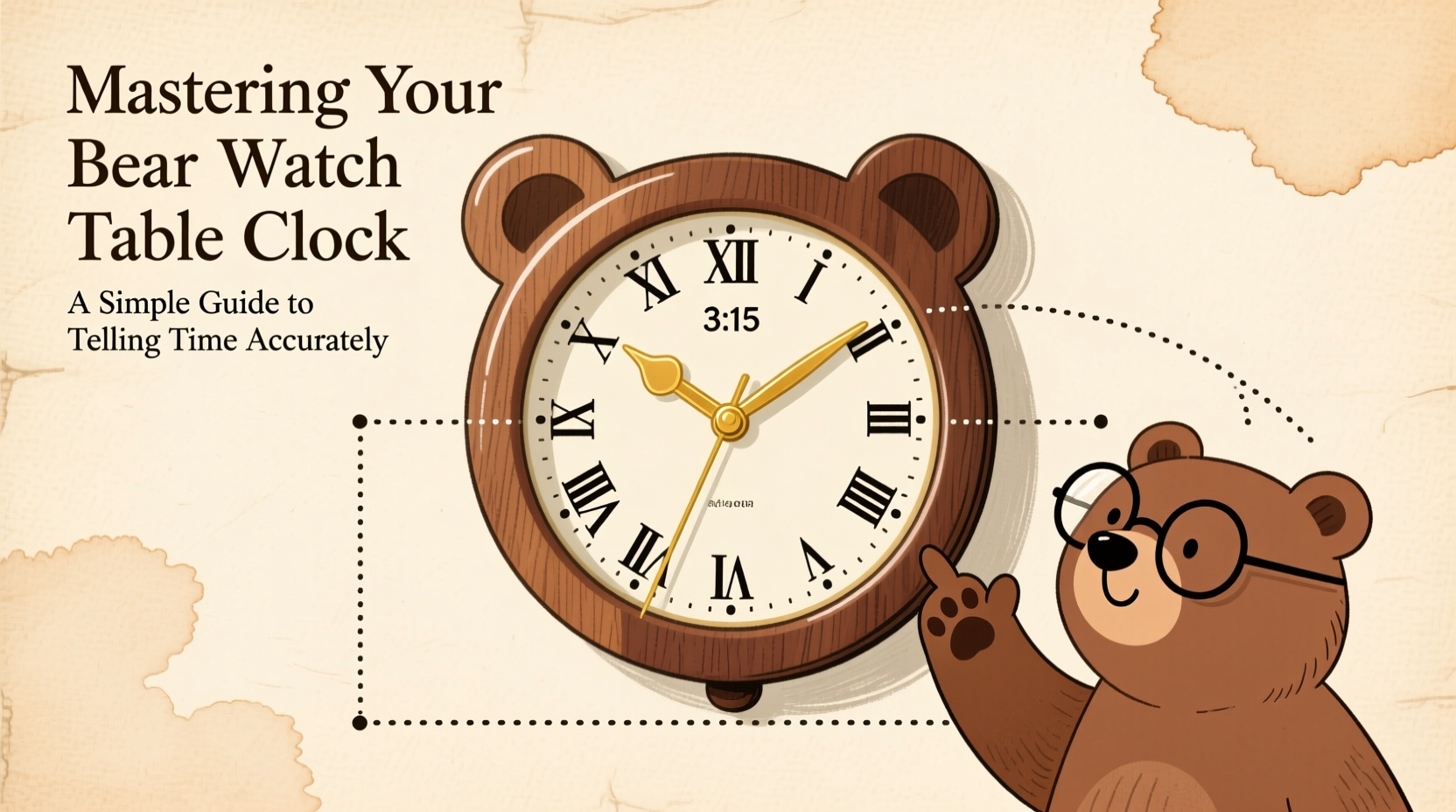
Before you can master timekeeping, it's important to understand the components of your Bear Watch table clock. Most models feature a traditional analog layout with three primary elements: the hour hand, the minute hand, and sometimes a seconds hand. The clock face typically includes 12 numerals or markers spaced evenly around the dial, representing each hour. Between these are smaller tick marks indicating minutes and seconds.
The hour hand is shorter and moves slowly, completing one full rotation every 12 hours. The minute hand is longer and completes a rotation every 60 minutes. If your model includes a seconds hand, it’s usually thin and red or black, sweeping around the dial once per minute. Some Bear Watch clocks also include decorative features such as moon-phase indicators or temperature dials, but these don’t affect timekeeping accuracy.
Step-by-Step Guide to Reading Time Accurately
Telling time on an analog clock is a foundational skill, yet subtle misreadings can lead to missed appointments or scheduling errors. Follow this clear sequence to interpret your Bear Watch clock with confidence:
- Identify the hour hand. Look for the shortest, often thicker hand. Note which numeral it’s closest to. If it’s between two numbers, the current hour is the lower number (e.g., if between 3 and 4, it’s still 3 o’clock).
- Read the minute hand. Use the longer hand to determine minutes past the hour. Each number represents five minutes (e.g., 1 = 5 min, 2 = 10 min). Count by fives up to the nearest number, then add individual ticks for remaining minutes.
- Account for elapsed time. For example, if the minute hand points to the 7th tick after 2, that’s 10 + 7 = 17 minutes past the hour.
- Confirm AM or PM. Since analog clocks repeat every 12 hours, use context (morning/evening) or a secondary device to verify whether it’s AM or PM.
Example: If the hour hand is just past 8 and the minute hand points to the 11th tick after 4, the time is 8:21. The hour is 8; the minute calculation is (4 × 5) + 1 = 21.
Calibrating and Setting Your Clock Correctly
Even high-quality clocks can drift slightly over time. Proper calibration ensures your Bear Watch reflects accurate time daily. Most Bear Watch table clocks are mechanical, powered by a wind-up spring, though some newer versions may be quartz-based.
To set the time:
- Gently turn the crown (usually located at the top or side) clockwise to adjust the hands.
- Move the hands forward only—never backward—on mechanical models to avoid gear stress.
- Pause briefly at each hour to allow any chime mechanism to complete its cycle, if applicable.
- Stop precisely at the correct time, double-checking against a trusted source like an atomic clock or smartphone.
For quartz models, remove the battery before adjusting to prevent circuit strain. After replacing it, wait for the hands to reset automatically or use the adjustment button as directed.
| Clock Type | Winding Frequency | Accuracy Range | Setting Direction |
|---|---|---|---|
| Mechanical (Wind-Up) | Daily or every 8–12 hours | ±1 to 2 minutes per day | Forward only |
| Quartz (Battery-Powered) | No winding needed | ±15 seconds per month | Both directions (check manual) |
Common Mistakes That Affect Time Accuracy
Even small habits can compromise your clock’s performance. Recognizing and avoiding these errors helps maintain long-term reliability:
- Over-winding the spring. This can damage the mainspring, especially in older mechanical models. Wind until resistance increases slightly, then stop.
- Placing near heat sources or magnets. Radiators, direct sunlight, or electronic devices can interfere with internal mechanisms, particularly in mechanical movements.
- Ignoring leveling. If the clock isn’t sitting flat, the pendulum (if present) may swing unevenly, affecting timing.
- Skipping regular cleaning. Dust buildup around the hands or dial can cause friction and slow movement.
“Analog clocks reward attention to detail. A well-maintained mechanical clock can gain or lose less than a minute a week with proper care.” — Daniel Reeves, Horology Conservator at the National Time Museum
Maintenance Checklist for Long-Term Accuracy
To keep your Bear Watch table clock performing optimally, follow this monthly maintenance checklist:
- Verify time against an atomic clock or GPS-enabled device
- Inspect for dust accumulation on the face and hands
- Ensure the clock sits level on a stable surface
- Wind mechanical models fully (without force)
- Check for unusual sounds (ticking too fast/slow, grinding)
- Replace quartz batteries annually, even if still working
Real-World Example: Restoring a Vintage Bear Watch Clock
Sarah Thompson inherited a 1970s Bear Watch table clock from her grandfather. Though beautiful, it consistently ran 10 minutes slow each day. Initially frustrated, she followed a systematic approach: first, she cleaned the glass and dial with a microfiber cloth, removing years of grime. Next, she ensured the clock was perfectly level on her bookshelf. She then wound the spring fully each morning at 8 a.m. and compared it to her phone’s time.
After three days, she noticed improvement but still saw a 3-minute lag. Upon inspection, she realized the minute hand occasionally brushed against the second hand, causing drag. Using tweezers, she gently lifted the minute hand slightly off the post (a common fix for bent hands), restoring smooth motion. Within a week, the clock was accurate within 30 seconds per week—proof that minor adjustments yield major results.
Frequently Asked Questions
Why does my Bear Watch clock lose time even after winding?
Several factors could be responsible: a worn mainspring, misaligned hands, exposure to temperature fluctuations, or magnetization of internal components. If consistent after proper winding and leveling, consider professional servicing.
Can I clean the inside of the clock myself?
Not recommended. Internal cleaning requires disassembly and specialized tools. Dust on the exterior glass can be removed safely, but never attempt to open the case unless you're trained. Moisture or oils from fingers can corrode delicate gears.
How do I know if my Bear Watch is a mechanical or quartz model?
Check for a winding key or crown—if present, it’s likely mechanical. Quartz models usually have a battery compartment on the back and tick once per second (vs. the smooth sweep of mechanical seconds hands). Refer to the user manual or model number online for confirmation.
Final Thoughts: Make Time Work for You
Your Bear Watch table clock is more than a decorative object—it’s a functional instrument that connects you to a tradition of craftsmanship and precision. By mastering how to read, set, and maintain it, you preserve not just timekeeping accuracy but also a piece of horological heritage. Whether it sits proudly on your nightstand or anchors your study desk, treating it with care ensures it will serve you reliably for years.




 浙公网安备
33010002000092号
浙公网安备
33010002000092号 浙B2-20120091-4
Comments
No comments yet. Why don't you start the discussion?