
A chronograph is more than just a stylish addition to a timepiece—it’s a functional instrument capable of measuring elapsed time with precision. Whether you're timing laps, tracking work intervals, or simply fascinated by mechanical craftsmanship, understanding how to use your chronograph correctly elevates both your confidence and your experience. Yet for many, the pushers, subdials, and tachymeter scales remain mysterious. This guide demystifies the chronograph, offering clear instructions, practical insights, and expert-backed techniques to help you operate your watch like a seasoned professional.
Understanding the Chronograph: Anatomy of Precision
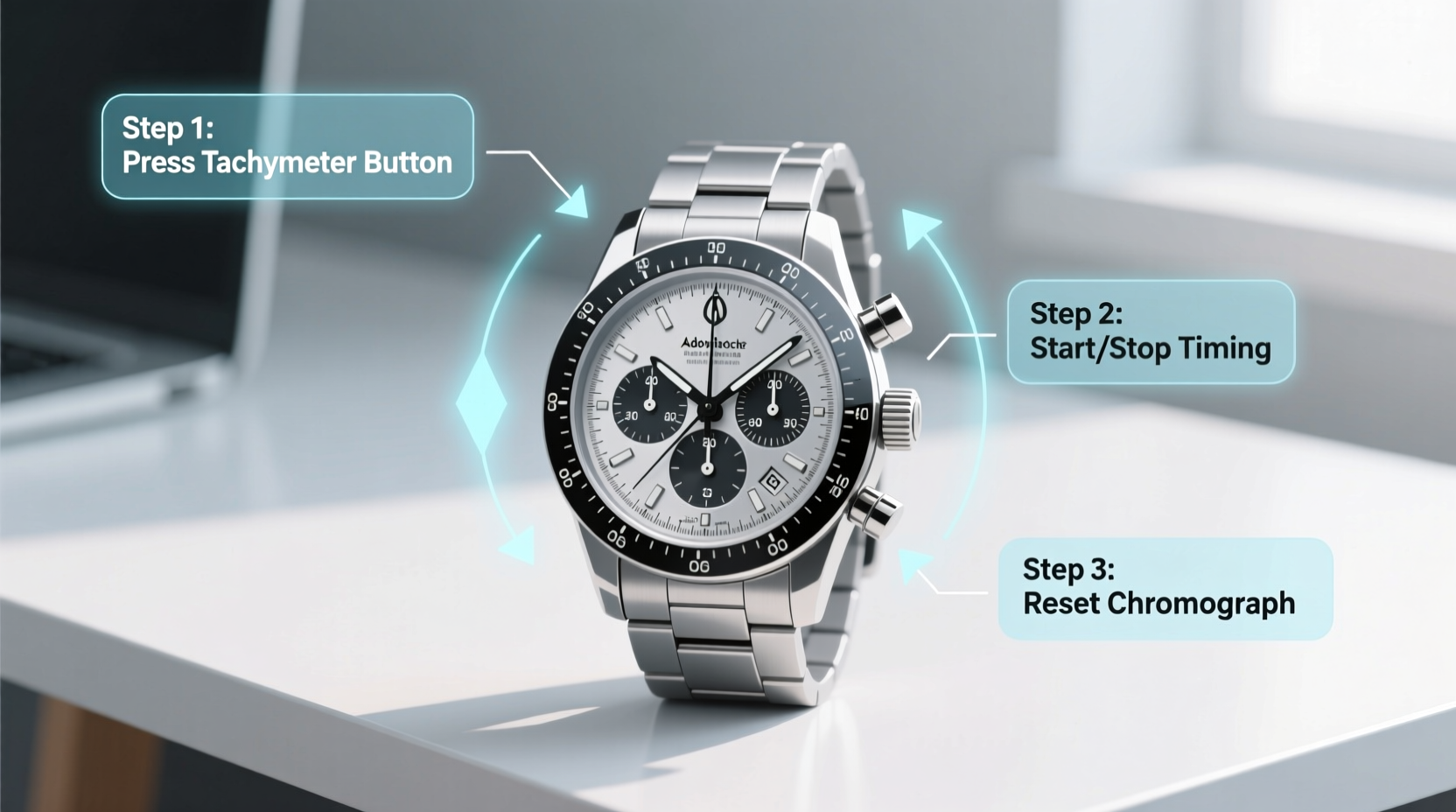
Before diving into operation, it's essential to recognize the key components of a typical chronograph watch:
- Main hands: Hour and minute hands showing regular time.
- Chronograph seconds hand: Usually centrally mounted, starts/stops/resets independently to measure elapsed time.
- Subdials (registers): Small dials on the main face that track elapsed minutes, hours, or continuous seconds.
- Start/Stop pusher: Located at 2 o’clock; activates and halts the chronograph function.
- Reset pusher: At 4 o’clock; returns the chronograph hand and subdials to zero.
- Tachymeter scale: Found on the bezel or dial, used to calculate speed based on travel time over a known distance.
Most analog chronographs follow a three-step sequence: start, stop, reset. Unlike digital stopwatches, mechanical and quartz chronographs require deliberate, sequential input—resetting before starting again is crucial to avoid damage.
Step-by-Step Guide to Using Your Chronograph
Operating a chronograph properly ensures accuracy and protects the internal mechanism. Follow this precise sequence:
- Prepare the watch: Ensure the crown is fully pushed in and secured. If your watch has a screw-down crown, make sure it’s tightened to maintain water resistance.
- Start the timer: Press the top pusher (2 o’clock). The central chronograph hand will begin moving, and any minute or hour counters will activate.
- Stop the timer: Press the same top pusher again. The hand freezes, displaying the elapsed time.
- Read the time: The central hand shows seconds. Subdials typically show elapsed minutes (30-minute counter) and sometimes hours (12-hour counter).
- Reset the timer: Press the bottom pusher (4 o’clock). All chronograph hands snap back to zero.
This process works whether you’re timing a 15-second espresso pull or a 45-minute workout. For repeated measurements, always reset between uses to ensure clarity and mechanical safety.
Using the Tachymeter Scale for Speed Calculation
The tachymeter, often engraved on the bezel, converts elapsed time (in seconds) into units per hour—typically speed over a fixed distance. Here’s how to use it:
- Begin timing when an object passes a starting point (e.g., a car at mile marker one).
- Stop the chronograph when it reaches the next mile marker (one mile later).
- Read where the chronograph seconds hand points on the tachymeter scale. That number is the speed in miles per hour.
For example, if it takes 30 seconds to travel one mile, the hand points to 120 on the tachymeter—meaning 120 mph. Note: This only works for events lasting less than 60 seconds, as the scale maxes out at 60.
“Precision timing isn’t about complexity—it’s about consistency. A well-used chronograph becomes an extension of your intent.” — Daniel Morel, Watchmaker & Horology Instructor, Geneva Institute of Timekeeping
Common Chronograph Mistakes and How to Avoid Them
Even experienced users occasionally misuse their chronographs. These pitfalls can affect performance or longevity:
| Mistake | Consequence | Solution |
|---|---|---|
| Resetting without stopping first | Can damage gear train or reset mechanism | Always stop the chronograph before resetting |
| Leaving the chronograph running for days | Unnecessary wear; drains battery (quartz) or power reserve (mechanical) | Use only when needed; reset after use |
| Ignoring water resistance during aquatic timing | Water ingress damaging movement | Ensure screw-down crown is locked; verify depth rating |
| Misreading subdials (e.g., confusing elapsed minutes with hours) | Inaccurate time tracking | Familiarize yourself with layout; refer to manual |
Real-World Application: Timing a 5K Run
Consider Sarah, a recreational runner preparing for a local 5K race. She uses her chronograph-equipped dive watch to time her training runs.
At the start line, she presses the 2 o’clock pusher as she crosses the mark. Her central chronograph hand begins sweeping around the dial. After 24 minutes and 38 seconds, she finishes. The central hand points to 38 seconds, the 30-minute subdial shows 24 minutes. She stops the timer and records her time. Later, she calculates her average pace using the tachymeter: over 1 kilometer, she ran it in 4 minutes and 52 seconds (~12.3 sec/km), which corresponds to roughly 12.3 km/h on the scale.
This real-time feedback helps her adjust pacing and build endurance—all made possible by confident, accurate use of her chronograph.
Expert Maintenance and Longevity Tips
A chronograph is a delicate system of levers, springs, and gears. Regular care extends its life and reliability.
- Clean pushers monthly: Use a soft brush and lukewarm water to remove grime from pusher crevices, especially after swimming or sweating.
- Service every 5–7 years: Mechanical chronographs benefit from professional cleaning, lubrication, and calibration.
- Avoid magnetic fields: Keep away from speakers, phones, and MRI machines to prevent timing inaccuracies.
- Wind regularly (mechanical models): If not worn daily, manually wind the watch to keep the mainspring tensioned.
Chronograph Care Checklist
- ✅ Always stop before resetting
- ✅ Secure crown before exposure to moisture
- ✅ Clean pushers gently with a soft brush
- ✅ Service every 5–7 years (mechanical)
- ✅ Store in a dry, temperature-stable environment
- ✅ Practice timing short intervals weekly to stay familiar
FAQ: Common Chronograph Questions Answered
Can I use my chronograph underwater?
Yes—if your watch has adequate water resistance (minimum 100m for swimming) and a screw-down crown. Ensure the crown is fully tightened before submersion. However, avoid operating pushers underwater unless explicitly rated for it, as pressure can force water past seals.
Why does my chronograph second hand not return exactly to zero?
Minor misalignment (“zero deviation”) is normal in mechanical watches. If the offset exceeds 1–2 seconds, it may need regulation. Quartz chronographs are generally more precise in reset accuracy.
What’s the difference between a chronograph and a chronometer?
A chronograph is a stopwatch function. A chronometer is a certification (e.g., COSC) indicating a watch meets strict accuracy standards. A watch can be both—a chronograph chronometer.
Conclusion: Own Your Instrument, Master Your Time
A chronograph is not merely a feature—it’s a tool designed for precision, discipline, and engagement. When you understand how to set, read, and maintain it, you transform your watch from a passive timekeeper into an active partner in your daily pursuits. Whether timing a presentation, monitoring heart rate intervals, or calculating fuel efficiency on a road trip, mastery begins with knowledge and practice.




 浙公网安备
33010002000092号
浙公网安备
33010002000092号 浙B2-20120091-4
Comments
No comments yet. Why don't you start the discussion?