
A chronograph watch is more than a timepiece—it’s a precision instrument capable of measuring elapsed time with accuracy down to fractions of a second. While many admire its sleek design and complex dial layout, few fully utilize its capabilities. Whether you're a pilot, athlete, engineer, or simply a watch enthusiast, understanding how to operate your chronograph elevates both functionality and appreciation. This guide walks through the anatomy, operation, and real-world application of chronograph watches, helping you unlock their full potential.
Understanding the Chronograph: More Than Just Stopwatch Functionality
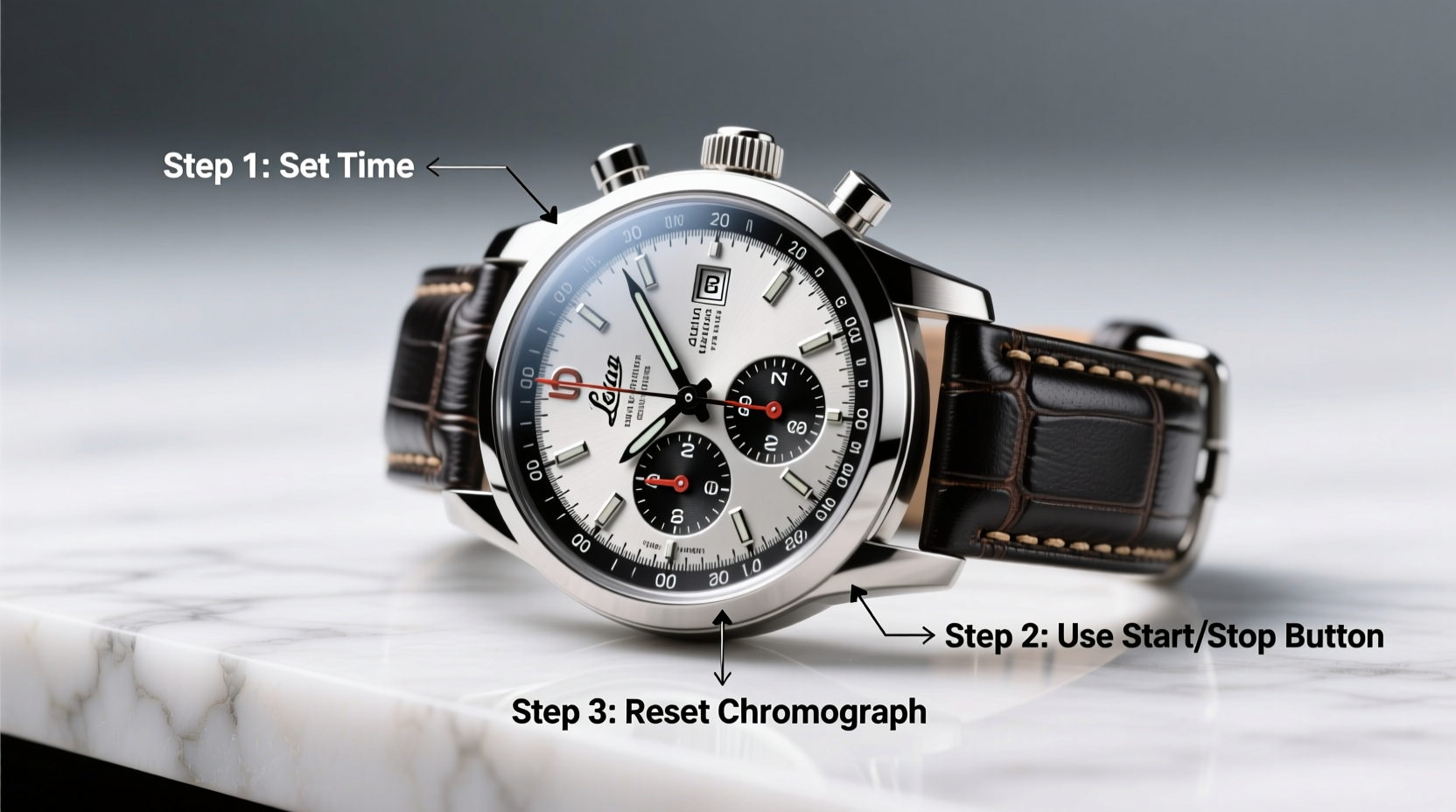
The term “chronograph” comes from the Greek words *chronos* (time) and *graph* (writer), originally referring to devices that recorded time intervals on paper. Today, it describes a watch with an integrated stopwatch function, typically controlled by pushers on the side of the case. Unlike a simple digital timer, a mechanical or quartz chronograph blends elegance with engineering, offering multiple subdials to track seconds, minutes, and sometimes hours of elapsed time.
Most modern chronographs feature three core components:
- Main Time Display: The primary hour and minute hands showing current time.
- Chronograph Hands: Usually a central seconds hand activated independently to measure duration.
- Subdials: Small registers that accumulate elapsed minutes (and sometimes hours) once the stopwatch runs beyond 60 seconds.
The pushers flanking the crown are key: the top one starts and stops the chronograph; the bottom resets it. Misuse—such as resetting while running—can damage mechanical movements over time.
“Precision timing isn’t just about speed—it’s about consistency and control. A well-used chronograph reflects discipline.” — Marcus Lang, Horological Instructor at Geneva Watchmaking School
Step-by-Step Guide to Operating Your Chronograph
Using a chronograph effectively requires deliberate action. Follow this sequence to avoid errors and protect your timepiece.
- Prepare the Watch: Ensure the chronograph hands are reset to zero. If not, press the lower pusher briefly to reset all counters.
- Start Timing: Press the upper pusher. The central chronograph hand will begin moving, tracking elapsed seconds.
- Monitor Subdials: After 60 seconds, the minute counter (usually at 3 o’clock) advances. Some models include an hour recorder at 6 or 9 o’clock.
- Stop Measurement: Press the upper pusher again. The hand freezes, displaying total elapsed time.
- Record & Reset: Note the time shown across the main hand and subdials. Then press the lower pusher to return all hands to zero.
Practical Applications: Using Your Chronograph in Real Life
Beyond novelty, the chronograph serves functional roles across professions and hobbies.
Sports and Fitness
Athletes use chronographs to time sprints, intervals, or lap durations. For example, a runner can start the timer at the beginning of a mile, stop after each lap, and analyze pace distribution without stopping the entire workout.
Aviation and Navigation
Pilots historically used chronographs to calculate fuel burn rates, ground speed, or time between waypoints. By measuring distance covered over a known time interval, they could estimate velocity without GPS.
Cooking and Productivity
In kitchens or workspaces, the chronograph allows precise tracking of tasks. Boiling eggs? Start the timer when water boils. Managing meeting segments? Allocate timed blocks for agenda items.
Driving and Racing
Auto enthusiasts time acceleration (0–60 mph) or lap times on tracks. Even daily drivers can monitor average speed over fixed routes to improve efficiency.
“During flight school, my chronograph was more reliable than cockpit electronics during simulator failures.” — Lt. Rebecca Tran, Retired Air Force Navigator
Do’s and Don’ts: Chronograph Best Practices
| Do | Don’t |
|---|---|
| Always stop the chronograph before resetting | Reset while the timer is still running |
| Use the chronograph sparingly if it’s a mechanical movement | Leave the chronograph running for days unnecessarily |
| Check water resistance rating before using near water | Operate pushers underwater unless rated for it (e.g., 100m+) |
| Service mechanical chronographs every 5–7 years | Ignore servicing; buildup can seize internal mechanisms |
| Familiarize yourself with your model’s specific layout | Assume all chronographs work identically |
Mini Case Study: Timing a Commute Optimization Project
David, a logistics manager in Chicago, wanted to reduce his team’s delivery window variance. He equipped each driver with a standard-issue chronograph watch. Over two weeks, they timed individual route segments—loading, traffic bottlenecks, parking, drop-offs—using the chronograph function.
By compiling data, David identified that 40% of delays occurred during final-block parking searches. He adjusted dispatch schedules to favor off-peak deliveries in dense zones and introduced curbside drop protocols. Average delivery time dropped by 18 minutes per route. The low-tech tool provided high-impact insights without relying on digital systems prone to signal loss.
This demonstrates how analog precision, combined with disciplined measurement, can solve modern operational challenges.
Advanced Features and What They Mean
Not all chronographs are basic stopwatches. Many include specialized scales and functions:
- Tachymeter Scale: Found on the bezel, it calculates speed based on travel over a fixed distance. For instance, if you drive one mile while timing it, the chronograph hand points to your average speed in mph.
- Telemeter Scale: Measures the distance to a distant event (like lightning) by timing the gap between sight and sound.
- Pulsometer Scale: Used medically to count heartbeats per minute—start the timer and stop after 30 beats; the hand shows BPM directly.
- Regatta Timer: On nautical chronographs, this counts down the 10-minute lead-up to a sailboat race start.
These scales require practice but offer quick calculations without tools. Understanding them turns your watch into a multi-functional analog computer.
FAQ: Common Chronograph Questions Answered
Can I use my chronograph every day?
Yes, especially with quartz chronographs. Mechanical versions benefit from moderation—constant use increases wear on the column wheel or cam system. Wind manually or wear regularly to maintain lubrication.
Why does my chronograph second hand jump in small increments?
This \"tick\" instead of smooth sweep is normal in quartz chronographs, which pulse every second. Mechanical chronographs may sweep smoothly (5–8 ticks per second) depending on beat rate.
How accurate is a chronograph compared to a smartphone timer?
Mechanical chronographs are accurate within -10 to +30 seconds per day. Certified chronometers (COSC) are tighter: -4/+6 seconds per day. While smartphones may be more precise, chronographs offer tactile feedback, no battery dependency, and instant access.
Conclusion: Take Control of Time
Mastering your chronograph watch is about more than pressing buttons—it’s about engaging with time as a measurable, manageable resource. From optimizing routines to executing critical tasks under pressure, the skills you develop translate far beyond the dial. Whether you own a vintage Valjoux-powered piece or a modern smart-analog hybrid, treat your chronograph as a tool of intentionality.




 浙公网安备
33010002000092号
浙公网安备
33010002000092号 浙B2-20120091-4
Comments
No comments yet. Why don't you start the discussion?