
Harsh lighting exposes every texture, pore, and imperfection on the skin. Whether you're preparing for a professional photoshoot, a high-definition video call, or an event with intense flash photography, your foundation choice can make or break your appearance in images. The debate between matte and dewy foundations isn't just about aesthetics—it's about how light interacts with your skin and makeup at a technical level. Understanding the science behind light reflection, skin finish, and camera exposure reveals why one finish often outperforms the other when the lights get bright.
The Science of Light and Skin Finish
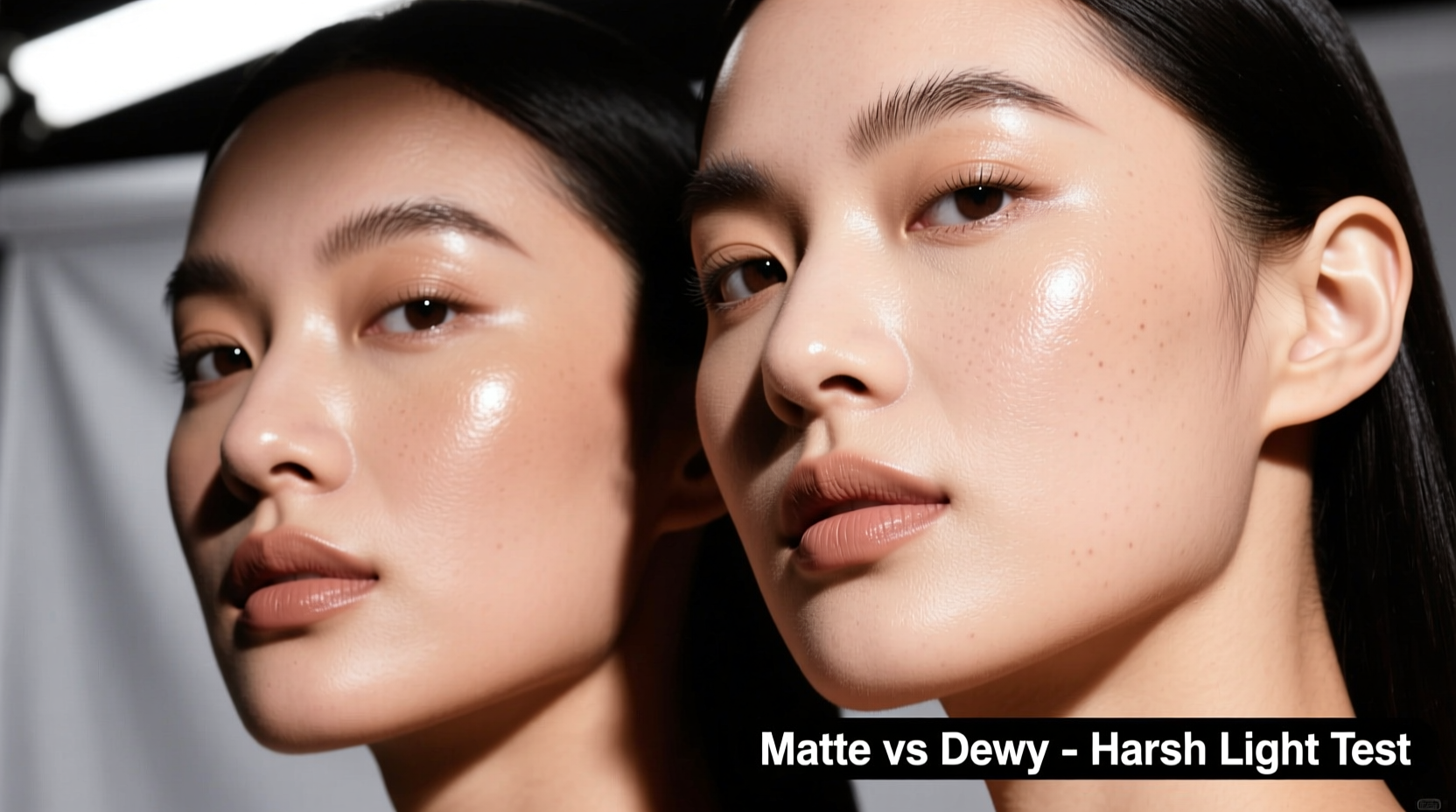
Light behaves differently depending on the surface it hits. A matte surface diffuses light, scattering it in multiple directions, while a dewy or glossy surface reflects light directly—often creating hotspots. In photography, especially under harsh, direct lighting (such as studio strobes, midday sun, or fluorescent overheads), these reflections become exaggerated by high-resolution sensors and flash bursts.
Dewy foundations are formulated to mimic hydrated, youthful skin by incorporating light-reflecting particles, oils, or silicones. While this creates a radiant glow in natural or soft lighting, that same glow turns into glare under intense conditions. Conversely, matte foundations absorb light rather than reflect it, minimizing shine and reducing the risk of overexposed areas on camera.
“Under studio lights, even the most subtle dewy finish can bloom into visible patches of shine. Matte finishes give us control—something we desperately need when pixels don’t forgive.” — Lena Park, Celebrity Makeup Artist & Photographic Consultant
How Cameras See Shine Differently Than the Human Eye
The human eye adjusts dynamically to lighting, balancing highlights and shadows through pupil dilation and brain processing. Cameras, however, capture light literally. High dynamic range (HDR) helps, but most consumer and even professional cameras struggle with extreme contrasts. When a dewy highlight sits next to a shadowed cheekbone, the sensor may blow out the highlight entirely, turning what looks like a healthy glow in person into a white streak in photos.
This phenomenon is known as \"specular reflection\"—a mirror-like bounce of light off smooth surfaces. Dewy foundations increase the skin’s specular reflectivity. Matte formulas, often containing silica, clay, or powders, create micro-textures that scatter light evenly, preventing concentrated reflections.
Comparative Analysis: Matte vs Dewy Under Harsh Lighting
| Feature | Matte Foundation | Dewy Foundation |
|---|---|---|
| Light Reflection | Diffused, low shine | Direct, high shine |
| Flash Photography Performance | Excellent – no glare | Poor – prone to overexposure |
| Skin Texture Camouflage | Good – blurs pores and fine lines | Fair – can accentuate texture due to light pooling |
| Longevity Under Heat/Light | High – resists melting | Moderate – oil separation increases shine |
| Best For | Studio shoots, interviews, outdoor events at noon | Soft lighting, evening events, editorial close-ups |
The data shows a clear trend: matte foundations offer superior performance under challenging lighting. They maintain consistency across exposures and reduce post-production editing time. Dewy finishes, while beautiful, require careful placement and controlled environments to avoid photographic pitfalls.
Real-World Example: Bridal Shoot Under Midday Sun
Alicia, a wedding photographer based in Arizona, recounted a destination bridal session she shot in July. The bride had opted for a dewy, “glass skin” look using a popular serum-infused foundation. The ceremony was scheduled at 1 PM under open sky with minimal shade.
“By the second roll of shots, her T-zone was reflecting sunlight like a car windshield,” Alicia said. “We weren’t using flash, but the ambient light was so strong that her cheeks looked wet. I had to stop and ask the MUA to blot and set with translucent powder. After that, the images improved dramatically—even though the original vision was compromised.”
The retouching process took nearly three hours longer than usual to tone down the shine and restore natural skin texture. In contrast, a similar shoot two weeks later—with a matte, long-wear foundation—required only minor color correction.
“Your foundation should serve the environment, not fight it. You can always add glow in post, but you can’t remove blown-out highlights easily.” — Marcus Tran, Professional Retoucher & Digital Imaging Specialist
When Dewy Can Work: Controlled Conditions and Strategic Application
It’s not that dewy foundations are inherently flawed—they’re simply context-dependent. In low-light settings, candlelit dinners, or golden hour outdoor photography, a dewy complexion enhances warmth and dimension. Even under studio lights, dewiness can be used strategically.
Modern techniques involve “dewy zoning”—applying luminous products only where light naturally hits: the center of the forehead, bridge of the nose, chin, and cheekbones. The rest of the face is kept matte to prevent chaos. This hybrid method gives the illusion of radiance without sacrificing photogenic integrity.
Additionally, some photographers use diffusion filters, softboxes, or bounce cards to soften harsh light before it reaches the subject. In such setups, a dewy finish can survive without turning into a hotspot. But relying on equipment adjustments isn’t always practical—especially in fast-paced environments like red carpets, press tours, or live broadcasts.
Step-by-Step: Preparing for a High-Light Photoshoot
- Assess the lighting conditions. Is it direct sun, studio strobes, or mixed indoor lighting? Bright environments favor matte finishes.
- Choose a long-wear matte foundation. Look for keywords like “transfer-resistant,” “oil-free,” or “photo-ready.” Avoid formulations with shimmer or serums.
- Prime with a mattifying base. Use a primer with silica or dimethicone to fill pores and create a smooth, non-reflective canvas.
- Apply foundation evenly with a damp sponge or flat brush. Build coverage gradually to avoid caking.
- Set with translucent powder. Focus on the T-zone and any area prone to shine. Consider baking for extended wear.
- Add subtle glow only where needed. Tap a cream highlighter on the inner corners of the eyes, brow bones, and just above the upper lip.
- Finish with a setting spray designed for longevity. Opt for a matte or balanced mist—not one labeled “luminous” or “glow-enhancing.”
Common Mistakes That Amplify Dewy Foundation Issues
- Over-applying illuminating primers. These can turn into reflective pools under strong light.
- Skipping setting powder. Even “natural finish” foundations can oxidize and shine after minutes under heat.
- Mixing dewy products layer by layer. Combining dewy primer, foundation, blush, and highlighter multiplies reflectivity exponentially.
- Ignoring skin prep. Oily or dehydrated skin exacerbates both shine and patchiness, making any finish harder to manage.
One frequent error is assuming that dewy equals “healthy” and matte equals “flat.” With proper technique, a matte base can still look vibrant and alive. The key is skin health underneath—well-moisturized, gently exfoliated, and evenly toned skin provides a strong foundation for any finish.
Expert Tips for Balancing Aesthetic and Functionality
Makeup artists working in television and film have long favored matte complexions—not because they’re less beautiful, but because they’re predictable. On set, lighting changes rapidly, and there’s no time for touch-ups between takes. A consistent finish ensures continuity across scenes.
Jamila Reyes, a makeup department head for daytime TV, shared her protocol: “I start with a hydrating primer for comfort, then switch to a matte foundation. I might dust a tiny bit of liquid illuminator on the apples of the cheeks, but only if the lighting is soft. If the studio lights are cranked up, everything goes matte—including the blush.”
She also emphasizes the importance of skin prep: “If the skin looks dry under matte makeup, it’s not the foundation’s fault. It’s a hydration issue. We moisturize, use facial mists, and sometimes do a quick sheet mask before application. Healthy skin wears matte beautifully.”
Frequently Asked Questions
Can I use a dewy foundation if I’m being photographed outdoors at noon?
It’s not recommended. Midday sun is extremely harsh and directional, making dewy finishes prone to glare. If you must use a dewy formula, apply it sparingly and set aggressively with powder. Better yet, opt for a satin or natural finish as a compromise.
Does matte foundation make me look older in photos?
Not if applied correctly. Older formulations could settle into fine lines, but modern matte foundations are lightweight and flexible. To avoid aging effects, ensure your skin is well-hydrated and avoid heavy powdering around the eyes and mouth.
Is there a foundation that’s both matte and hydrating?
Yes. Many brands now offer “balanced” or “natural” finishes that control oil without drying the skin. Look for ingredients like hyaluronic acid, glycerin, and squalane paired with mattifying agents like kaolin clay or perlite.
Final Checklist Before Your Next Shoot
- ✅ Confirm lighting environment
- Know whether you’ll be indoors, outdoors, under flash, or in mixed lighting.
- ✅ Choose the right foundation finish
- Matte for harsh light, dewy for soft light, satin for in-between.
- ✅ Prep skin thoroughly
- Cleanse, exfoliate gently, and moisturize at least 30 minutes before application.
- ✅ Prime appropriately
- Use mattifying primer for oily skin; hydrating but non-greasy for dry skin.
- ✅ Set strategically
- Focus powder on high-shine zones. Use a puff for baking if needed.
- ✅ Limit dewy products to accent areas
- Highlight only where light naturally hits—never all over.
- ✅ Bring touch-up supplies
- Blotting papers, pressed powder, and a small brush are essential for maintaining finish.
Conclusion: Make Your Makeup Work With the Light, Not Against It
The choice between matte and dewy foundation under harsh lighting isn’t about beauty standards—it’s about optical physics and practical results. While dewy skin symbolizes youth and vitality, its real-world performance under intense light often falls short. Matte foundations, with their ability to diffuse light and resist shine, consistently deliver cleaner, more professional-looking photographs.
That doesn’t mean you have to sacrifice radiance entirely. Smart application, strategic highlighting, and proper skin care allow you to achieve a fresh, healthy look without the glare. The goal isn’t to eliminate glow but to control it—so it enhances your features instead of overwhelming them in high-definition captures.




 浙公网安备
33010002000092号
浙公网安备
33010002000092号 浙B2-20120091-4
Comments
No comments yet. Why don't you start the discussion?