
Carrying only what you need in a small shell bag—whether it’s a clutch, crossbody, or minimalist tote—requires more than just tossing in your phone and keys. Without a thoughtful approach, even the smallest items can create clutter, make retrieval difficult, and compromise the bag’s sleek design. The key lies not in reducing necessity, but in optimizing function. With strategic organization, you can maintain both style and practicality, turning a compact bag into a highly efficient personal command center.
Understand Your Bag’s Layout and Limitations
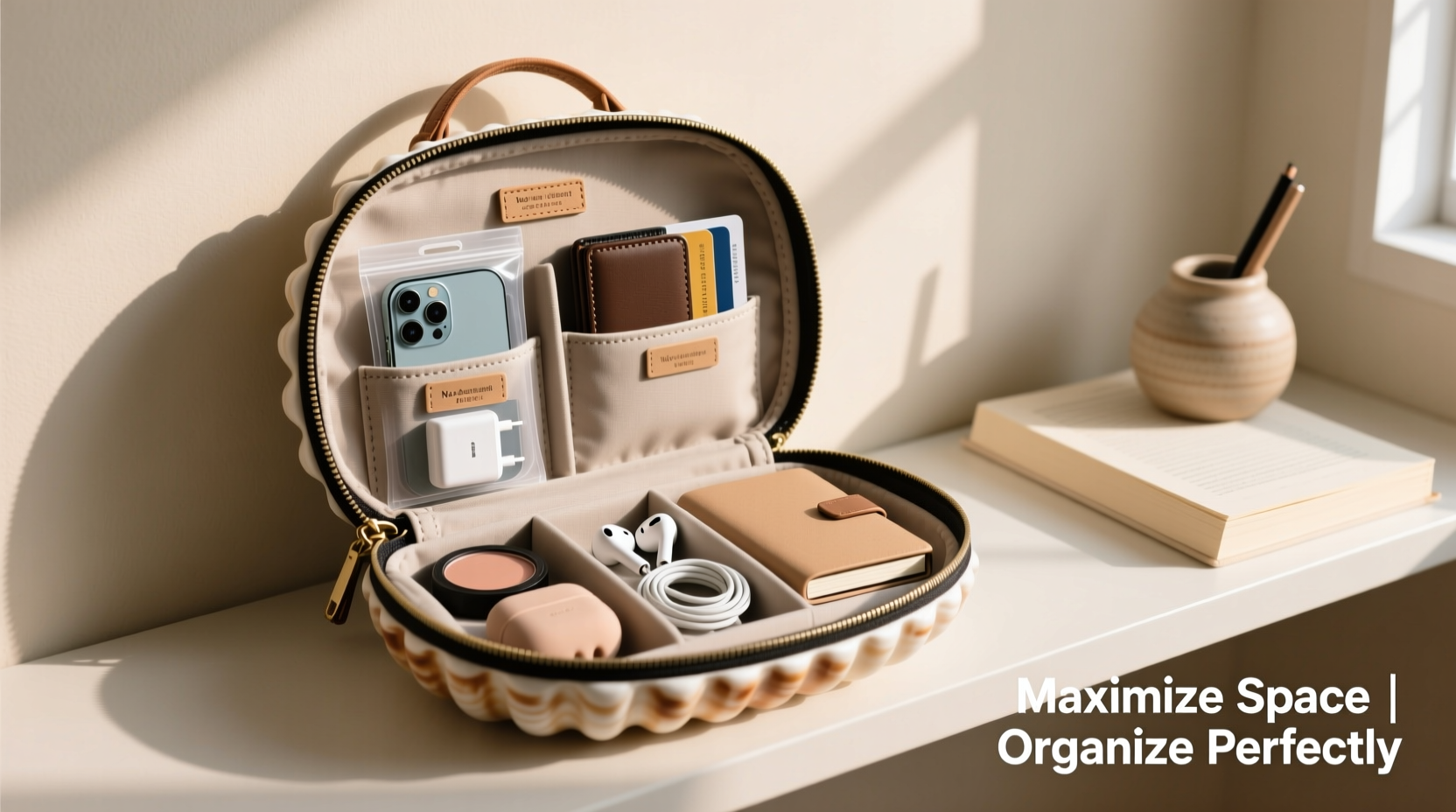
A shell bag typically features minimal internal structure—no zipped compartments, padded sleeves, or dividers. This streamlined design enhances aesthetics but reduces organizational capacity. Before filling it, assess its dimensions, closure type, and access points. Is there a single main compartment? A back slip pocket? Does it open wide or stay narrow?
Knowing these details helps determine what fits and how to prioritize placement. For instance, a narrow-opening clutch may require flat-layer packing, while a slightly larger shell-style crossbody might allow vertical stacking if folded correctly.
Prioritize Essentials with a Capsule Mindset
Treat your bag like a capsule wardrobe: every item must earn its place. Start by listing what you *actually* use daily—not what you *might* need. Most people overpack out of habit, not necessity.
Common daily essentials include:
- Phone
- Keys
- Wallet or cardholder
- Lip balm or compact mirror (if used regularly)
- Hand sanitizer wipe (travel-sized)
- Earbuds or hearing aids (if applicable)
Anything beyond this should be evaluated for frequency of use. That mini notebook? Only if you jot notes daily. Makeup touch-up kit? Only if you reapply during the day. Be ruthless—each extra item increases bulk and reduces accessibility.
“Efficiency in small bags starts with editing, not organizing. You can’t optimize clutter.” — Lena Torres, Urban Lifestyle Organizer
Use Space-Saving Techniques and Accessories
Once you’ve defined your essentials, refine how they occupy space. Even minor adjustments can free up critical room.
Roll, Fold, or Stack Strategically
Flat items like tissues, receipts, or slim wallets benefit from horizontal layering. Roll soft items like fabric masks or charging cables instead of stuffing them loosely. This prevents tangling and creates uniform shapes that nestle together.
Downsize Key Components
- Wallet: Switch to a minimalist cardholder holding only 3–4 essential cards and cash.
- Keys: Use a compact key leash or foldable key holder to reduce jangling and bulk.
- Sanitizer: Opt for a credit-card-sized alcohol wipe pack instead of a liquid bottle.
Utilize Multi-Functional Items
Choose tools that serve dual purposes. A lipstick doubles as blush; a silk scarf can be a neck pillow on transit; earbuds replace standalone headphones. Fewer objects mean more breathing room.
| Item | Bulkier Version | Space-Smart Alternative |
|---|---|---|
| Wallet | Bi-fold with 8+ cards | Horizontal cardholder (3–4 cards) |
| Keys | Loose or on large ring | Foldable silicone key leash |
| Cleaning | Mini hand sanitizer bottle | Disposable wipe sheet (credit card size) |
| Charger | Full-length cable + brick | Magnetic USB-C cable clip-on |
Step-by-Step: Organizing Your Shell Bag in 5 Minutes
Follow this routine weekly or whenever you switch bags:
- Empty completely. Lay all contents on a clean surface.
- Sort by category. Group like items: tech, documents, personal care, etc.
- Eliminate redundancies. Remove duplicates (two lip balms?) or expired items (old tickets, dried wipes).
- Select only daily-use items. Return non-essentials to home storage.
- Reinsert in order of priority:
- Bottom layer: Flat, least-used-but-necessary (e.g., emergency cash in sealed pouch)
- Middle layer: Frequently accessed (wallet, keys)
- Top layer: Immediate access (phone, pass card)
This layered method ensures you’re not digging through layers to find your train pass or phone. It also protects delicate items from pressure damage.
Real Example: How Sarah Transformed Her Daily Carry
Sarah, a graphic designer in Portland, relied on a chic shell crossbody for her commute and client meetings. Despite its elegant look, she constantly fumbled for her transit card and worried about overstuffing it. After two weeks of tracking what she actually used, she realized she carried a full wallet (with rarely used loyalty cards), three pens, and a bulky power bank she never charged.
She downsized to a titanium cardholder, kept one pen, replaced the power bank with a clip-on battery, and stored her transit card in a dedicated slot behind the phone sleeve. The result? She could access her card in under five seconds, the bag retained its shape, and she felt lighter throughout the day.
“I thought I needed everything,” she said. “But once I edited down, I realized efficiency was more stylish than excess.”
Checklist: Perfect Small Bag Organization in One Go
Use this checklist each time you reset your bag:
- ✅ Empty all contents
- ✅ Wipe down interior with dry microfiber cloth
- ✅ Discard trash (receipts, wrappers, dried tissues)
- ✅ Review each item: Have I used this in the past 3 days?
- ✅ Replace bulky versions with compact alternatives
- ✅ Arrange items in access-order: top = fastest reach
- ✅ Test closure—should zip or snap without strain
FAQ
Can I fit a small notebook in a shell bag?
Only if it’s ultra-thin (A7 size or smaller) and used daily. Otherwise, consider voice memos or digital notes. If you must carry one, place it vertically against the back wall to avoid pushing other items forward.
How do I keep items from getting scratched?
Layer soft barriers: use a fabric pouch for keys, place phone screen-down, and avoid mixing metal objects directly with lenses or screens. A small felt-lined card case adds protection without bulk.
What if my bag has no pockets at all?
Add a slim, foldable organizer insert (measuring under 0.5” thick). These provide structure and hidden compartments without altering the bag’s silhouette. Alternatively, use labeled elastic bands to group similar items (e.g., a colored band around cards).
“The best small bag systems are invisible—everything works because nothing fights for space.” — Marcus Lin, Product Design Consultant
Conclusion
Maximizing space in a small shell bag isn’t about squeezing more in—it’s about achieving effortless access with less. By curating essentials, using intelligent packing techniques, and maintaining a disciplined layout, you transform limitation into elegance. A well-organized shell bag reflects clarity of purpose and attention to detail, qualities far more valuable than extra storage.




 浙公网安备
33010002000092号
浙公网安备
33010002000092号 浙B2-20120091-4
Comments
No comments yet. Why don't you start the discussion?