
After weeks or even months of dedicated study, many pre-med students hit a frustrating wall: their MCAT scores stop improving. You’ve reviewed content, taken practice tests, and studied consistently—yet your score remains unchanged. This plateau isn’t a sign of failure; it’s a signal that your current approach needs refinement. Understanding the root causes behind stagnant performance is the first step toward meaningful improvement.
Why Your MCAT Score Has Stalled
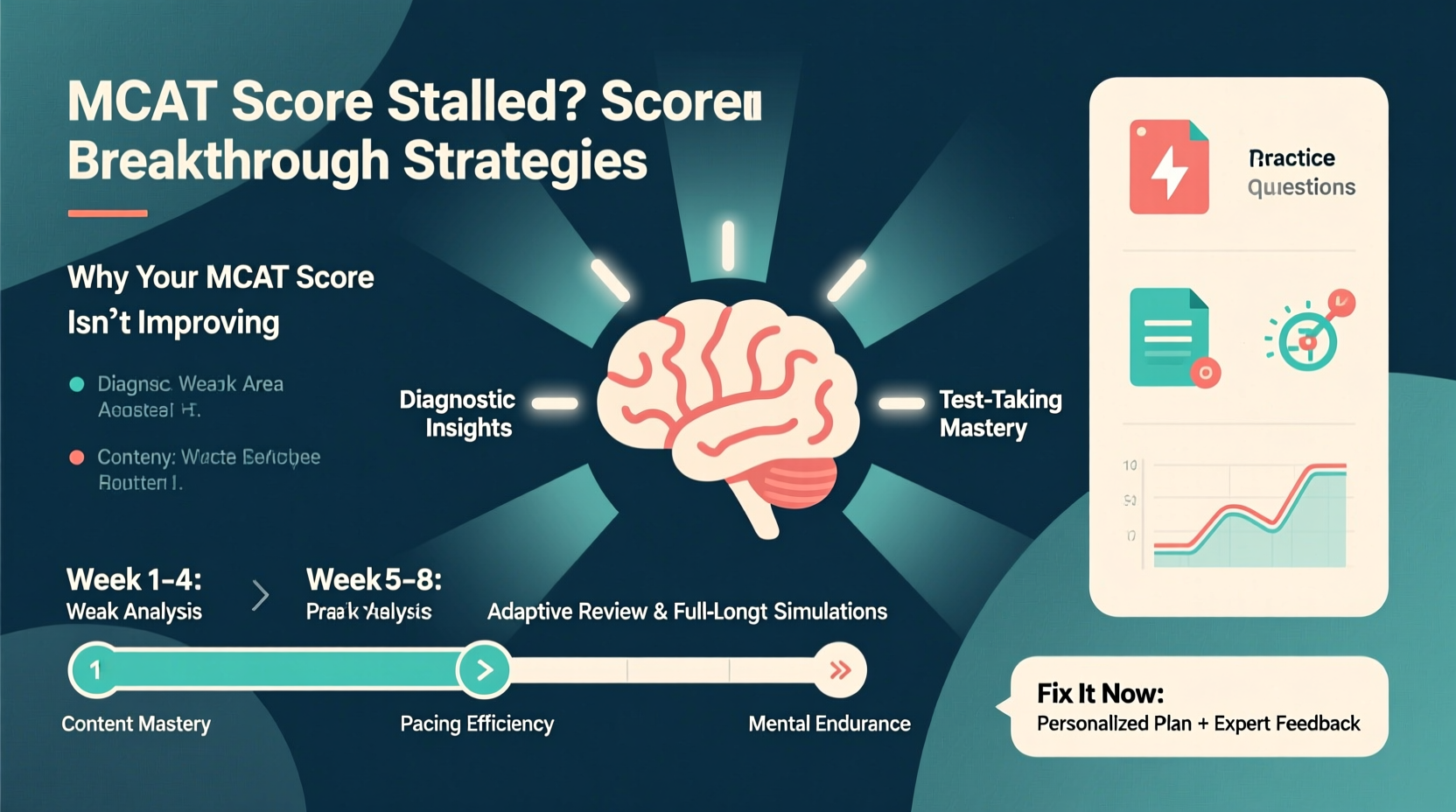
A plateau in MCAT preparation is common, but it's rarely due to lack of intelligence or effort. More often, it stems from inefficiencies in study strategy. When students rely heavily on passive learning—rereading notes, highlighting textbooks, or watching videos without active recall—they create an illusion of mastery. The brain feels familiar with the material, but retention and application lag.
Another frequent cause is inconsistent practice testing. Taking full-length exams sporadically prevents you from building endurance and identifying evolving weaknesses. Without regular, timed assessments, you can't accurately measure growth or adjust focus areas.
Some students also fall into the trap of overemphasizing content review at the expense of critical thinking. The MCAT doesn’t test rote memorization—it evaluates how well you apply knowledge under pressure. If your practice doesn’t simulate real test conditions, including time constraints and complex passages, your score will reflect that gap.
“Many students think they’re studying hard, but they’re not studying smart. The difference between a 505 and a 515 often comes down to strategy, not content.” — Dr. Sarah Nguyen, MCAT Curriculum Director at MedPath Prep
Common Mistakes That Keep Scores Flat
- Passive Review Over Active Recall: Reading and re-reading without self-testing leads to shallow understanding.
- Neglecting Full-Length Practice Exams: Skipping FLs means missing out on stamina-building and realistic feedback.
- Poor Error Analysis: Reviewing incorrect answers without asking *why* you got them wrong limits growth.
- Ignoring Timing Strategy: Spending too long on early questions leaves insufficient time for later sections.
- Focusing Only on Weak Subjects: Over-correcting one area while neglecting others creates imbalance.
How to Break Through the Plateau: A Step-by-Step Guide
- Pause Content Review and Take a Diagnostic FL: Before making changes, assess your current level with a full-length exam under real conditions—timed, no breaks, no distractions.
- Analyze Every Mistake Systematically: Categorize errors by topic (e.g., amino acids), skill (e.g., data interpretation), and reason (e.g., misread question, ran out of time).
- Adjust Your Study Plan Based on Data: Spend more time on high-yield, frequently missed topics. Use your error log to guide priorities.
- Incorporate Active Learning Daily: Dedicate 30–60 minutes per day to spaced repetition (Anki), passage-based questions, or whiteboard teaching.
- Simulate Test Day Weekly: Schedule one full-length exam every 7–10 days, gradually improving pacing and mental endurance.
- Target Weak Skills, Not Just Topics: If you struggle with CARS, practice untimed reading first, then gradually reduce time per passage.
- Seek Targeted Feedback: Join a study group or work with a tutor to get insight into blind spots you might miss.
What Success Looks Like: A Real Example
Jamal had been preparing for the MCAT for four months. He scored a 504 on his first diagnostic and improved to 508 after two months—but then his next three practice tests hovered between 507 and 509. Frustrated, he considered delaying his exam.
He decided to pause and analyze his last two FLs in detail. He discovered that while his science content was strong, he consistently lost points in CARS due to poor time management and second-guessing answers. In the sciences, he realized he was missing questions not because he didn’t know the material, but because he rushed through passages and made careless errors.
He adjusted his plan: he reduced content review by half, added daily CARS drills with strict timing, and began reviewing every practice question—even the ones he got right. Within four weeks, his score jumped to 514. On test day, he scored a 515.
His breakthrough wasn’t from learning new content. It came from changing how he practiced.
Do’s and Don’ts of Breaking an MCAT Plateau
| Do | Don’t |
|---|---|
| Review every practice question thoroughly | Only review incorrect answers |
| Use Anki or another spaced repetition tool daily | Rely solely on rereading notes |
| Take full-length exams regularly | Save FLs for “when I’m ready” |
| Time all section banks and QPacks | Practice without time pressure |
| Focus on pattern recognition in questions | Treat each question as isolated |
Essential Checklist to Restart Progress
- ✔ Taken a recent full-length under test-like conditions
- ✔ Reviewed all incorrect and uncertain answers
- ✔ Identified top 3 weak content areas and 2 weak skills (e.g., inference, timing)
- ✔ Created a revised 4-week study schedule with focused practice
- ✔ Integrated daily active recall (flashcards, self-testing)
- ✔ Scheduled next FL for 7–10 days out
- ✔ Eliminated passive study habits (e.g., endless video lectures)
Frequently Asked Questions
How long does an MCAT plateau usually last?
Plateaus typically last 2–6 weeks if unaddressed. With strategic adjustments—like improving error analysis and increasing active practice—most students see progress within 3–4 weeks.
Should I change my study materials if my score isn’t improving?
Not necessarily. Switching resources too often disrupts continuity. First, evaluate your method. If you're using quality materials (e.g., AAMC, UWorld, Jack Westin) but still stalling, the issue is likely your approach, not the content.
Is it normal to score lower on a practice test after studying?
Yes. Fluctuations happen. A single lower score doesn’t indicate regression. Look at trends across 2–3 exams. Temporary dips can result from fatigue, test difficulty, or focusing on harder topics.
Final Steps to Unlock Your Next Level
Breaking through an MCAT plateau requires honesty, discipline, and a willingness to change. You don’t need to study longer—you need to study differently. Shift from passive consumption to active engagement. Treat every practice question as a diagnostic tool. Refine your timing, deepen your reasoning, and prioritize quality over quantity.
Remember, scoring stagnation is not a dead end—it’s a pivot point. The most successful test-takers aren’t those who never struggle, but those who respond strategically when progress stalls. Your next score jump isn’t just possible; it’s within reach if you’re willing to adapt.




 浙公网安备
33010002000092号
浙公网安备
33010002000092号 浙B2-20120091-4
Comments
No comments yet. Why don't you start the discussion?