
Mechanical keyboards have evolved from niche peripherals to mainstream essentials for typists, programmers, and gamers alike. One of the most debated topics in the mechanical keyboard community revolves around switch mounting: hot swappable versus soldered designs. The choice isn't just about convenience—it affects repairability, customization, cost, and even typing feel over time. Understanding the real-world implications of each option helps buyers make informed decisions that align with their usage patterns, technical comfort, and budget.
At first glance, hot swappable keyboards seem like the obvious upgrade—why wouldn’t you want the ability to swap switches without soldering? But the reality is more nuanced. Soldered keyboards still dominate high-end builds and enthusiast circles for good reasons. This article breaks down both options objectively, weighing performance, longevity, and practicality to answer the critical question: which type is truly worth your investment?
Understanding the Core Differences
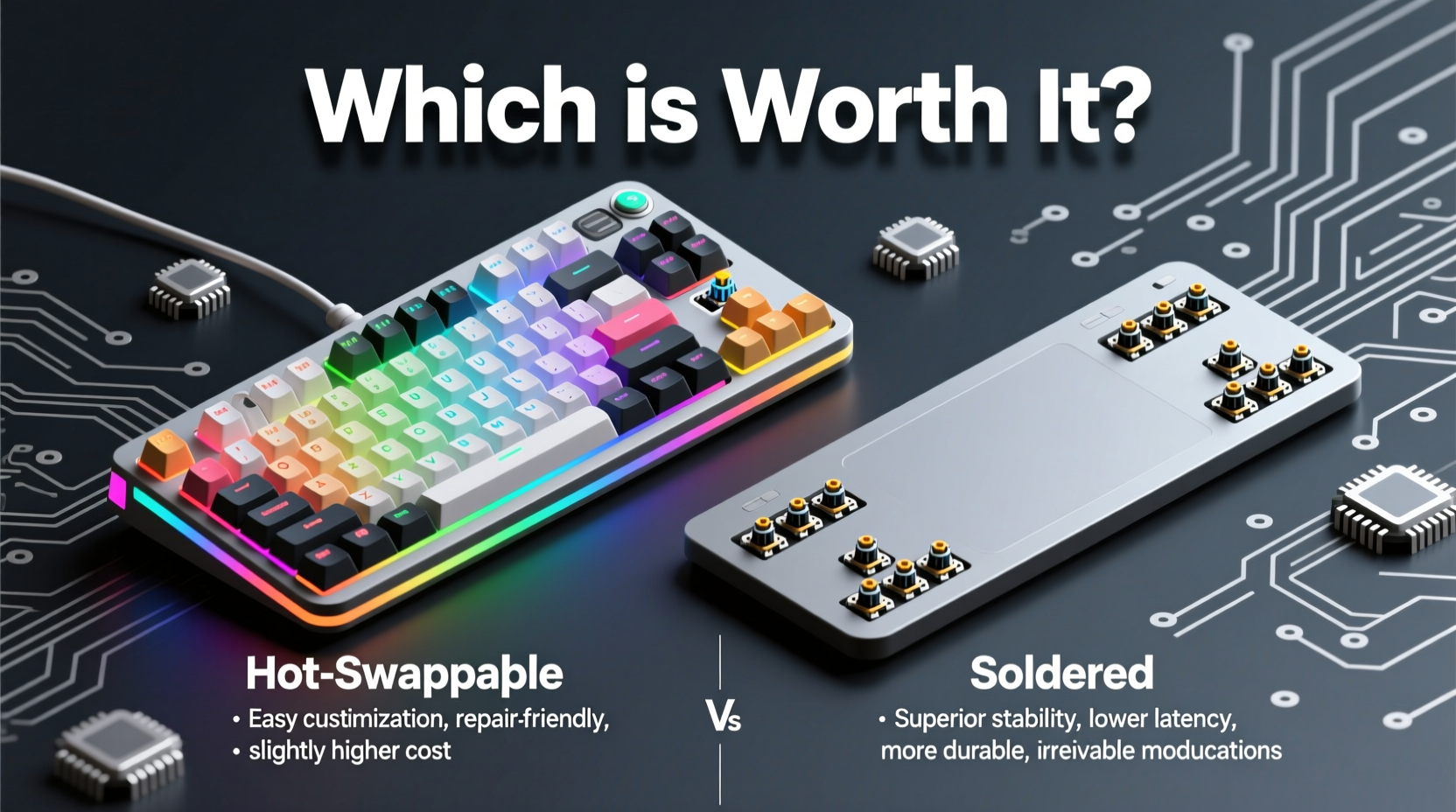
The fundamental difference between hot swappable and soldered mechanical keyboards lies in how the switches connect to the printed circuit board (PCB). In a soldered keyboard, each switch is permanently attached via solder joints—tiny beads of molten metal that create an electrical and mechanical bond. This method has been standard since the inception of mechanical keyboards.
Hot swappable keyboards, on the other hand, use specialized sockets on the PCB that allow switches to be inserted and removed by hand or with minimal tools. These sockets function like miniature connectors, enabling plug-and-play replacement without heat, flux, or a soldering iron. While this sounds revolutionary, it introduces variables in contact stability, signal integrity, and long-term wear.
It's important to note that hot swappability doesn't refer to keycaps—it applies exclusively to the underlying switches. Keycaps are almost always removable regardless of the switch-mounting method.
Performance and Typing Experience
Many users assume that switch type alone determines typing feel—but the connection method plays a subtle yet significant role. Soldered connections offer the most direct electrical pathway between switch and PCB, resulting in consistent actuation and zero latency. Because there’s no intermediary socket, signal transmission is as clean as possible.
Hot swappable sockets, while engineered for reliability, introduce a small gap between the switch pins and the PCB. Over time, oxidation, dust, or minor misalignment can lead to inconsistent contact, potentially causing double-actuations or missed keystrokes. Most modern hot swap sockets (like Kailh or JWK models) are well-designed and minimize these issues, but they remain a risk factor absent in soldered boards.
In blind tests, experienced typists often report negligible differences in tactile feedback or responsiveness between the two types. However, under heavy use—especially in gaming or rapid typing scenarios—soldered keyboards tend to maintain peak performance longer. For professionals relying on absolute consistency, such as coders or competitive esports players, this margin matters.
“Even a 0.5% input inconsistency can disrupt muscle memory during high-speed typing or gameplay. Soldered connections eliminate one variable in that equation.” — David Lin, Firmware Engineer & Mechanical Keyboard Designer
Customization and Flexibility
If performance favors soldered keyboards, flexibility unquestionably leans toward hot swappable models. The ability to change switches without tools opens up experimentation that was once limited to DIY enthusiasts with soldering experience.
For example, a user might start with linear Red switches for gaming but later prefer tactile Browns for office work. On a hot swappable board, this transition takes minutes. On a soldered keyboard, it requires desoldering old switches and carefully soldering new ones—a process that risks damaging the PCB if done incorrectly.
This flexibility extends beyond personal preference. It allows users to:
- Replace worn-out switches individually
- Test different brands (e.g., Gateron vs. Cherry MX) before committing
- Repair single-switch failures without replacing the entire unit
- Adapt the keyboard to changing needs over years
Hot swappable keyboards lower the barrier to entry for modding. Users who might otherwise avoid hardware tinkering can now customize their typing experience safely. This democratization of customization is a major reason for the surge in popularity of hot swappable designs across mid-range and budget keyboards.
Longevity and Repairability
Durability is where the debate gets complex. Soldered keyboards, when built with quality components, are inherently more stable. There are fewer moving parts and no socket degradation. However, if a switch fails, repair becomes a technical challenge. Without proper tools and skills, users must either live with a faulty key or replace the entire keyboard.
Hot swappable keyboards trade some structural integrity for serviceability. While sockets can wear out after hundreds of insertions, most users won’t reach that threshold under normal conditions. More commonly, issues arise from poor-quality sockets or improper switch insertion (e.g., bending pins). That said, replacing a single malfunctioning switch on a hot swappable board is faster and safer than desoldering.
A telling example: A software developer using a soldered keyboard noticed a sticky spacebar after 18 months. Lacking soldering tools, he continued using the keyboard despite discomfort. In contrast, a colleague with a hot swappable model replaced the same switch during lunch break using only a pair of pliers.
Over a five-year lifespan, the average user may replace 1–3 switches due to wear or preference changes. Hot swappable designs accommodate this naturally; soldered ones do not.
Cost and Value Comparison
Price is another critical factor. Historically, hot swappable keyboards carried a premium due to added engineering complexity. Today, however, the gap has narrowed significantly. Many entry-level hot swappable boards retail for under $70, while high-end soldered models can exceed $200.
Still, the manufacturing cost of hot swap sockets adds approximately $5–$10 per unit. Some manufacturers pass this on directly; others offset it by using lower-tier materials elsewhere (e.g., cheaper stabilizers or plastic cases).
| Feature | Hot Swappable | Soldered |
|---|---|---|
| Switch Replacement | Tool-free, instant | Soldering required |
| Signal Stability | High (with quality sockets) | Very High |
| Lifetime Maintenance | Easy | Difficult without tools |
| Entry Cost | $50–$150 | $80–$300+ |
| DIY Accessibility | Beginner-friendly | Intermediate/Expert |
| Long-Term Customization | Excellent | Limited |
The table illustrates that value depends on user priorities. If you plan to keep your keyboard unchanged for years, a well-built soldered model offers superior performance per dollar. But if you anticipate tweaking your setup, learning about switches, or extending the keyboard’s life through repairs, hot swappable becomes the better long-term investment.
Step-by-Step Guide to Choosing the Right Type
Follow this decision framework to determine which keyboard suits your needs:
- Assess Your Technical Comfort: Are you willing to learn soldering? If not, hot swappable gives you future repair options.
- Define Your Use Case: Gamers and writers who demand consistency may prefer soldered; tinkerers and multi-role users benefit from hot swap.
- Budget Realistically: Factor in potential future costs—replacing a whole keyboard vs. a few switches.
- Research Build Quality: Not all hot swappable boards are equal. Look for reviews mentioning socket durability and PCB thickness.
- Consider Longevity Goals: Planning to use the keyboard for 5+ years? Hot swappable supports easier upgrades and repairs.
Real-World Scenario: Two Users, Two Choices
Meet Alex and Jamie—both bought mechanical keyboards at the same time but made different choices.
Alex chose a premium soldered keyboard known for its aluminum case and flawless typing feel. After two years, a switch failed. Unable to solder, Alex kept using the keyboard with a less-responsive Enter key. Eventually, frustration led to purchasing a second keyboard instead of repairing the first.
Jamie opted for a mid-range hot swappable model. Over 18 months, Jamie experimented with three different switch types, settling on silent tactile switches ideal for shared workspaces. When a switch developed chatter, Jamie replaced it in under five minutes using spare switches from a previous build.
Jamie’s total cost remained low, and satisfaction stayed high. Alex enjoyed superior initial performance but faced higher long-term friction. This scenario reflects a growing trend: convenience and adaptability often outweigh marginal performance gains in everyday use.
Frequently Asked Questions
Can I convert a soldered keyboard to hot swappable?
Technically, yes—but it requires advanced skills. You’d need to desolder all switches, drill or mill space for sockets, then solder the sockets onto the PCB. This is risky and generally not cost-effective unless you’re deeply experienced in PCB modification.
Do hot swappable keyboards feel different?
Not inherently. The switch itself defines the feel. However, slight wobble or reduced stability can occur if the socket-to-pin fit is loose. Higher-end hot swappable boards minimize this with tighter tolerances and reinforced sockets.
Are soldered keyboards obsolete?
No. High-end custom kits and boutique boards still favor soldered designs for their reliability and cleaner internal layout. They remain the choice for purists and those building once-in-a-lifetime keyboards.
Final Verdict: Which Is Worth It?
The answer depends on your definition of “worth.” If you prioritize peak performance, rigidity, and are confident in your ability to repair hardware, a soldered mechanical keyboard delivers unmatched integrity. It’s ideal for users who know exactly what they want and don’t plan to change it.
But for most people—including casual typists, remote workers, hobbyists, and even serious enthusiasts exploring switch preferences—hot swappable keyboards offer superior value. The freedom to experiment, repair, and evolve your setup over time outweighs the minimal performance trade-offs. As manufacturing improves, the reliability gap continues to shrink, making hot swappable models increasingly viable even for demanding tasks.
In a market where technology evolves rapidly and personalization matters, adaptability is a form of durability. A keyboard that can grow with you lasts longer—not just in years, but in relevance.




 浙公网安备
33010002000092号
浙公网安备
33010002000092号 浙B2-20120091-4
Comments
No comments yet. Why don't you start the discussion?