
For artists, architects, and hobbyists alike, the quality of a pencil’s line can dramatically affect the outcome of a sketch. While many assume that graphite grade alone determines smoothness, the delivery mechanism—mechanical versus retractable—plays an equally crucial role. The choice between a mechanical pencil and a retractable one isn’t just about convenience; it influences line consistency, pressure response, and overall drawing experience. Understanding the subtle yet significant differences between these two types helps artists make informed decisions based on their workflow, preferred medium, and artistic goals.
Understanding the Mechanics: How Each Pencil Delivers Graphite
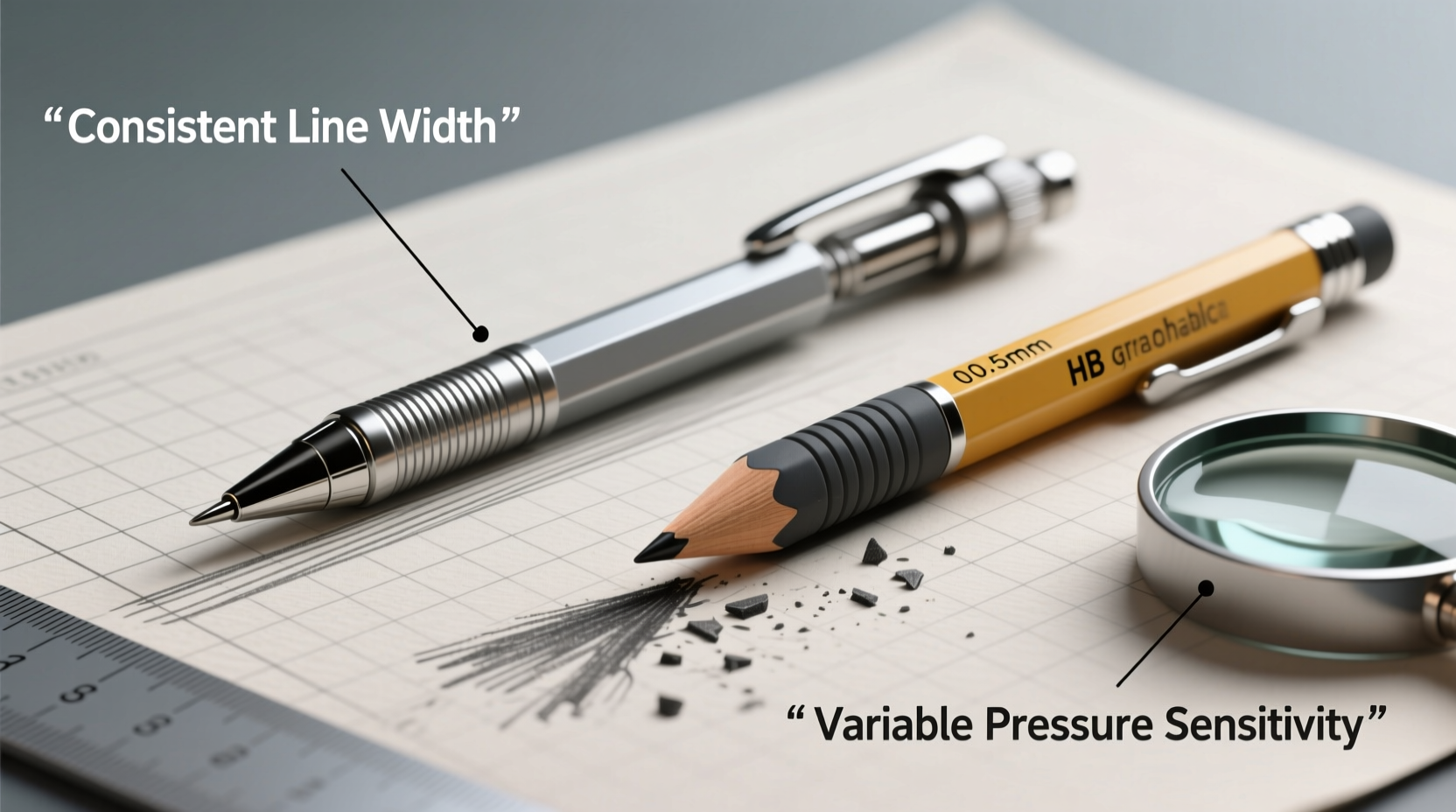
The fundamental difference between mechanical and retractable pencils lies in how they expose and advance the graphite core. A mechanical pencil uses a clutch mechanism to extend and lock a thin lead (typically 0.3mm to 0.9mm) with each click or twist. This lead remains fixed in position until manually advanced or retracted. In contrast, a retractable pencil—often referred to as a \"leadholder\"—holds thicker leads, usually 2mm or larger, and advances them incrementally via a push-button or twist mechanism. These pencils resemble traditional wooden pencils in size and weight but offer replaceable leads.
Because of their design, mechanical pencils provide fine, consistent lines ideal for precision work. The thinner lead allows for detailed hatching, technical drawings, and tight linework. Retractable pencils, with their broader cores, are better suited for expressive sketching, shading, and bold mark-making. However, when evaluating which produces smoother lines, several factors come into play beyond just diameter.
Factors Influencing Line Smoothness
Smoothness in pencil lines is not solely determined by the tool—it's a combination of lead composition, tip sharpness, point retention, and how evenly the graphite deposits onto paper. Several key variables affect performance:
- Lead Diameter: Thinner leads (0.5mm, 0.7mm) produce finer lines but may skip or feel scratchy if too hard. Wider leads (2mm+) glide more easily due to greater surface contact.
- Graphite Quality: Higher-grade graphite with proper clay-to-carbon ratios reduces friction and enhances laydown.
- Tip Consistency: Mechanical pencils maintain a sharper point longer, while retractable pencils require frequent sharpening for precision.
- Pressure Sensitivity: Retractable pencils allow more natural pressure variation, mimicking the feel of a wooden pencil.
- Paper Texture: Smoother papers reduce drag, especially beneficial for fine-point mechanical pencils.
While both tools can deliver smooth results under optimal conditions, their inherent designs favor different applications. For example, a 0.5mm HB mechanical pencil might feel crisp but slightly abrasive on textured paper, whereas a 2mm B-grade lead in a retractable holder glides effortlessly, depositing rich, even tones.
Comparative Analysis: Mechanical vs Retractable for Sketching
| Feature | Mechanical Pencil | Retractable Pencil |
|---|---|---|
| Typical Lead Size | 0.3mm – 0.9mm | 1.18mm – 3.2mm (commonly 2mm) |
| Line Precision | Excellent for fine details | Moderate; better for broad strokes |
| Smoothness Potential | Good with soft leads and smooth paper | Superior due to larger, softer lead mass |
| Consistency Over Time | High (point stays sharp) | Variable (requires frequent sharpening) |
| Ease of Shading | Limited by narrow tip | Excellent; wide lead enables quick tonal gradients |
| Portability & Refill Speed | Very high | Moderate (larger size, slower advance) |
| Best For | Technical sketches, inking guides, fine linework | Freehand drawing, gestural sketches, expressive work |
This comparison highlights a clear trade-off: mechanical pencils excel in control and longevity of point, while retractable pencils offer superior tactile feedback and richer graphite application. Artists seeking ultra-smooth, continuous lines—especially in loose, organic sketching—will often find the retractable pencil more satisfying.
“With a 2mm leadholder, you get the spontaneity of a wooden pencil without the constant sharpening. The line flow feels uninterrupted, almost like using a charcoal stick.” — Daniel Reeves, Illustration Instructor at Rhode Island School of Design
Real-World Example: Urban Sketching in Kyoto
Consider the case of Maya Tran, a travel artist documenting street scenes across Japan. During her month-long stay in Kyoto, she tested both a 0.5mm Pentel GraphGear 500 and a Staedtler Mars Lumograph 780 2mm retractable pencil for on-location sketching. Her goal was to capture delicate temple structures and bustling market life with minimal tools.
Initially, she favored the mechanical pencil for its portability and clean lines. However, she found herself frequently breaking the 0.5mm lead when applying mid-pressure for shadow definition. On rougher sketchbook paper, the line became inconsistent, requiring multiple passes to build tone. Switching to the 2mm retractable pencil, she noticed immediate improvement. The thicker lead resisted breakage, covered large areas faster, and delivered a buttery-smooth stroke even on cold-pressed paper. Though she carried extra leads and a small hand sharpener, the enhanced expressiveness justified the added bulk.
After two weeks, Maya concluded that while the mechanical pencil was ideal for architectural outlines, the retractable model produced far smoother, more dynamic sketches overall—particularly when blending with fingers or stumps. Her final portfolio reflected this shift, with looser, more atmospheric compositions made possible by the free-flowing nature of the wider lead.
How to Maximize Line Smoothness with Either Tool
Regardless of your choice, certain techniques and accessories can elevate the smoothness of your pencil lines. Follow this checklist to optimize performance:
- Use softer graphite grades (B to 6B) for easier laydown
- Select smooth, hot-pressed paper or bristol board
- Keep tips sharp—use a precision sharpener for mechanical leads
- Apply light, even pressure; let the graphite do the work
- Rotate the pencil slightly while drawing to wear the tip evenly
- Store pencils horizontally to prevent internal lead damage
- Clean the pencil tip occasionally with a kneaded eraser
For mechanical pencil users, consider upgrading to models with adjustable grip tension and metal sleeves that protect the lead from snapping. Some high-end versions feature anti-slip barrels and counterbalanced weights for improved control. Retractable pencil owners should invest in a dedicated lead pointer or sandpaper pad to shape the tip into a chisel or wedge form—this increases surface contact and promotes even graphite distribution.
Frequently Asked Questions
Can I use the same leads in both mechanical and retractable pencils?
No. Mechanical pencils typically use 0.3mm to 0.9mm refills designed for spring-loaded mechanisms. Retractable pencils require thicker leads—most commonly 2mm—which are incompatible with standard mechanical pencil housings. Always check manufacturer specifications before purchasing refills.
Why does my mechanical pencil feel scratchy even with soft lead?
Scratchiness often results from a worn or misaligned tip sleeve, low-quality paper texture, or excessive hand pressure. Inspect the metal tip for dents or debris. If damaged, replace it. Try switching to smoother paper (e.g., marker paper or vellum finish) and practice using a lighter touch.
Are there hybrid options that combine benefits of both types?
Yes. Some premium models, like the Rotring 600 or Uni Kuru Toga, offer robust construction and fine lead support with improved shock absorption. Additionally, leadholders with micro-adjustment mechanisms allow incremental lead extension, mimicking the precision of mechanical pencils while retaining the smoothness of thick leads.
Final Recommendation: Matching Tool to Artistic Intent
The answer to which pencil delivers smoother lines ultimately depends on context. For controlled, repeatable strokes and technical accuracy, a high-quality mechanical pencil with a 0.7mm or 0.9mm soft lead (such as 2B or 4B) performs admirably. Its rigid structure ensures minimal wobble, translating hand movement directly to paper. However, when smoothness is defined by fluidity, richness, and tactile pleasure, the retractable pencil stands out.
The larger lead diameter allows for effortless gliding, reduced point pressure, and rapid coverage—qualities essential for expressive sketching. Artists who value gesture, tone, and immediacy will find the retractable pencil not only smoother in output but also more intuitive in handling. It bridges the gap between traditional wooden pencils and modern drafting tools, offering the best of both worlds for freeform work.
In practice, many professionals keep both types in their kits. They begin with a mechanical pencil for initial layout and detail, then switch to a retractable model for shading and finishing touches. This dual approach leverages the strengths of each system, maximizing both precision and smoothness.
“The right pencil doesn’t fight your hand—it disappears into the motion. Sometimes that’s a finely engineered click-pencil; other times, it’s a chunky leadholder that feels like an extension of your arm.” — Lena Choi, Concept Artist, DreamWorks Animation
Take Action: Experiment to Find Your Ideal Sketching Companion
Don’t settle for assumptions. Test both mechanical and retractable pencils side by side using the same paper, lighting, and subject matter. Start with a 0.7mm 2B mechanical pencil and a 2mm B retractable model. Sketch a simple still life, focusing on line variation and tonal buildup. Pay attention to how each tool responds to pressure changes, corner turns, and long sweeping strokes.
Afterward, evaluate not just the visual result but also the physical experience. Did one feel more natural? Did you have to adjust your grip or rework areas? Let both performance and comfort guide your decision. Remember, the smoothest line isn’t always the thinnest or darkest—it’s the one that flows effortlessly from thought to page.




 浙公网安备
33010002000092号
浙公网安备
33010002000092号 浙B2-20120091-4
Comments
No comments yet. Why don't you start the discussion?