
Choosing the right timepiece for daily wear is more than a matter of telling time—it’s about identity, utility, and lifestyle alignment. In today’s market, two dominant categories stand out: mechanical watches and smartwatches. One represents centuries of horological tradition, craftsmanship, and timeless design; the other embodies modern innovation, connectivity, and digital integration. For those weighing which makes a better everyday carry, the decision isn’t just practical—it’s personal.
The answer depends on what you value most: precision engineering and aesthetic longevity, or real-time data, fitness tracking, and seamless smartphone integration. This article breaks down both options across key dimensions—design, functionality, maintenance, longevity, and social context—to help you determine which timepiece earns its place on your wrist every day.
Design and Aesthetic Appeal
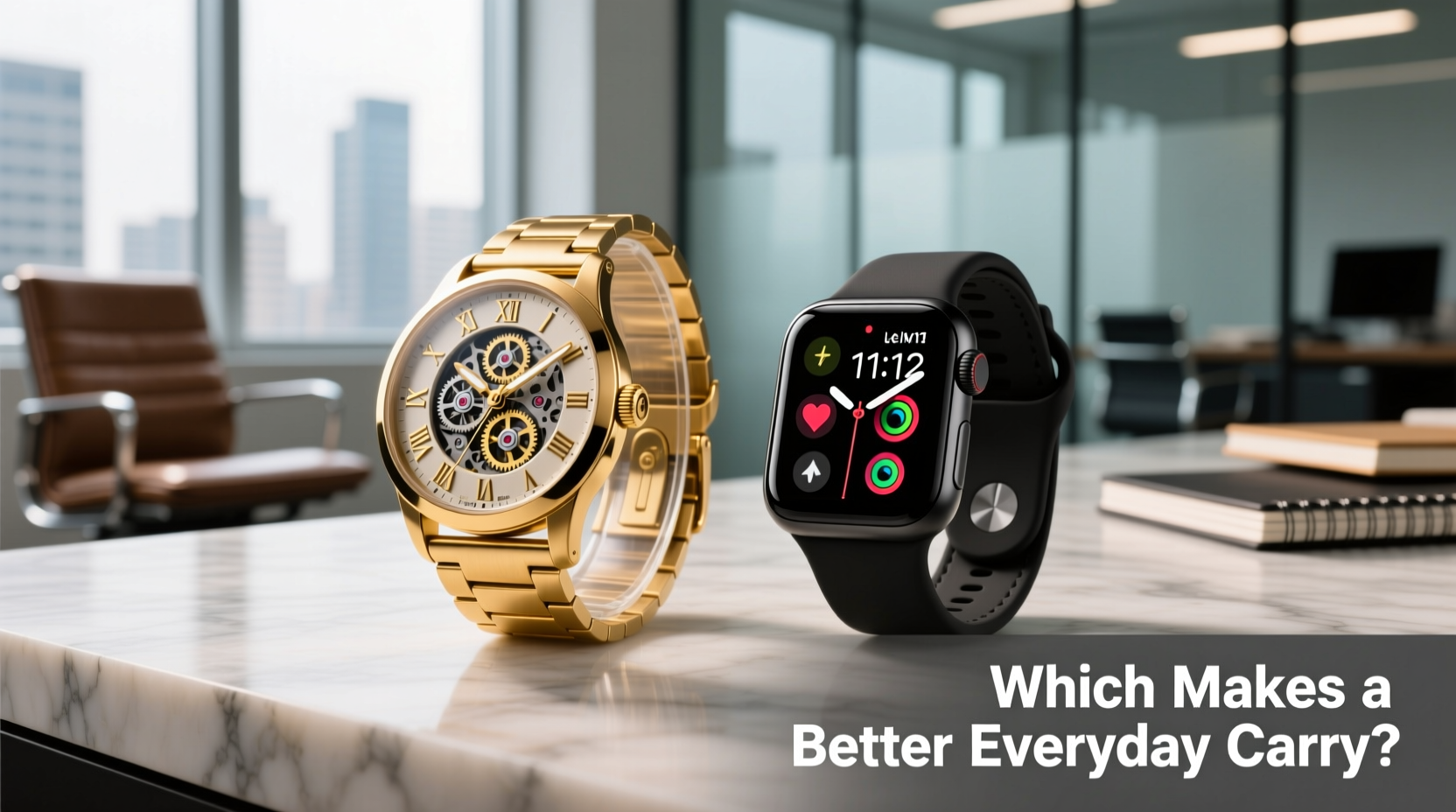
At first glance, the difference between a mechanical watch and a smartwatch is visual. Mechanical watches are crafted with attention to detail—polished cases, sapphire crystals, intricate dials, and hand-finished movements visible through exhibition casebacks. They’re often made from premium materials like stainless steel, titanium, or even precious metals. The aesthetic is intentional, refined, and built to age gracefully.
Smartwatches, by contrast, prioritize function over form. While models like the Apple Watch Ultra or Samsung Galaxy Watch6 have improved in design sophistication, they still lean toward utilitarian minimalism. Screens dominate the face, and bands, though interchangeable, are typically silicone or nylon for sport-focused use. Their look evolves with software updates, not patina.
A luxury mechanical watch can elevate an outfit at a business meeting or evening event. It signals attention to detail and appreciation for craftsmanship. A smartwatch, while sleek, rarely serves as a fashion statement in traditional settings. However, it excels in environments where activity tracking or notifications matter more than aesthetics—like the gym, hiking trail, or remote work setup.
Functionality and Daily Utility
When it comes to raw functionality, smartwatches outperform mechanical watches by a wide margin. They offer heart rate monitoring, sleep tracking, GPS navigation, message alerts, call handling, music control, and even ECG readings. Some support contactless payments, voice assistants, and fall detection—features that actively contribute to health and safety.
On the other hand, a mechanical watch performs one primary function: displaying the time. Even complications like date windows, moon phases, or chronographs are secondary and manually operated. There’s no battery to charge, no app to sync, and no risk of software glitches—but also no access to real-time data.
“Wearing a mechanical watch is a ritual. It connects you to time in a way digital devices can’t replicate.” — James Holloway, Horology Curator at the British Watch Museum
For professionals who need constant connectivity—entrepreneurs, remote workers, healthcare providers—a smartwatch reduces phone dependency. Glancing at your wrist to see a calendar alert or incoming text streamlines workflow. Meanwhile, mechanical watch enthusiasts appreciate the absence of distractions. No vibrations, no buzzes—just quiet precision.
Longevity and Maintenance Requirements
This is where the philosophies diverge sharply. Mechanical watches, when properly maintained, can last generations. High-end brands like Rolex, Omega, or Patek Philippe produce timepieces that retain or increase in value over decades. Regular servicing—every 5 to 7 years—is essential but manageable. It involves cleaning, lubricating, and recalibrating the movement, typically costing $200–$600 depending on complexity.
Smartwatches, however, are bound by technological obsolescence. Most models become outdated within 3 to 5 years due to software limitations, battery degradation, or lack of update support. The lithium-ion batteries degrade with each charge cycle, reducing performance over time. After three years, many users report sluggish interfaces or shortened battery life—even with careful use.
| Factor | Mechanical Watch | Smartwatch |
|---|---|---|
| Lifespan | Decades (with care) | 3–5 years average |
| Battery/Power | Manual winding or automatic rotor | Rechargeable (daily/weekly) |
| Software Updates | N/A | Required, limited duration |
| Repair Complexity | Specialized watchmakers | Manufacturer-dependent |
| Resale Value | High (especially vintage/luxury) | Low (rapid depreciation) |
Consider this: a well-maintained 1960s Rolex Submariner might now be worth six figures. An Apple Watch Series 5 from the same era has little to no resale value. Long-term ownership favors mechanical timepieces, especially if passed down as heirlooms.
Everyday Practicality and Lifestyle Fit
Practicality hinges on how you live. Are you constantly on the move, managing tasks, tracking workouts, and relying on notifications? A smartwatch integrates into that rhythm. Receiving a calendar reminder during a commute, measuring your run’s pace, or checking your heart rate post-workout adds tangible value.
But if your days are structured, less tech-reliant, or involve frequent meetings where screen glances seem disruptive, a mechanical watch offers silent reliability. It doesn’t demand charging, won’t buzz during a presentation, and never runs out of battery mid-day. Its simplicity becomes its strength.
Water resistance varies. Many mechanical watches boast 100m+ water resistance suitable for swimming and diving. Smartwatches like the Garmin Fenix or Apple Watch Series 9 also offer strong water ratings, but exposure to saltwater or chlorine requires extra cleaning to prevent corrosion—something less critical with a stainless steel dive watch.
Mini Case Study: Two Professionals, Two Choices
Take Sarah, a project manager at a tech startup. Her day revolves around Slack messages, Zoom calls, and fitness goals. She wears an Apple Watch Ultra. It tracks her steps, reminds her to stand, and vibrates gently when a deadline approaches. On weekends, she uses GPS to map hikes. For her, the smartwatch is a productivity tool as much as an accessory.
Then there’s Mark, a corporate lawyer who attends court hearings and client dinners. He wears a vintage-inspired Jaeger LeCoultre with a leather strap. It doesn’t track his sleep, but it commands respect in boardrooms. When asked about his choice, he says, “I don’t want my wrist to feel like another screen. I want it to reflect who I am.”
Neither is wrong. Each aligns their timepiece with their environment, values, and needs.
Cost Considerations Over Time
Upfront cost isn’t the full story. Entry-level mechanical watches start around $300 (e.g., Tissot, Hamilton), while luxury models exceed $10,000. Smartwatches range from $150 (Fitbit) to $800+ (Apple Watch Hermès). But ongoing costs differ dramatically.
A mechanical watch may require servicing every few years, but these are predictable expenses. With proper storage and gentle use, repairs are infrequent. Many owners service their watches only once a decade.
Smartwatches, meanwhile, often require full replacement every 3–5 years. Add in band replacements, screen protectors, and potential insurance for loss or damage, and the long-term investment stacks up. Plus, older models lose compatibility with new smartphones, forcing upgrades.
Which Should You Choose? A Decision Framework
Rather than declare a universal winner, here’s a step-by-step guide to help you decide based on your priorities:
- Assess your daily routine: Do you need constant connectivity, or do you prefer minimal distractions?
- Evaluate your style: Is your wardrobe formal, casual, or sport-oriented? Does your watch need to complement suits or survive trail runs?
- Consider long-term goals: Are you building a collection, seeking a gift, or looking for a temporary tool?
- Review maintenance tolerance: Can you commit to occasional servicing, or do you prefer plug-and-play convenience?
- Test emotional resonance: Which excites you more—the hum of gears beneath a crystal, or the glow of a notification lighting up your wrist?
If you value heritage, craftsmanship, and enduring style, a mechanical watch is the superior everyday carry. If you prioritize health metrics, instant communication, and adaptive functionality, a smartwatch fits better.
Checklist: Choosing Your Everyday Watch
- ☐ Identify your top 3 daily needs (e.g., timekeeping, fitness tracking, notifications)
- ☐ Try both types on—note comfort and presence on your wrist
- ☐ Research brand reputation for durability and customer service
- ☐ Check water resistance and battery life requirements
- ☐ Determine budget for initial purchase + 5-year upkeep
- ☐ Think about how it fits with your other accessories and clothing
- ☐ Decide whether you want a device or a keepsake
Frequently Asked Questions
Can I wear a mechanical watch every day?
Absolutely. Modern mechanical watches are built for daily wear. Automatic models gain power from arm movement, so regular use keeps them running. Just avoid extreme shocks and remember periodic servicing.
Do smartwatches lose accuracy over time?
Their timekeeping remains precise via smartphone synchronization, but sensor accuracy (like heart rate) can decline due to dirt buildup on optical sensors or aging hardware. Cleaning and calibration help maintain performance.
Is it pretentious to wear a mechanical watch in a tech-heavy workplace?
Not at all. Many engineers and tech founders wear mechanical watches as a counterbalance to digital overload. It’s seen as a sign of personal taste, not arrogance. Confidence in your choice matters more than perception.
Conclusion: The Right Watch for Your Life
There is no single “better” option between a mechanical watch and a smartwatch. Each serves distinct purposes and speaks to different values. The mechanical watch is a testament to human ingenuity—an analog marvel that turns springs and gears into measured moments. It rewards patience, care, and appreciation for subtlety. The smartwatch is a digital companion, amplifying your capabilities with data, alerts, and automation. It thrives in fast-paced, connected environments.
Your everyday carry should reflect not just what you do, but who you are. If you seek permanence, elegance, and a piece of art on your wrist, go mechanical. If you want efficiency, health insights, and seamless integration with your digital life, choose smart.
Some people own both—one for weekdays, one for weekends. Others commit fully to one philosophy. Whichever path you take, make it intentional. A watch is more than a tool. It’s a daily companion, a marker of time well spent, and a quiet expression of self.




 浙公网安备
33010002000092号
浙公网安备
33010002000092号 浙B2-20120091-4
Comments
No comments yet. Why don't you start the discussion?