
Back pain affects millions of people worldwide, and while causes vary—from poor posture to injury—sleep quality plays a critical role in recovery and prevention. One of the most overlooked factors in spinal health is the mattress. Many assume that simply buying a \"comfortable\" bed will solve their discomfort, but the truth is more nuanced. Memory foam and hybrid mattresses dominate the market today, each promising relief from chronic back pain. But which one truly delivers?
The answer isn’t universal—it depends on your sleeping position, body type, and the nature of your pain. Understanding how each mattress type interacts with your spine, pressure points, and movement during sleep is essential to making an informed decision.
How Mattresses Influence Spinal Alignment and Pain Relief
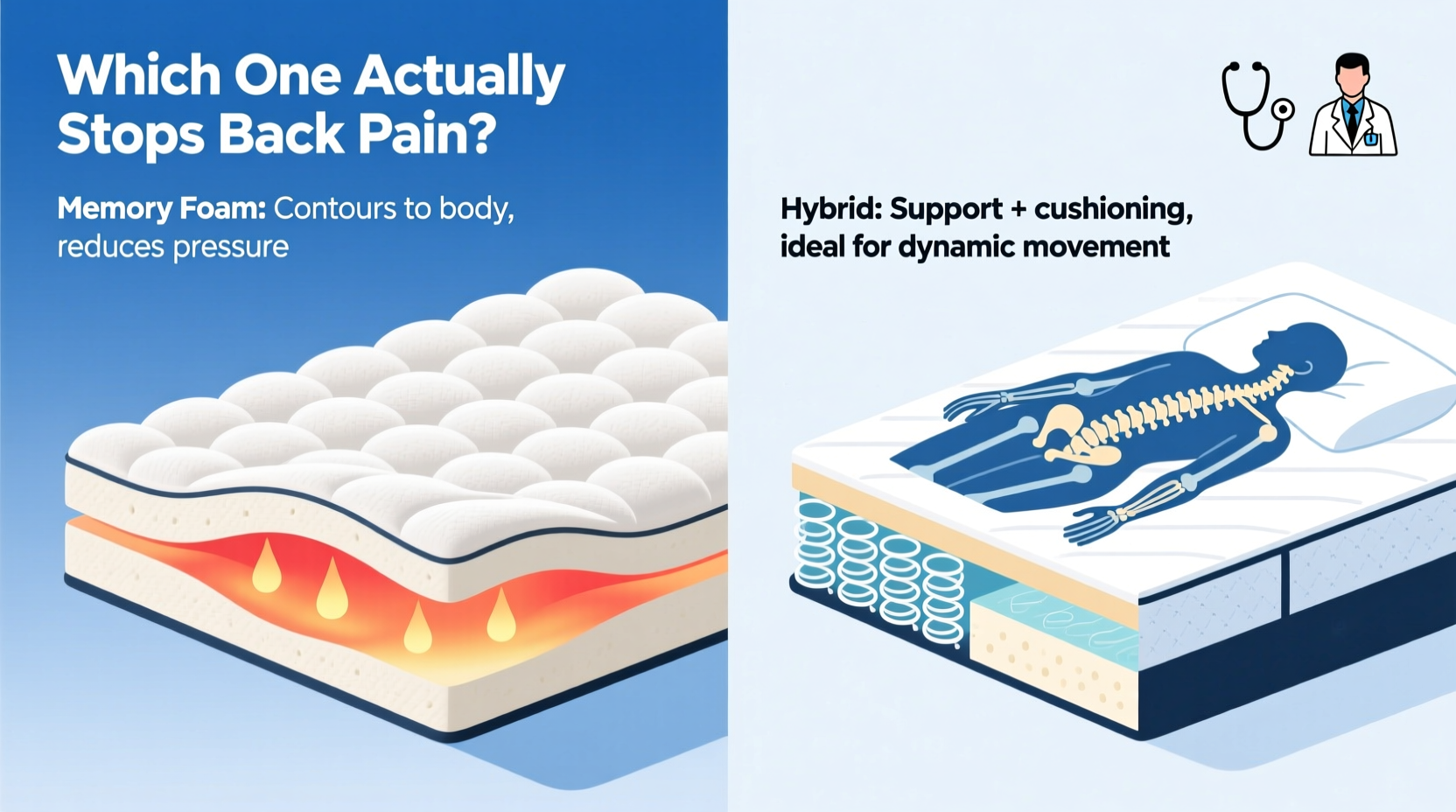
Proper spinal alignment during sleep ensures that your vertebrae remain in a neutral position, reducing strain on muscles, ligaments, and discs. When misaligned—whether due to sinking too deeply or insufficient support—the spine can develop unnatural curves, leading to morning stiffness, nerve compression, and worsening pain over time.
Mattresses impact alignment through three key features:
- Support core: Determines whether your midsection sags or stays elevated.
- Pressure relief: Absorbs weight at sensitive areas like hips and shoulders.
- Motion isolation: Reduces disturbances from a partner, which can cause micro-awakenings and tense muscles.
Memory foam and hybrid mattresses approach these elements differently. Memory foam excels in conforming closely to the body, while hybrids combine responsive coils with cushioning layers for balanced support.
Memory Foam Mattresses: Deep Conformity and Pressure Relief
Originally developed by NASA, memory foam has become synonymous with contouring comfort. It responds to heat and pressure, molding precisely to the shape of your body. This deep cradle can be highly effective for relieving pressure on joints and soft tissues.
For side sleepers, especially those with hip or shoulder pain, this close conformity helps maintain even spinal alignment by filling the gap between the mattress and body. However, the same trait can become a liability for back and stomach sleepers who need firmer support to prevent their hips from sinking too far, which tilts the pelvis and strains the lower back.
Traditional memory foam also retains heat, potentially disrupting sleep for hot sleepers—poor sleep quality indirectly exacerbates pain perception. Newer variants like gel-infused foam or open-cell structures aim to mitigate this issue.
“Patients with sciatica or joint arthritis often report significant nighttime relief on high-density memory foam due to its ability to offload pressure points.” — Dr. Lena Patel, Physical Medicine Specialist
Pros and Cons of Memory Foam for Back Pain
| Advantages | Drawbacks |
|---|---|
| Excellent pressure relief for hips, shoulders, and lower back | Hips may sink too deeply for back/stomach sleepers, causing misalignment |
| Superior motion isolation—ideal for couples | Potential heat retention without cooling tech |
| Consistent surface with no bounce, reducing muscle tension | Off-gassing odor common in first few days |
| Effective for arthritis, fibromyalgia, and sciatica | Limited edge support; feels “stuck” when moving |
Hybrid Mattresses: Balanced Support with Responsive Feel
Hybrid mattresses combine the best of both worlds: pocketed coils for structural support and multiple foam or latex layers for comfort. The coil system provides targeted responsiveness, keeping the spine aligned while allowing easier repositioning during the night.
This dual-layer design benefits individuals who need firm foundational support but still want cushioning at pressure points. For example, a person with lumbar disc issues may find that a hybrid prevents their lower back from collapsing into the mattress while the top foam layer relieves tension.
Because coils promote airflow, hybrids tend to sleep cooler than all-foam models. They also offer better edge support, making them ideal for larger individuals or those who sit on the edge of the bed frequently.
However, hybrids are generally heavier and more expensive. Motion transfer is slightly higher than in memory foam, though modern pocketed coils minimize this significantly.
Who Benefits Most from Hybrid Mattresses?
- Back sleepers: Need even support along the entire spine; hybrids prevent lower back sagging.
- Stomach sleepers: Require a firmer surface to avoid pelvic tilt; coil systems resist excessive sinkage.
- Heavier individuals (over 230 lbs): Benefit from reinforced coil support that maintains shape over time.
- Couples: Enjoy reduced partner disturbance and better temperature regulation.
Real-World Example: Two Patients, Two Solutions
Consider two individuals with chronic lower back pain:
Sarah, 42, side sleeper with sciatica: She tried a firm hybrid mattress but found her hips weren't adequately cushioned. After switching to a medium-plush memory foam model with gel infusion, she reported reduced radiating leg pain and deeper sleep within three weeks. The foam’s slow response allowed her spine to stay neutrally aligned without jarring movements.
James, 55, back sleeper with degenerative disc disease: He initially used a soft memory foam bed but woke up with tight lower back muscles. His physical therapist recommended a hybrid with firmer support and zoned lumbar coils. Within a month, his morning stiffness decreased significantly, and he no longer needed painkillers upon waking.
These cases illustrate that neither mattress type is universally superior. Effectiveness depends on individual biomechanics and pain patterns.
Choosing the Right Firmness Level for Your Body Type
Firmness is arguably more important than material type when managing back pain. A mismatch between body weight, sleep position, and mattress firmness can negate any technological advantage.
Here’s a practical guide:
| Sleep Position | Recommended Firmness (Lightweight <130 lbs) | Medium Weight (130–230 lbs) | Heavyweight (>230 lbs) |
|---|---|---|---|
| Side | Medium-Soft (4–5) | Medium (5–6) | Medium-Firm (6–7) |
| Back | Medium (5–6) | Medium-Firm (6–7) | Firm (7–8) |
| Stomach | Medium-Firm (6–7) | Firm (7–8) | Firm (8) |
Note: Ratings are on a 10-point scale, where 1 is very soft and 10 is ultra-firm.
“The ideal mattress doesn’t eliminate pain overnight—it supports healing by maintaining proper posture throughout the night.” — Dr. Rajiv Mehta, Sleep and Spine Consultant
Action Plan: How to Test and Choose the Right Mattress
Selecting a mattress for back pain should be methodical. Follow this step-by-step process:
- Identify your primary sleep position: Use a sleep diary or wearable tracker for one week to confirm if you’re primarily a side, back, or combo sleeper.
- Assess your current pain triggers: Does your back hurt more when you wake up? Is it stiff after long periods of immobility? These clues point to alignment issues.
- Determine your weight category: This influences how much a mattress will compress under your body.
- Try before you buy: Visit showrooms and lie down in your typical sleep pose. Bring supportive pillows to simulate home conditions.
- Check return policies: Opt for brands offering at least a 100-night trial. Many pain improvements take 3–4 weeks to manifest as your body adjusts.
- Look for certifications: CertiPUR-US® for foam safety, OEKO-TEX® for chemical-free materials, and eco-friendly labels if sustainability matters.
Frequently Asked Questions
Can a new mattress make back pain worse?
Yes. Any major change in support or firmness requires an adjustment period of up to four weeks. However, persistent or increasing pain beyond that window suggests incompatibility. Return it if discomfort continues despite adaptation efforts.
Do orthopedic doctors recommend memory foam or hybrid mattresses?
There’s no single recommendation. Orthopedists typically advise based on patient-specific needs. Memory foam is often suggested for pressure-related pain, while hybrids are favored for structural spinal issues. Always consult your physician if you have diagnosed conditions like scoliosis or herniated discs.
How long does a mattress last when used for back pain management?
High-quality memory foam and hybrid mattresses last 7–10 years. Signs it’s time to replace include visible sagging (especially near the waist), loss of responsiveness, or recurring pain that wasn’t present earlier. Warranties typically cover indentations deeper than 1.5 inches.
Final Checklist Before You Buy
- ✅ I know my dominant sleep position
- ✅ I’ve measured my body weight accurately
- ✅ I’ve tested firmness levels appropriate for my profile
- ✅ The mattress has a sleep trial of at least 100 nights
- ✅ It includes cooling technology if I sleep hot
- ✅ Edge support is strong enough if I sit on the bed daily
- ✅ The brand offers white-glove delivery and old mattress removal
Conclusion: Match the Mattress to Your Pain, Not the Hype
When it comes to stopping back pain, the best mattress isn’t the most advertised or expensive one—it’s the one tailored to your anatomy and sleep habits. Memory foam shines for those needing deep pressure relief and minimal motion transfer, particularly side sleepers with joint pain. Hybrids deliver superior spinal support and breathability, making them ideal for back and stomach sleepers, heavier individuals, and anyone prone to overheating.
Don’t let marketing claims override personal experience. Invest time in research, take advantage of trial periods, and prioritize long-term spinal health over short-term comfort. Your back will thank you not just in the morning, but for years to come.




 浙公网安备
33010002000092号
浙公网安备
33010002000092号 浙B2-20120091-4
Comments
No comments yet. Why don't you start the discussion?