
Side sleepers represent the largest group of sleepers, making up nearly 70% of the population. For these individuals, spinal alignment and shoulder/hip pressure relief are critical to avoiding morning stiffness, joint pain, and long-term discomfort. Choosing between a memory foam and a spring mattress can significantly impact how rested—or sore—you feel each morning. While both types offer distinct advantages, understanding their mechanics in relation to side sleeping is essential for minimizing physical strain.
The key difference lies in how each mattress responds to body weight and movement. Memory foam conforms closely to the body’s shape, offering deep pressure relief. In contrast, innerspring mattresses provide firmer, more responsive support with greater airflow. But which one actually hurts less for side sleepers? The answer depends on body type, sleeping habits, and personal comfort preferences—factors we’ll explore in depth.
How Side Sleeping Affects Your Body
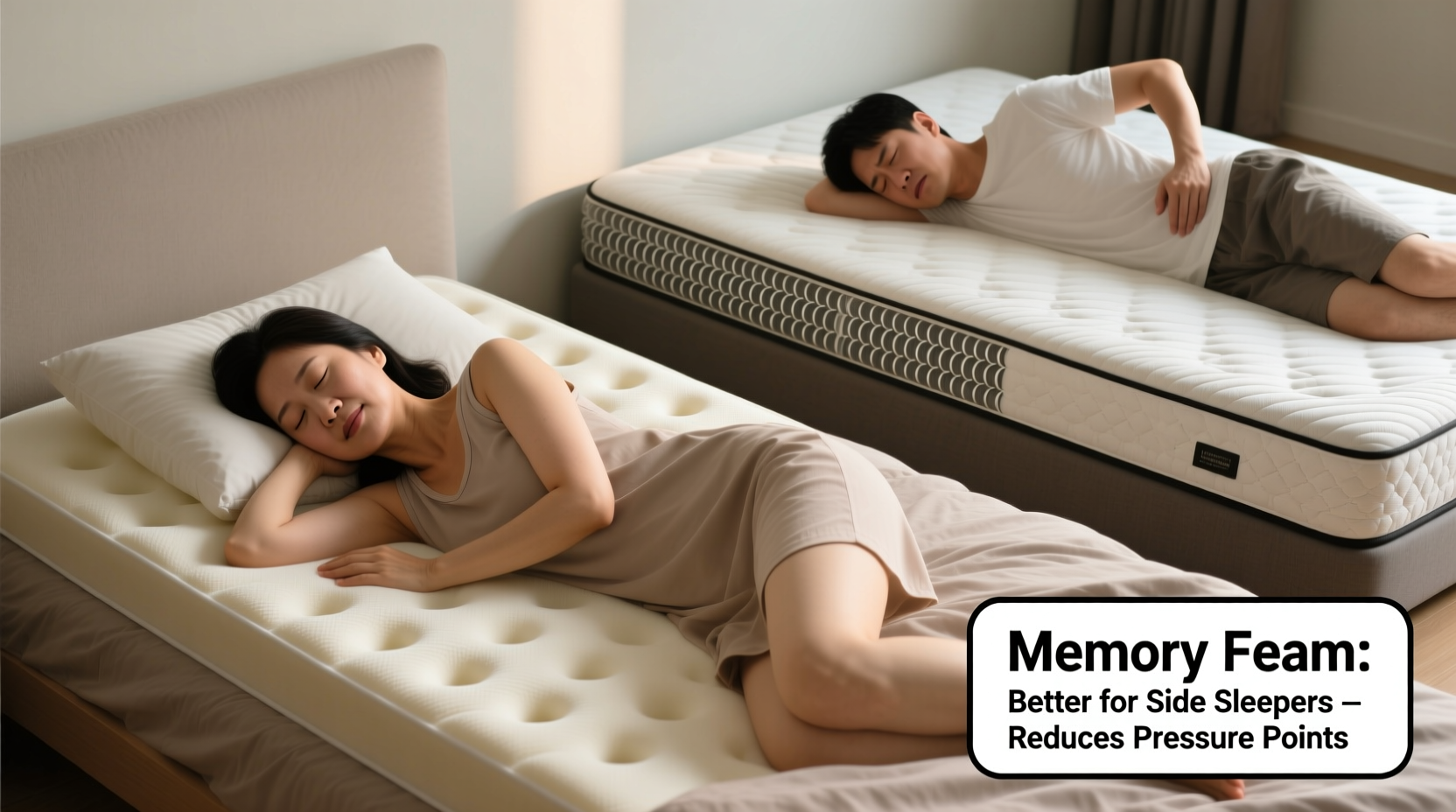
When you sleep on your side, your hips and shoulders bear the brunt of your body weight. Without proper cushioning, these pressure points can compress nerves and restrict blood flow, leading to numbness, tingling, or chronic joint pain over time. The spine must also remain in neutral alignment—neither arched nor twisted—to prevent lower back strain.
A well-suited mattress for side sleepers should:
- Distribute weight evenly across the shoulder and hip zones
- Maintain a straight line from the ear to the shoulder to the hip
- Allow slight sinkage at pressure points without causing misalignment
- Support the lumbar region without pushing the torso upward
Failure to meet these criteria often results in waking up with shoulder pain, hip soreness, or lower back tension—issues that compound over weeks and months of poor sleep support.
“Side sleepers need a balance between contouring and support. Too firm, and the shoulders and hips ache. Too soft, and the spine collapses into an unnatural curve.” — Dr. Lena Patel, Chiropractor & Sleep Posture Specialist
Memory Foam Mattresses: Deep Contouring for Pressure Relief
Memory foam gained popularity for its ability to “mold” to the sleeper’s body. Originally developed by NASA, modern viscoelastic foams respond to heat and pressure, softening in areas where contact is greatest. This makes them particularly effective for side sleepers who need targeted cushioning around the shoulders and hips.
Advantages for side sleepers:
- Superior pressure relief: Reduces stress on joints by allowing the shoulder and hip to sink slightly into the mattress.
- Minimized motion transfer: Ideal for couples; one partner’s movements won’t disturb the other.
- Consistent surface: No coils to shift or poke through, providing uniform support.
However, traditional memory foam has notable drawbacks. Many users report overheating due to poor breathability. Newer models address this with gel infusions, copper particles, or open-cell structures that improve airflow. Additionally, some all-foam mattresses may lack edge support, making it harder to sit or sleep near the perimeter.
Best Use Cases for Memory Foam
Memory foam excels for:
- Lighter to average-weight individuals (under 230 lbs)
- Sleepers with joint pain or arthritis
- Couples where one partner moves frequently
- Those who prefer a cradled, hugging sensation
Innerspring Mattresses: Bounce and Support for Active Sleepers
Innerspring mattresses rely on steel coil systems to deliver support. Modern versions use pocketed coils—individually wrapped springs that move independently—to improve contouring and reduce motion transfer. These designs have evolved far beyond the rigid, bouncy beds of the past.
Advantages for side sleepers:
- Better responsiveness: Easier to shift positions during the night without feeling stuck.
- Natural cooling: Air circulates freely through the coil layer, helping regulate temperature.
- Firmer support: Prevents excessive sinkage, which benefits heavier side sleepers.
- Edge reinforcement: Stronger perimeter support allows full use of the bed surface.
The main challenge with innersprings is ensuring adequate cushioning above the coils. A thin comfort layer may not provide enough give for shoulder and hip relief, leading to localized pressure. High-end hybrid models solve this by combining pocketed coils with thick layers of memory foam or latex—offering the best of both worlds.
Best Use Cases for Spring Mattresses
Innerspring or hybrid spring mattresses are ideal for:
- Heavier individuals (over 200 lbs) who need structural support
- Sleepers who switch positions frequently
- Hot sleepers who struggle with foam’s heat retention
- Those who prefer a more buoyant, less sinking feel
Comparative Analysis: Memory Foam vs Spring for Pain Reduction
| Feature | Memory Foam | Spring (Pocketed/Hybrid) |
|---|---|---|
| Pressure Relief | Excellent – conforms deeply to shoulders and hips | Good to excellent – depends on comfort layer thickness |
| Spinal Alignment | Good – if medium-soft to medium firmness | Excellent – especially with zoned support |
| Cooling Performance | Fair to good – varies with gel or open-cell tech | Excellent – natural airflow through coils |
| Motion Isolation | Excellent – minimal disturbance | Fair to good – better in hybrids with foam layers |
| Durability | 7–10 years – may develop sagging over time | 8–12 years – longer lifespan with reinforced edges |
| Pain Reduction (Shoulder/Hip) | High – when properly matched to body weight | High – especially with adaptive top layers |
| Best For | Light to average weight, pain-sensitive sleepers | Active, heavier, or hot sleepers |
The table reveals that while memory foam leads in pressure relief, modern pocketed coil systems—especially in hybrid configurations—can rival or surpass it when paired with quality foam or latex overlays. For side sleepers concerned about pain, neither option is universally superior; the decision hinges on individual physiology and sleep behavior.
Real-World Example: Choosing the Right Mattress After Chronic Shoulder Pain
Consider Sarah, a 38-year-old graphic designer and lifelong side sleeper. She began experiencing persistent left shoulder pain after switching to a firm innerspring mattress recommended by her father. Despite using pillows to adjust positioning, the discomfort persisted for months. Upon visiting a physical therapist, she learned that her shoulder was compressing against the unyielding surface, restricting circulation and irritating the rotator cuff.
She transitioned to a medium-soft memory foam mattress with a 3-inch gel-infused top layer. Within two weeks, her shoulder pain diminished significantly. The foam allowed her shoulder to sink naturally, aligning her spine and reducing nerve compression. However, after six months, she noticed increased heat retention during summer nights.
Her solution? Upgrading to a hybrid model with pocketed coils and a 2-inch memory foam comfort layer. This provided balanced support, improved cooling, and sustained pain relief. Her case illustrates that initial preference may evolve—and that hybrid options often deliver optimal compromise.
Step-by-Step Guide to Choosing Your Ideal Mattress
Selecting the right mattress isn’t just about brand names or marketing claims. Follow this practical sequence to ensure lasting comfort and reduced pain:
- Assess your body weight: Under 130 lbs? Lean toward softer foams. Over 200 lbs? Prioritize hybrids or firmer support.
- Evaluate your pain points: Shoulder pain suggests need for deeper contouring. Lower back pain may indicate insufficient support.
- Determine your temperature sensitivity: If you sleep hot, avoid all-foam unless it has advanced cooling tech.
- Test firmness levels: Medium to medium-soft (between 4–6 on a 10-point scale) is typically best for side sleepers.
- Check return policies: Opt for brands offering at least a 100-night trial to assess long-term comfort.
- Read verified reviews: Focus on feedback from side sleepers with similar body types.
- Consider hybrid models: They combine the contouring of foam with the breathability and support of coils.
Frequently Asked Questions
Can a mattress really cause shoulder pain?
Yes. A mattress that’s too firm prevents the shoulder from sinking appropriately, creating pressure that can lead to inflammation, nerve pinching, and muscle strain. Conversely, a mattress that’s too soft may allow the torso to drop, misaligning the spine and indirectly stressing the shoulder joint.
Are hybrid mattresses better for side sleepers?
Often, yes. Hybrids combine the pressure-relieving qualities of memory foam or latex with the supportive structure of pocketed coils. This balance helps maintain spinal alignment while cushioning sensitive joints—making them a top recommendation for many side sleepers, especially those over 150 lbs.
How often should I replace my mattress if I’m a side sleeper?
Every 7–10 years, depending on material and usage. Signs it’s time for replacement include visible sagging, increased morning pain, difficulty getting comfortable, or if the mattress no longer isolates motion effectively. Side sleepers may notice wear sooner in shoulder and hip zones.
Action Checklist: Find Your Pain-Free Sleep Solution
- ✅ Identify your primary pain points (shoulders, hips, lower back)
- ✅ Determine your weight range to guide firmness selection
- ✅ Decide whether you sleep hot or cold
- ✅ Test both memory foam and hybrid options with extended trials
- ✅ Prioritize at least 2 inches of quality comfort layering
- ✅ Ensure the mattress has strong edge support if you sit on the bed often
- ✅ Choose a brand with a risk-free sleep trial and warranty
Conclusion: Reduce Pain by Matching Mattress to Your Needs
There is no single “best” mattress type for all side sleepers. Memory foam offers unmatched pressure relief and motion isolation, making it ideal for lighter individuals or those with joint sensitivities. Spring and hybrid mattresses provide responsive support, better cooling, and enhanced durability—advantages that benefit heavier or hotter sleepers.
The goal isn’t to pick a category, but to find a mattress that supports neutral spinal alignment while relieving pressure on the shoulders and hips. Pain reduction comes not from material alone, but from thoughtful matching of design to body and behavior.




 浙公网安备
33010002000092号
浙公网安备
33010002000092号 浙B2-20120091-4
Comments
No comments yet. Why don't you start the discussion?