
A mattress that sags or sinks over time is more than just an aesthetic issue—it can directly impact your spinal health, comfort, and long-term sleep quality. Whether you own a memory foam or innerspring mattress, understanding how and why it deteriorates helps determine whether a sinking surface is truly harmful to your back. With both types dominating the market, consumers often face confusion: Is one inherently better at preventing sinkage? Does a slight dip mean it’s time for a replacement? And most importantly, can a sagging mattress worsen back pain?
This article examines the structural differences between memory foam and spring mattresses, evaluates how each responds to wear, and answers whether sinking compromises spinal support. You’ll also find expert insights, real-world scenarios, and practical guidance on when and how to address mattress degradation.
How Mattress Sinkage Develops Over Time
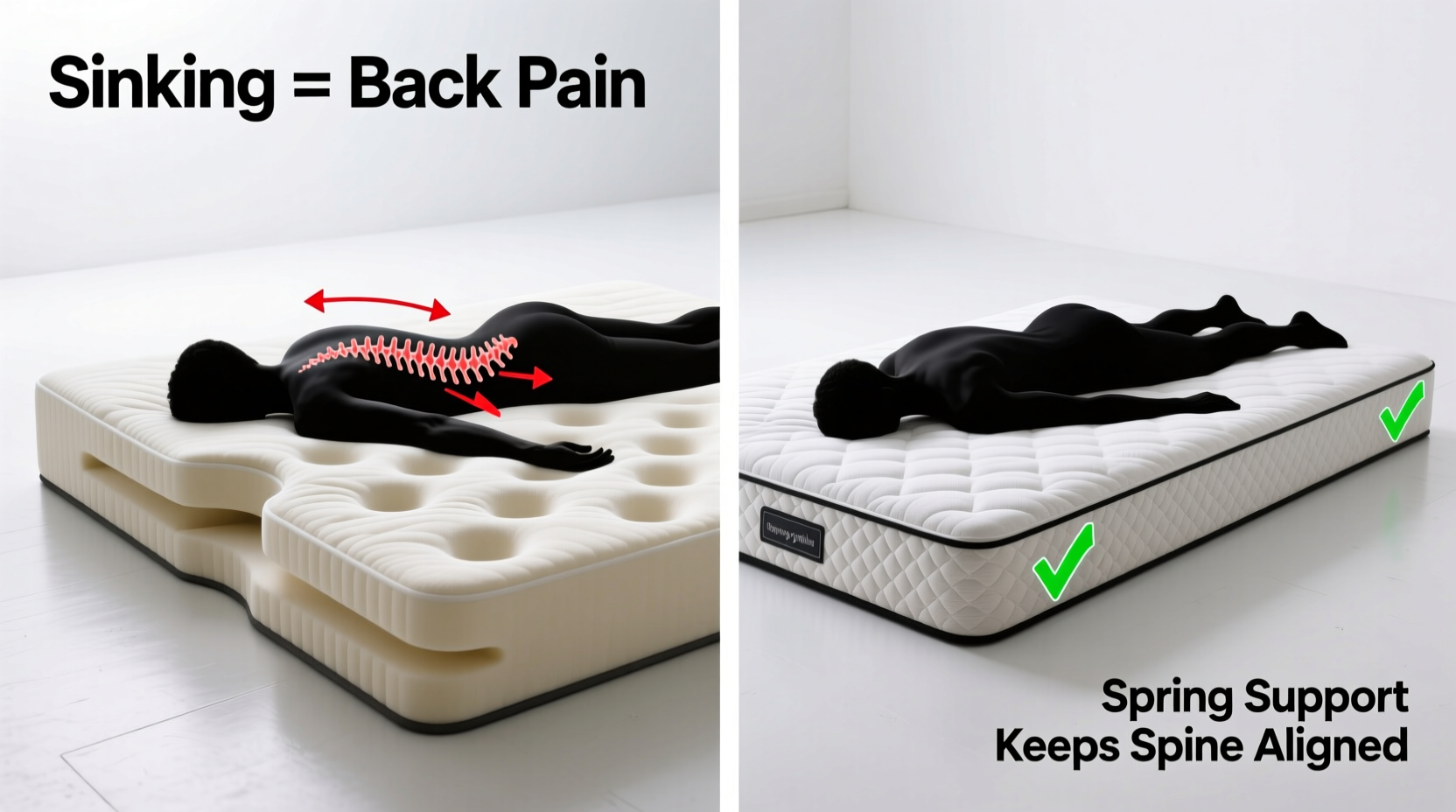
All mattresses degrade with use. Body impressions—commonly referred to as “sinking”—occur due to repeated pressure on specific areas, especially where hips and shoulders rest. While some degree of contouring is intentional (particularly in memory foam), persistent sagging deeper than 1.5 inches is typically considered structural failure.
Sinkage happens differently depending on the core material:
- Memory foam compresses under heat and weight. Over years, its viscoelastic cells may lose resilience, leading to permanent indentations.
- Innerspring mattresses rely on steel coils. When these coils weaken or break, they create uneven support zones, causing the surface to collapse in certain spots.
The key distinction lies in uniformity: Memory foam tends to develop broad, gradual dips, while spring mattresses often show localized, sharp sags—especially if coil count is low or gauge is thin.
“Persistent sagging disrupts neutral spine alignment. Even small deviations can increase disc pressure and strain lower back muscles over time.” — Dr. Lena Torres, Chiropractic Sleep Specialist
Memory Foam vs Spring: Support, Durability, and Spinal Alignment
To assess which type fares better against sinkage—and how each influences back health—we compare five critical factors: motion isolation, responsiveness, durability, edge support, and pressure relief.
| Feature | Memory Foam | Innerspring |
|---|---|---|
| Motion Isolation | Excellent – absorbs movement, ideal for couples | Poor to moderate – motion transfers across coils |
| Responsiveness | Slower – takes time to rebound after pressure | High – immediate bounce-back response |
| Durability | 7–10 years; high-density foam lasts longer | 5–8 years; depends on coil quality and count |
| Edge Support | Moderate; softer edges prone to compression | Better; reinforced perimeter coils resist sinking |
| Pressure Relief | Superior – molds closely to body curves | Variable – depends on cushioning layers above coils |
While memory foam excels in conforming to the body and reducing pressure points—beneficial for side sleepers with back or hip pain—it may encourage excessive sinkage if density falls below 3 pounds per cubic foot. Conversely, innerspring models offer firmer, more buoyant support but often lack sufficient cushioning for sensitive joints unless paired with pillow tops or hybrid designs.
Is a Sinking Mattress Actually Bad for Your Back?
The answer depends on severity, location, and individual biomechanics. A slight impression (under 1 inch) is normal and not harmful. However, deep sinkage—particularly around the midsection—can misalign the spine by allowing hips to drop too low. This forces the lower back into an unnatural curve, increasing lumbar strain.
For individuals with pre-existing back conditions such as sciatica, degenerative disc disease, or chronic lower back pain, sleeping on a compromised surface may exacerbate symptoms. Poor support prevents the spine from maintaining its natural S-curve during rest, reducing recovery time and potentially contributing to morning stiffness.
Moreover, sinkage often creates a \"hammock effect,\" especially in older innerspring units. When central coils fail, the body rolls inward toward the dip, making it difficult to change positions without effort. This restricted mobility can lead to poor circulation and increased tossing and turning.
Memory foam avoids the hammock effect due to its consistent cellular structure, but low-quality foams may retain impressions faster, particularly under heavier body weights. High-density foams (4 lb/ft³ or higher) resist compaction better and are recommended for people over 230 lbs.
Real-World Example: The Office Worker’s Dilemma
Mark, a 42-year-old software developer, began experiencing worsening lower back pain after switching to a budget memory foam mattress. Initially comfortable, the bed developed a 2-inch hip crater within 18 months. He noticed he could no longer lie flat without feeling his pelvis tilted downward. His chiropractor identified the issue: the degraded foam failed to support proper spinal alignment, forcing his lumbar spine into hyperextension overnight.
After replacing the mattress with a high-density hybrid model (combining pocketed coils and gel-infused foam), Mark reported significant improvement in both pain levels and sleep continuity within three weeks. His case illustrates how sinkage—even in a material marketed for back support—can undermine health if durability is compromised.
When to Replace Your Mattress: A Step-by-Step Guide
Don’t wait until your mattress resembles a canyon. Follow this timeline-based checklist to evaluate whether it’s time for a replacement:
- Month 0–6: Break-in period. Minor impressions up to 1 inch are normal. Allow 30 days for full acclimation.
- Year 1–3: Inspect quarterly. Use the “bathroom test”: place a glass of water on the mattress. If it wobbles or slides toward a dip, structural imbalance exists.
- Year 4–5: Evaluate support quality. Lie down and ask someone to take a photo from the side. Your spine should appear straight, not curved downward.
- Year 6+: Check for co-morbid signs: creaking springs, lumps, or visible tears. If you wake up stiffer than when you went to bed, consider replacement.
- Immediate action: Replace if sag exceeds 1.5 inches, coils are poking through, or pain increases after sleep.
“The average person spends a third of their life in bed. A failing mattress isn’t just uncomfortable—it’s a chronic stressor on the musculoskeletal system.” — Dr. Alan Reed, Sleep Medicine Physician
Prevention and Maintenance Checklist
Extend your mattress lifespan and protect your back with these proactive steps:
- ✅ Use a supportive foundation or box spring designed for your mattress type
- ✅ Rotate the mattress head-to-foot every 3–6 months (unless one-sided)
- ✅ Avoid jumping or sitting on the edges, which accelerates wear
- ✅ Keep humidity low—excess moisture degrades adhesives and foams
- ✅ Vacuum regularly to remove dust mites and debris from the surface
- ✅ Use a breathable protector to prevent sweat and spills from breaking down materials
- ✅ Do not exceed manufacturer’s weight recommendations
Frequently Asked Questions
Can a sagging mattress cause permanent back damage?
While a sinking mattress alone won’t cause irreversible spinal injury, prolonged use can contribute to chronic muscle imbalances, joint strain, and aggravated disc issues. For those with existing conditions, poor support may accelerate degeneration. Addressing the problem early reduces long-term risk.
Do all memory foam mattresses eventually sink?
Most develop some indentation, but high-density foams (4 lb/ft³ or higher) resist permanent sag much better than low-density versions. CertiPUR-US® certified foams also undergo rigorous testing for durability and emissions, offering greater longevity and safety.
Are hybrid mattresses a better solution?
Hybrids combine the contouring benefits of memory foam with the structural integrity of pocketed coils. They generally offer superior support, reduced motion transfer, and slower degradation compared to traditional innersprings. For back pain sufferers seeking balanced firmness and resilience, hybrids are often the optimal choice.
Conclusion: Prioritize Support, Not Just Comfort
Whether you prefer the hugging feel of memory foam or the responsive lift of springs, the true measure of a mattress lies in its ability to sustain proper spinal alignment over years of use. Sinkage isn’t just cosmetic—it’s a warning sign that support is failing. Left unaddressed, it can compromise sleep quality and aggravate back pain.
Your back deserves consistent, even support throughout the night. Monitor your mattress for deep impressions, listen to your body’s signals, and don’t hesitate to upgrade when needed. Investing in a durable, well-constructed mattress isn’t a luxury—it’s a foundational element of long-term spinal health.




 浙公网安备
33010002000092号
浙公网安备
33010002000092号 浙B2-20120091-4
Comments
No comments yet. Why don't you start the discussion?