
For side sleepers, the right mattress isn’t just about comfort—it’s a critical factor in spinal alignment, pressure relief, and long-term joint health. When choosing between memory foam and innerspring mattresses, many assume it's a matter of personal preference. However, biomechanics, material response, and body weight distribution tell a more nuanced story. Side sleeping places concentrated pressure on the shoulders and hips, demanding both cushioning and structural support. This article breaks down how each mattress type performs under these demands, backed by ergonomic research and user experience.
Understanding the Needs of Side Sleepers
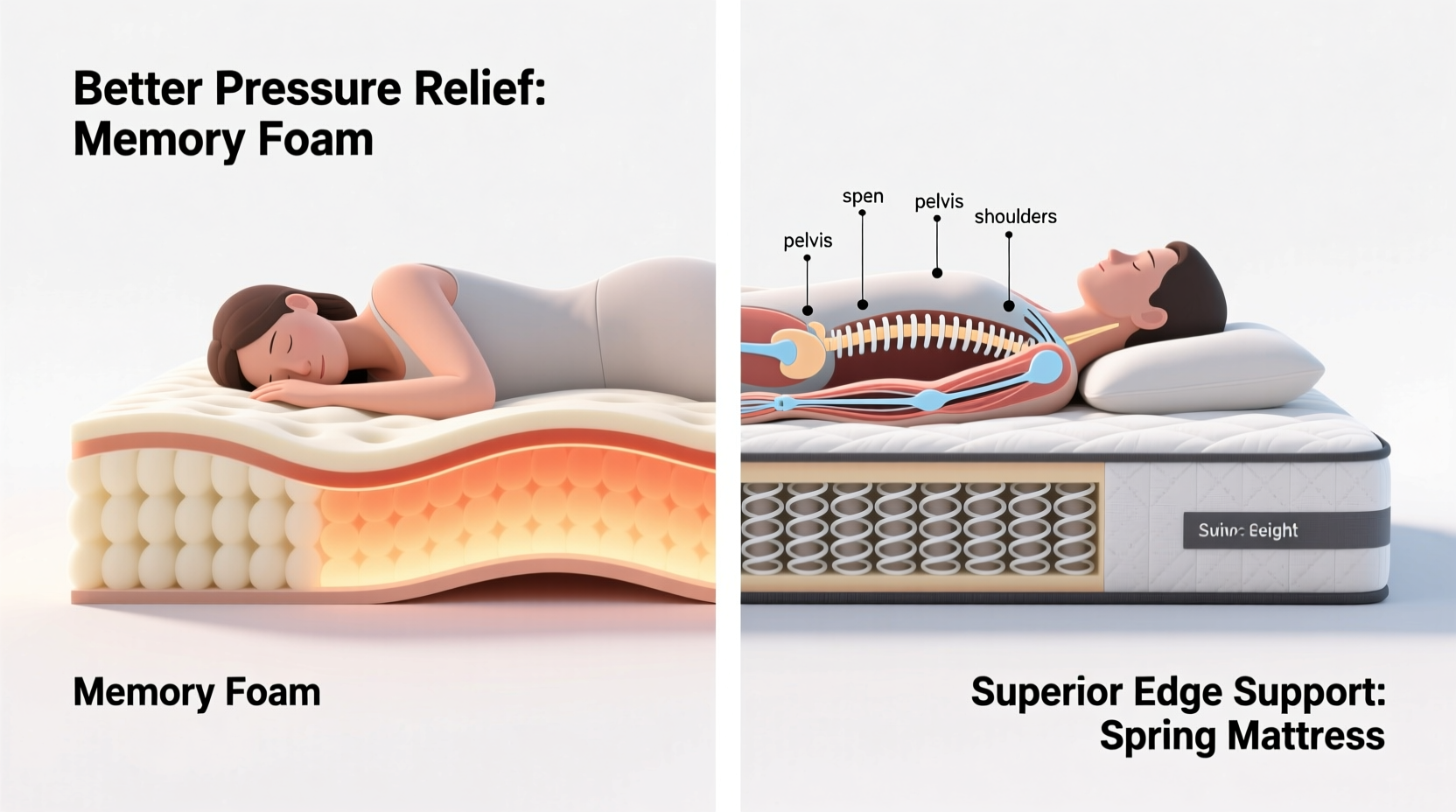
Side sleeping is the most common sleep position, adopted by over 60% of adults according to the National Sleep Foundation. In this posture, the spine should remain in a neutral alignment—neither curved nor twisted. The ideal mattress must contour to the natural curves of the body while supporting the heaviest points: the hips and shoulders.
Without proper support, side sleepers often wake with shoulder pain, hip stiffness, or neck strain. A mattress that’s too firm resists the necessary sinkage at key pressure points. One that’s too soft allows the hips to drop too low, misaligning the spine. The balance lies in responsive cushioning combined with deep support.
“Side sleepers need a surface that gives slightly under the shoulders and hips but maintains enough push-back to keep the spine straight.” — Dr. Lena Torres, Chiropractor and Sleep Posture Specialist
Memory Foam Mattresses: Deep Contouring and Pressure Relief
Memory foam, originally developed by NASA, is known for its viscoelastic properties—meaning it responds slowly to body heat and weight, molding precisely to the sleeper’s shape. For side sleepers, this can be a major advantage.
The material excels at distributing weight evenly. As a side sleeper lies down, the foam compresses under the shoulder and hip, reducing localized pressure. High-density memory foam also isolates motion, making it an excellent choice for couples where one partner moves frequently.
However, not all memory foam is created equal. Lower-density foams may degrade faster and lack sufficient support, leading to a “stuck” feeling. Modern advancements like gel-infused foam or open-cell structures help dissipate heat, addressing one of the traditional drawbacks: heat retention.
Pros of Memory Foam for Side Sleepers
- Precise body contouring reduces shoulder and hip pressure
- Excellent motion isolation for undisturbed sleep
- Consistent support across various body weights when properly rated
- No spring noise or bounce interference
Cons of Memory Foam for Side Sleepers
- Can retain heat, especially in older or non-breathable models
- May feel too conforming for those who dislike sinking into the mattress
- Off-gassing odor during initial setup (usually temporary)
- Less edge support compared to hybrid or innerspring options
Innerspring Mattresses: Bounce, Breathability, and Support
Innerspring mattresses rely on steel coil systems as their core support layer. Traditionally firmer, modern versions incorporate pillow tops or foam overlays to improve comfort for side sleepers. The primary appeal lies in airflow and responsiveness—the coils allow air to circulate, keeping the mattress cooler than traditional memory foam.
There are two main types of coil systems: Bonnell coils (hourglass-shaped, interconnected) and pocketed coils (individually wrapped). Pocketed coils offer superior motion isolation and targeted support, making them more suitable for side sleepers. Each coil responds independently, so when pressure is applied to the shoulder area, only that section compresses, maintaining spinal alignment.
While innersprings provide excellent support, they often fall short in pressure relief unless paired with thick comfort layers. A thin pillow top may compress quickly, leaving heavier side sleepers unsupported after a few months.
Pros of Innerspring for Side Sleepers
- Natural breathability keeps sleepers cooler
- Firmer support prevents excessive sinkage
- Better edge support for sitting or sleeping near the perimeter
- Longer lifespan when high-quality coils are used
Cons of Innerspring for Side Sleepers
- Limited contouring without substantial foam or latex layers
- Potential for noise from metal coils over time
- May transfer motion more easily, especially with non-pocketed coils
- Less effective at relieving pressure on bony prominences
Comparative Analysis: Key Performance Factors
| Factor | Memory Foam | Innerspring |
|---|---|---|
| Pressure Relief | Excellent – conforms closely to shoulders and hips | Fair to Good – depends on comfort layer thickness |
| Spinal Alignment | Very Good – molds to maintain neutral spine | Good – requires proper coil zoning for side support |
| Cooling | Fair – improved with gel or graphite infusion | Excellent – natural airflow through coils |
| Motion Isolation | Excellent – minimal disturbance from partner movement | Poor to Good – varies by coil type (pocketed better) |
| Durability | Good – high-density lasts 7–10 years | Very Good – quality coils last 8–10+ years |
| Edge Support | Fair – softer edges common in all-foam designs | Excellent – reinforced edges typical in innerspring |
This comparison highlights a clear trade-off: memory foam wins in pressure relief and motion control, while innerspring leads in cooling and structural resilience. For side sleepers prioritizing pain reduction, memory foam often delivers better results. Those who sleep hot or prefer a more buoyant feel may lean toward innerspring—especially hybrid models that combine coils with foam layers.
Real-World Example: Sarah’s Transition from Spring to Memory Foam
Sarah, a 38-year-old nurse and chronic side sleeper, had used a traditional innerspring mattress for over a decade. While she appreciated its firmness, she began waking with persistent shoulder pain and numbness in her arm. After consulting a physical therapist, she learned her mattress wasn’t allowing her shoulder to sink adequately, forcing her spine into a slight curve.
She switched to a medium-firm memory foam mattress with a 4 lb density and gel infusion. Within two weeks, her morning discomfort decreased significantly. “It feels like my body finally has room to relax,” she said. “My shoulder doesn’t fight the mattress anymore.” She did note an adjustment period due to the initial warmth but found that using a breathable bamboo cover resolved the issue.
Sarah’s experience reflects a common pattern among mid-weight side sleepers: transitioning to memory foam improves pressure distribution and reduces joint strain, particularly when the mattress is properly matched to body weight and sleeping habits.
Choosing the Right Option: A Step-by-Step Guide
Selecting the best mattress involves more than brand names or marketing claims. Follow this practical process to make an informed decision:
- Evaluate your body weight: Lighter individuals (<130 lbs) may find standard memory foam too deep; opt for softer foams or hybrids. Heavier side sleepers (>230 lbs) need high-density foam or zoned coils to prevent bottoming out.
- Test firmness levels: Side sleepers typically benefit from medium to medium-soft mattresses (between 4–6 on a 10-point firmness scale).
- Check layer composition: For memory foam, look for at least 2–3 inches of comfort layer. For innerspring, ensure a thick foam or latex top (3+ inches) for cushioning.
- Consider temperature regulation: If you sleep hot, prioritize gel-infused foam, copper additives, or innerspring/hybrid models with airflow channels.
- Read return policies: Many brands offer 100-night trials. Use this period to assess pain levels upon waking, not just initial comfort.
Expert Tips for Maximizing Mattress Performance
Checklist: What to Look for in a Side-Sleeper Mattress
- ✅ Medium to medium-soft firmness (4–6/10)
- ✅ At least 2 inches of high-density memory foam (≥4 lb/cu ft)
- ✅ Zoned support or pocketed coils (for innerspring)
- ✅ Cooling technologies (gel, graphite, phase-change materials)
- ✅ Minimum 100-night sleep trial with free returns
- ✅ Motion isolation if sharing the bed
- ✅ Strong edge support if you sit or sleep near the edge
Frequently Asked Questions
Is memory foam or spring better for shoulder pain?
Memory foam is generally better for shoulder pain because it allows the shoulder to sink in naturally, reducing pressure buildup. In contrast, a firm innerspring may resist compression, forcing the spine out of alignment. However, a hybrid mattress with pocketed coils and a plush foam top can offer a balanced solution.
Can a spring mattress be good for side sleepers?
Yes, but only if it includes a deep, soft comfort layer and advanced coil technology like individually wrapped coils. Traditional innersprings with thin padding are usually too firm and unyielding for side sleepers. Hybrid models—combining coils with memory foam or latex—are often the best compromise.
How do I know if my mattress is too firm as a side sleeper?
If you wake up with shoulder or hip pain, notice indentations on your skin from pressure points, or feel like you’re sleeping “on top of” rather than “in” the mattress, it’s likely too firm. Your hips and shoulders should gently sink in 1–2 inches while your spine stays level.
Final Recommendation: It Depends—But Memory Foam Often Wins
After evaluating biomechanics, user feedback, and clinical recommendations, memory foam tends to offer superior support for the majority of side sleepers. Its ability to conform precisely to the body’s curves addresses the fundamental challenge of pressure point relief. However, the ideal choice isn’t universal.
Lighter sleepers may find some memory foams too soft, while hotter sleepers might struggle with heat retention. In these cases, a well-constructed hybrid mattress—featuring pocketed coils and a 3-inch memory foam top—can deliver the best of both worlds: contouring comfort with enhanced breathability and support.
The key is matching the mattress to your specific body type, sleep habits, and environmental preferences. Don’t rely solely on marketing terms like “plush” or “orthopedic.” Instead, focus on measurable factors: foam density, coil count, layer thickness, and trial policies.
“The best mattress for a side sleeper isn’t the softest or firmest—it’s the one that balances give and support to keep the spine neutral throughout the night.” — Dr. Rajiv Mehta, Sleep Medicine Physician
Take Action Tonight
Your sleep quality directly impacts your energy, mood, and long-term health. If you’re a side sleeper experiencing discomfort, don’t settle for temporary fixes. Evaluate your current mattress against the criteria discussed here. Consider testing a new option through a risk-free trial. Small changes in support can lead to profound improvements in rest and recovery. Start your journey to pain-free mornings today—your body will thank you.




 浙公网安备
33010002000092号
浙公网安备
33010002000092号 浙B2-20120091-4
Comments
No comments yet. Why don't you start the discussion?