
Sitting for extended periods—whether working from home, streaming, or gaming—puts significant strain on your body. The right chair can make the difference between chronic discomfort and sustained productivity. Two of the most popular options in today’s market are mesh chairs and leather gaming chairs. While both promise comfort and style, they diverge sharply when it comes to handling heat, moisture, and spinal support. For users who sweat easily or spend hours seated, choosing between them isn’t just about aesthetics—it’s a matter of health, hygiene, and performance.
This article breaks down the real-world differences between mesh and leather gaming chairs with a focus on two critical factors: thermal regulation (how well each handles sweating) and ergonomic integrity (how effectively they support posture and reduce fatigue). By examining material science, design principles, and user experience, we’ll help you determine which chair truly earns its place at your desk.
Thermal Performance: How Each Chair Handles Heat and Sweat
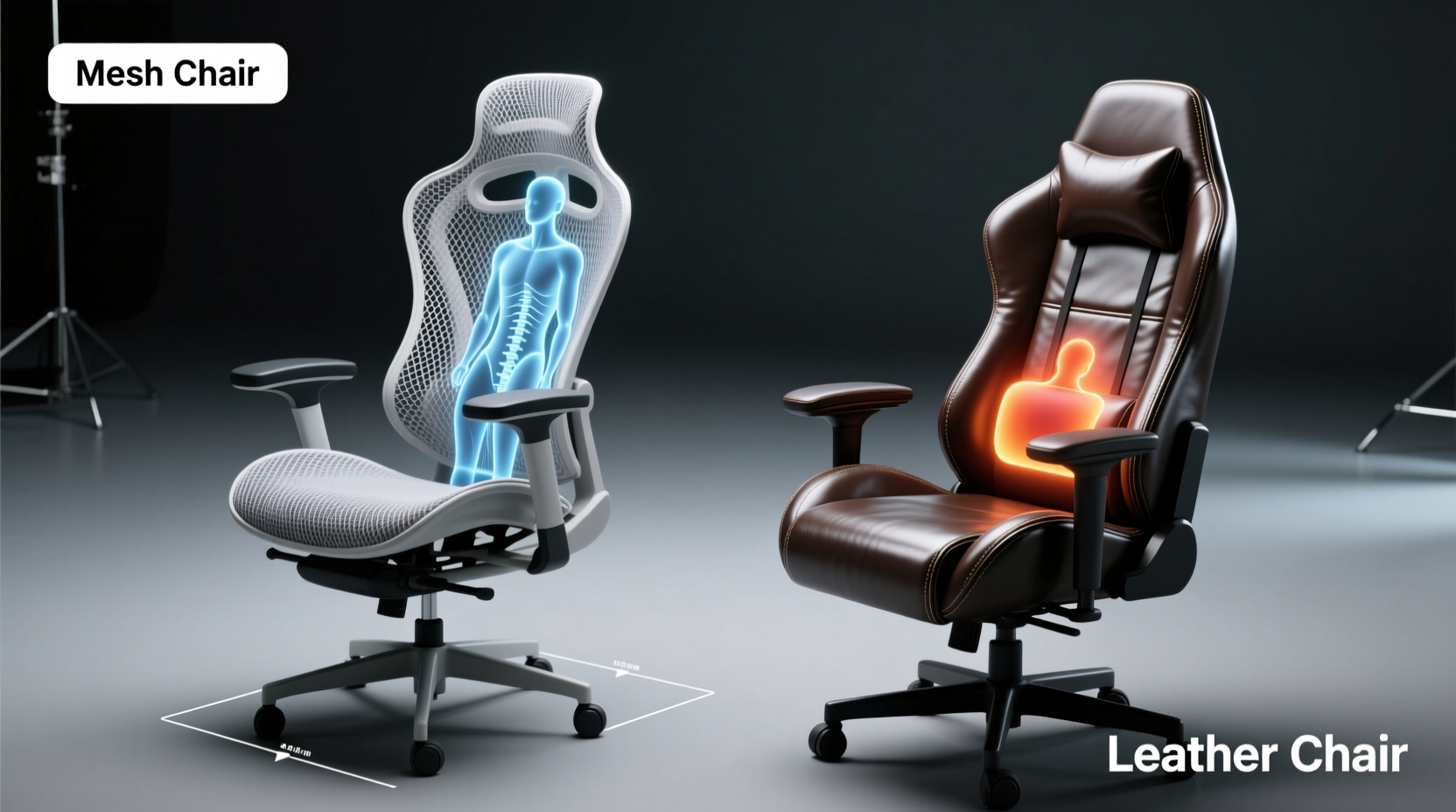
The human body generates heat continuously, especially during prolonged sitting. Without proper ventilation, this leads to trapped moisture, increased skin temperature, and discomfort. This is where the fundamental difference between mesh and leather becomes apparent.
Mesh chairs are constructed with a flexible, woven polymer fabric stretched over a frame. This material is inherently porous, allowing air to circulate freely across the back and seat. As a result, heat dissipates quickly, reducing the risk of overheating and minimizing sweat accumulation. The open structure also prevents moisture from being absorbed into the material, making it easier to wipe clean and less prone to odor retention.
In contrast, leather gaming chairs—particularly those made with PU (polyurethane) leather, which dominates the market—are largely non-porous. Even genuine leather has limited breathability compared to mesh. These materials trap body heat against the skin, creating a microclimate that promotes sweating. Over time, continuous exposure to moisture degrades PU leather, leading to cracking, peeling, and staining. Users in warm climates or those with higher metabolic rates often report “sticking” to the chair after long sessions, a telltale sign of poor thermal management.
Ergonomic Design: Support, Adjustability, and Postural Health
Ergonomics refers to how well a product aligns with the natural mechanics of the human body. A poorly designed chair forces unnatural postures, contributing to lower back pain, neck strain, and reduced circulation. Both chair types offer adjustable features, but their structural approaches differ significantly.
Mesh chairs, especially high-end office models like the Herman Miller Aeron or Steelcase Leap, are engineered around dynamic lumbar support. The tension in the mesh automatically conforms to spinal curvature, providing consistent lower back reinforcement without added padding. Many include tilt mechanisms, seat depth adjustment, and armrest customization, allowing users to fine-tune positioning for optimal alignment. Because the mesh stretches slightly under pressure, it encourages subtle movement—promoting blood flow and reducing stiffness.
Leather gaming chairs, while visually aggressive with high backs and bolstered sides, often fall short in functional ergonomics. Most rely on fixed foam padding and a rigid S-shaped curve that doesn’t adapt to individual spines. Lumbar support is typically an add-on pillow that shifts out of place rather than integrating into the structure. Additionally, the bucket-seat design restricts natural hip rotation, encouraging a static posture that increases fatigue over time. Despite bold marketing claims, few gaming chairs meet ISO 9241-5 standards for office ergonomics.
“True ergonomics isn’t about how a chair looks—it’s about how it responds to movement, supports the spine, and reduces load on joints. Mesh excels here because it moves *with* the body.” — Dr. Lena Torres, Biomechanics Researcher at MIT AgeLab
Comparative Breakdown: Mesh vs Leather Gaming Chairs
| Feature | Mesh Chair | Leather Gaming Chair |
|---|---|---|
| Breathability | Excellent – allows free airflow | Poor – traps heat and moisture |
| Lumbar Support | Integrated, adaptive, and dynamic | Often external pillows; inconsistent |
| Durability | High – resists wear, UV, and sweat | Low to moderate – PU leather cracks over time |
| Maintenance | Easy – wipeable surface, no absorption | Difficult – stains and odors embed in material |
| Long-Term Comfort | Superior – promotes movement and cooling | Declines over time – foam compresses, heat builds |
| Price Range (Quality Models) | $300–$1,000+ | $200–$500 |
Real-World Scenario: A Developer’s Experience After Six Months
Mark, a freelance software developer based in Austin, Texas, worked 10-hour days year-round. In early 2023, he purchased a popular $350 black leather gaming chair, drawn by its racing-style look and RGB lighting. Within three months, he began noticing discomfort: his back felt sticky after lunch, and he developed a persistent ache in his lower spine. By summer, the heat index regularly exceeded 95°F (35°C), and the chair became unbearable. He’d leave work with damp clothes and frequent headaches from tensing up.
In August, Mark switched to a used mesh office chair—a decade-old model with adjustable arms and a breathable back. The change was immediate. “I didn’t realize how much I was sweating until I wasn’t,” he said. “The mesh lets air through, and my back doesn’t feel glued to the seat. My posture improved because I’m not constantly shifting to escape the heat.” After six months, he reported fewer back issues, better focus, and no degradation in chair quality. The mesh showed no signs of wear, while his old gaming chair had begun peeling at the edges.
His experience reflects a broader trend: users who prioritize function over form often report higher satisfaction with mesh seating, especially in demanding environments.
How to Choose Based on Your Needs: A Step-by-Step Guide
Selecting the right chair shouldn’t be based on trends or influencer endorsements. Follow these steps to make a decision grounded in your actual usage patterns:
- Assess your daily sitting duration. If you sit more than four hours a day, prioritize ergonomic integrity and breathability. Mesh is better suited for long-term use.
- Evaluate your environment. Do you work in a hot or humid climate? Is your room air-conditioned? High ambient temperatures favor mesh.
- Consider your body type and physiology. Do you run hot? Are you prone to night sweats or hyperhidrosis? These conditions amplify the drawbacks of non-breathable materials.
- Test adjustability features. Look for seat depth, recline tension, and armrest height adjustments. Mesh chairs are more likely to include comprehensive ergonomic controls.
- Think long-term value. While some mesh chairs cost more upfront, their lifespan (often 10+ years) far exceeds that of most gaming chairs (typically 2–5 years).
FAQ: Common Questions About Mesh and Gaming Chairs
Can I modify a leather gaming chair to make it more breathable?
Some users install aftermarket mesh back inserts or use perforated seat covers to improve airflow. However, these are partial fixes. The core structure still retains heat, and modifications may void warranties. For serious thermal issues, replacing the chair is more effective than retrofitting.
Do all mesh chairs lack padding? Aren’t they uncomfortable?
No—this is a common misconception. High-quality mesh chairs distribute weight evenly across the taut surface, eliminating pressure points. The elasticity of the material provides dynamic cushioning that responds to movement. While they feel firmer initially than padded seats, most users adapt within a week and report greater comfort over time due to reduced sinking and better support.
Is genuine leather better than PU leather for breathability?
Slightly, yes. Genuine leather allows minimal air transfer compared to synthetic alternatives. However, it’s still far less breathable than mesh and requires regular conditioning to prevent drying and cracking. It’s also significantly more expensive and rarely used in mass-market gaming chairs. From a functional standpoint, even genuine leather falls short of mesh in thermal performance.
Action Plan: What You Should Do Next
- If you sweat heavily or work in a warm space: Choose a high-tension mesh chair with adjustable lumbar support.
- If you value aesthetics and occasional use: A leather gaming chair may suit you—provided you limit sessions to under three hours and maintain a cool room.
- If you’re investing long-term: Prioritize certified ergonomic designs (look for BIFMA or ISO compliance) over branded gaming labels.
- If budget is tight: Consider refurbished premium mesh chairs from brands like Herman Miller or Humanscale—they often come with warranties and outperform new budget gaming models.
Final Verdict: Function Over Form Wins
When it comes to managing sweat and supporting healthy posture, mesh chairs outperform leather gaming chairs in nearly every measurable category. They promote airflow, adapt to spinal movement, resist degradation from moisture, and encourage dynamic sitting—all critical for physical well-being during long sedentary periods. Leather gaming chairs, while appealing visually, are built more for image than utility. Their materials trap heat, their ergonomics are often superficial, and their longevity is compromised by everyday use.
This isn’t to say gaming chairs have no place. For short bursts of play, streamers who value branding, or users with controlled environments, they can serve a purpose. But if your priority is staying cool, supported, and pain-free over months and years, mesh is the superior choice—not just as a trend, but as a scientifically sound solution.
“The best chair is the one you forget you’re sitting in.” — Niels Diffrient, Pioneer of Ergonomic Seating Design




 浙公网安备
33010002000092号
浙公网安备
33010002000092号 浙B2-20120091-4
Comments
No comments yet. Why don't you start the discussion?