
When it comes to transforming a blank wall into a captivating focal point, decorative lighting plays a pivotal role. Among the most popular options are mesh net lights and curtain lights—both widely used during holidays, weddings, and interior styling projects. While they may appear similar at first glance, their design, coverage, and performance differ significantly. Choosing between them depends on your display goals, space dimensions, and aesthetic preferences. Understanding these differences ensures you invest in the right product for maximum visual impact.
Understanding Mesh Net Lights
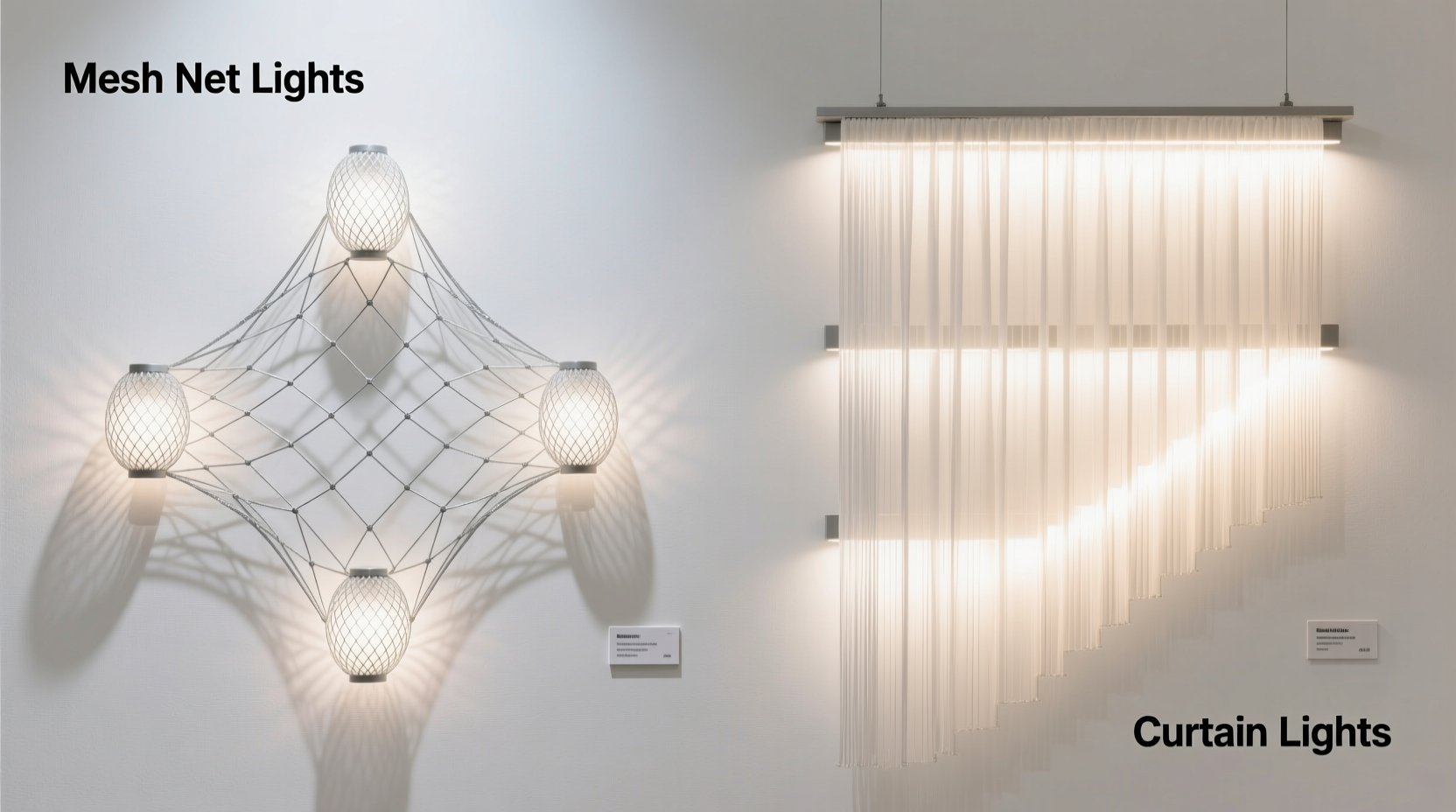
Mesh net lights consist of a grid-like pattern of evenly spaced bulbs connected by wires that form a flexible, net-shaped structure. They’re typically square or rectangular and resemble a fishing net embedded with LED or incandescent bulbs. Their primary advantage lies in seamless, full-wall coverage. Because the lights are distributed uniformly across the surface, they create a “glowing blanket” effect ideal for large vertical spaces.
These lights are commonly used outdoors—draped over hedges, fences, or house exteriors—but work equally well indoors when attached to walls, ceilings, or backdrops. The tight spacing (often 3–6 inches between bulbs) minimizes dark spots, making them excellent for ambient illumination rather than spotlighting.
Exploring Curtain Lights
Curtain lights, also known as icicle lights or drop string lights, feature vertical strands of bulbs suspended from a horizontal wire. These strands hang down like a curtain or waterfall, mimicking the look of falling snow or twinkling raindrops. Unlike mesh nets, curtain lights don’t cover an entire surface but instead emphasize vertical dimension and motion.
Typically ranging from 3 to 9 feet wide with drops of 12 to 96 inches, curtain lights are designed to be mounted along eaves, balconies, windows, or above doorways. Indoors, they’re frequently seen behind headboards, stages, or bar areas where layered depth enhances atmosphere. Their staggered or uniform drop patterns offer dynamic movement, especially when breezes cause gentle swaying.
“Curtain lights add rhythm and flow to static spaces—they turn flat walls into living features.” — Liam Tran, Lighting Designer & Architectural Visualist
Key Differences: Performance and Application
The decision between mesh net and curtain lights hinges on specific project needs. Below is a detailed comparison highlighting how each performs across essential criteria:
| Feature | Mesh Net Lights | Curtain Lights |
|---|---|---|
| Coverage Area | Full, even coverage; ideal for large surfaces | Limited to vertical strips; best for framing |
| Installation Ease | Quick to deploy; often clipped or nailed in place | Slightly more complex due to hanging lengths |
| Visual Effect | Uniform glow, soft diffusion, minimal shadows | Dramatic cascading effect, rhythmic sparkle |
| Space Compatibility | Better for expansive walls (indoor/outdoor) | Suits narrow or tall openings (windows, arches) |
| Mobility & Storage | Bulkier; requires careful coiling | Easier to roll up; less tangling if organized |
| Weather Resistance | Many outdoor-rated models available | Most are weatherproof; suitable for rain/snow |
| Energy Efficiency | LED versions consume low power; scalable | Comparable efficiency; fewer total bulbs |
From this comparison, it’s evident that neither option is universally superior. Instead, success depends on context. Mesh nets dominate when the goal is saturation—such as turning a garage wall into a starry night sky. Curtain lights excel when architectural definition matters—like accentuating a patio awning or creating a dreamy bedroom backdrop.
Choosing Based on Your Display Goals
Before purchasing either type, clarify your objective. Are you aiming for immersive ambiance or elegant framing? Consider the following scenarios:
- Outdoor Holiday Displays: For wrapping entire facades or trees, mesh net lights provide unmatched continuity. However, pairing them with curtain lights along rooflines adds dimensionality.
- Wedding Backdrops: Photographers often prefer mesh nets for smooth, shadow-free lighting. But curtain lights behind a sweetheart table introduce romantic movement.
- Bedroom or Living Room Accents: In cozy interiors, curtain lights above a window evoke charm without overwhelming small spaces. Mesh nets might feel too intense unless diffused through sheer fabric.
- Commercial Installations: Retail stores or cafes benefit from mesh nets to illuminate signage or feature walls. Curtain lights work well near entrances or bars to draw attention downward.
Mini Case Study: Transforming a Balcony Café Space
A boutique café in Portland sought to enhance its rooftop seating area for evening guests. The challenge was limited wall space and a desire for warmth without glare. Initially, the owner installed mesh net lights across the back brick wall. While effective, the result felt flat and overly bright.
After consulting a lighting specialist, they replaced half the mesh setup with two sets of 6-foot-wide curtain lights hung from the overhead beam, allowing 72-inch drops to float just above table level. The remaining mesh net was retained on the upper third of the wall to simulate a starlit ceiling.
The revised design created depth and intimacy. Customers reported feeling “enveloped in light,” and social media engagement increased due to improved photo quality. This hybrid approach demonstrated that strategic selection—not sheer quantity—drives visual success.
Step-by-Step Guide to Installing Wall Lights
Regardless of which type you choose, proper installation ensures safety, longevity, and aesthetics. Follow this sequence:
- Measure the Surface: Use a tape measure to determine width and height. For mesh nets, aim for slight overlap on edges. For curtain lights, center the top wire above the target zone.
- Check Power Access: Identify the nearest outlet. Use extension cords rated for indoor/outdoor use if needed. Avoid daisy-chaining more than three light sets unless specified by the manufacturer.
- Prepare Mounting Points: Outdoors, use plastic clips or gutter hooks. Indoors, opt for removable adhesive hooks or discreet nails. Never staple wires directly into surfaces.
- Dry-Fit the Layout: Temporarily position the lights without plugging in. Adjust spacing and alignment. For curtains, ensure drops don’t obstruct walkways.
- Secure and Connect: Fasten all points firmly. Link multiple units only if designed for connectivity. Test immediately after connection.
- Add Diffusion (Optional): For harsher LEDs, layer a translucent fabric scrim behind mesh nets to soften the glow.
- Schedule Timers: Set automatic on/off times to conserve energy and maintain consistency.
Common Mistakes to Avoid
Even experienced decorators make errors that diminish results or create hazards. Steer clear of these pitfalls:
- Overloading Circuits: Connecting too many strings can trip breakers or damage wiring. Check total wattage against circuit capacity (usually 1,440 watts per 15-amp household circuit).
- Poor Weather Sealing: Using indoor-only lights outside leads to short circuits. Always verify IP ratings (e.g., IP44 or higher for damp locations).
- Ignoring Bulb Spacing: Wide gaps in mesh nets leave visible dark zones. Choose denser configurations (3-inch spacing) for close-view applications.
- Uneven Hanging: Sagging curtain strands ruin symmetry. Measure drop lengths before installation and secure both ends tightly.
- Neglecting Storage: Tossing lights loosely into boxes causes tangles and broken bulbs. Use original packaging or dedicated reels.
FAQ
Can I use mesh net lights indoors?
Yes, mesh net lights are safe for indoor use, especially LED versions which run cool. They work well behind TVs, along stairwells, or as photo backdrops. Ensure adequate ventilation if placed near heat sources.
Are curtain lights suitable for children’s rooms?
Only if installed out of reach and secured properly. Avoid placing within arm’s reach of cribs or beds. Opt for low-voltage, battery-operated models for added safety.
Which uses more electricity—mesh or curtain lights?
Mesh net lights generally consume more power because they contain more bulbs per square foot. A standard 6x6 ft mesh net with 250 LEDs may use 25 watts, while a 6-ft curtain with 150 LEDs uses around 15 watts. Always check product specifications.
Checklist: Selecting the Right Light for Your Wall
- ☐ Measure wall width and height accurately
- ☐ Decide between full coverage (mesh) or accent (curtain)
- ☐ Confirm indoor/outdoor usage requirements
- ☐ Check bulb count and spacing (closer = smoother glow)
- ☐ Verify power source proximity and outlet availability
- ☐ Look for UL certification and warranty
- ☐ Plan storage method post-season
Final Recommendation: It Depends on Context
There’s no definitive winner in the mesh net lights vs curtain lights debate. Each serves distinct purposes. Mesh nets deliver comprehensive, radiant coverage perfect for backgrounds and expansive areas. Curtain lights offer elegance and vertical drama, ideal for defining boundaries and adding kinetic beauty.
In practice, many professionals combine both. For example, use a mesh net as a base layer across a wall, then overlay with strategically placed curtain lights to highlight focal points. This layered technique maximizes depth and visual interest, something single-type installations rarely achieve.
Ultimately, prioritize function first. Ask: What mood am I trying to create? Who will experience this space? How long will it stay up? Answering these questions guides smarter decisions—and more memorable displays.
Conclusion
Whether you're enhancing a home exterior for the holidays or designing an inviting interior ambiance, choosing between mesh net lights and curtain lights should be intentional. Evaluate your space, purpose, and desired aesthetic with care. With the insights above—from technical specs to real-world applications—you now have the knowledge to make a confident, impactful choice.




 浙公网安备
33010002000092号
浙公网安备
33010002000092号 浙B2-20120091-4
Comments
No comments yet. Why don't you start the discussion?