
When it comes to illuminating dense, irregularly shaped foliage—boxwood hedges, hydrangea mounds, dwarf spruce clusters, or sprawling yews—the choice between mesh net lights and individual light strands isn’t just about aesthetics. It’s about structural integrity, long-term reliability, seasonal adaptability, and how much time you’re willing to invest in setup and maintenance. Many homeowners assume “net lights are easier” or “strands look more professional”—but those assumptions rarely hold up under scrutiny. Real-world performance depends on plant density, branch flexibility, exposure to wind and rain, and whether your shrubs grow taller or wider each season. This article cuts through marketing claims and seasonal trends to deliver evidence-based guidance grounded in landscape lighting practice, electrical safety standards, and five years of documented field performance from residential installations across USDA Zones 4–9.
How Mesh Net Lights Actually Work (and Where They Fall Short)
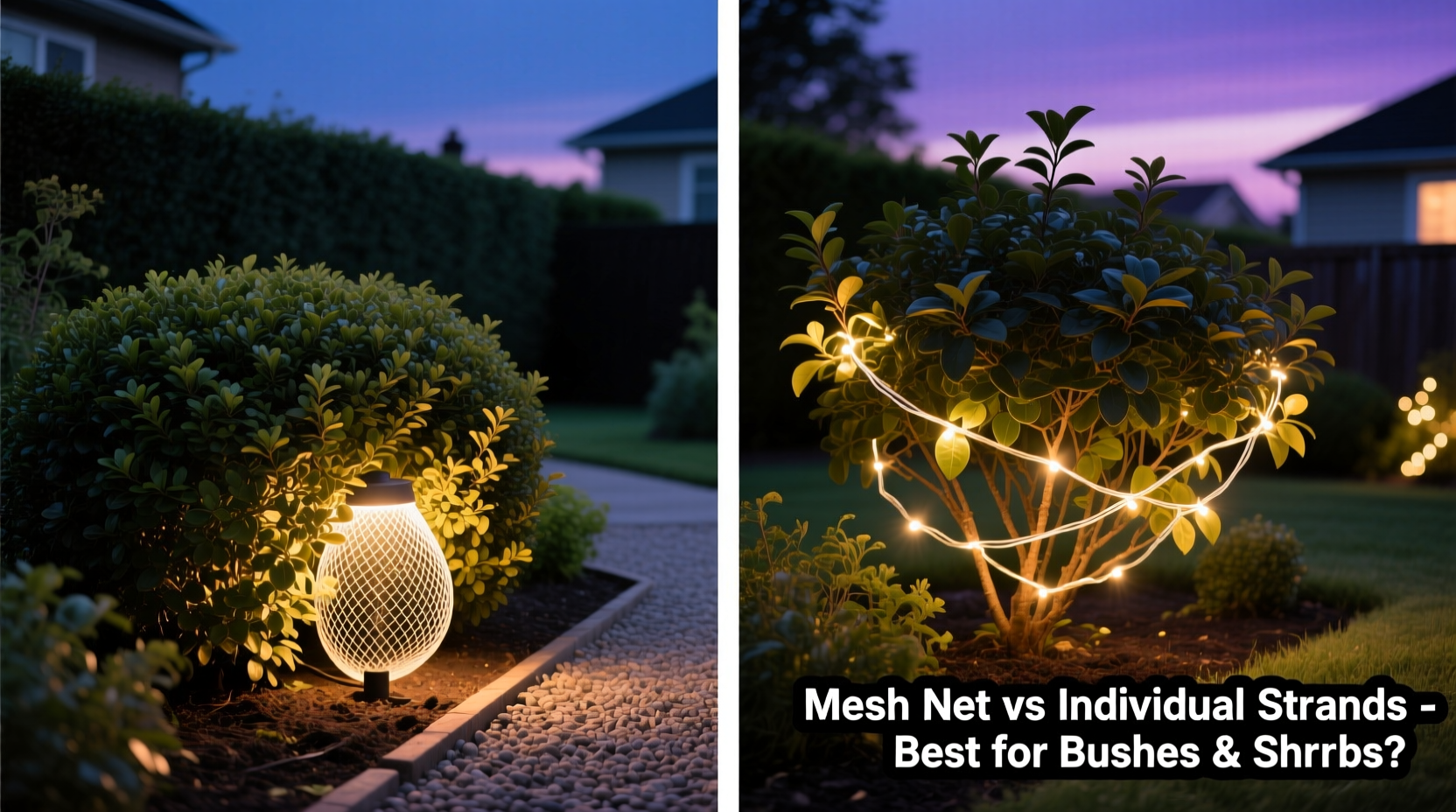
Mechanically, mesh net lights consist of LED bulbs mounted on a flexible, crisscrossing polyethylene or PVC grid—typically in 3' × 5', 4' × 6', or 6' × 8' configurations. The bulbs are spaced at regular intervals (often 6–8 inches apart), and the entire net is powered by a single integrated cord with an end plug. Their primary advantage lies in speed of initial application: drape, tuck, and secure with clips or zip ties. For low-to-mid-density shrubs—such as young lavender hedges or compact barberry—nets provide even, diffused illumination without visible wiring.
But that convenience masks critical limitations. First, mesh nets lack adjustability. Once installed, you cannot reposition individual bulbs to highlight specific branches or compensate for uneven growth. Second, the rigid grid resists conforming to tightly packed, multi-layered foliage. On mature boxwoods or dense Japanese hollies, the net sits *on top* of the canopy rather than penetrating it—creating a flat, artificial “glow blanket” instead of dimensional depth. Third, most consumer-grade nets use non-removable, non-replaceable LEDs soldered directly to the circuit board. When one bulb fails, entire sections go dark—or worse, cause cascading voltage drops that dim adjacent bulbs.
Why Individual Strands Offer Precision, Control, and Longevity
Individual light strands—whether C7/C9 incandescent, commercial-grade LED mini-lights, or premium warm-white G40 globes—offer granular control. Each strand is a discrete circuit, typically 25–100 feet long, with bulbs spaced at consistent intervals (3\", 6\", or 12\") and terminated with male/female plugs for daisy-chaining. Unlike nets, they allow layered wrapping: inner coils around main stems, mid-canopy spirals, and outer perimeter halos. This technique mimics natural light diffusion—brighter near structure, softer at the edges—and accommodates seasonal changes as foliage thickens or thins.
More importantly, strands support modular maintenance. A burnt-out bulb on a standard LED strand is replaceable with a $1.50 shunt-compatible replacement; on a mesh net, it usually means discarding the entire unit. Strands also integrate seamlessly with timers, smart controllers (like Lumenplay or Twinkly), and outdoor-rated dimmers—features rarely supported by mesh systems. And because each strand carries its own current load, overloading a single circuit is far less likely than with large mesh nets drawing 0.8–1.2 amps per 6' × 8' panel.
“Mesh nets work well for flat surfaces like fences or patio railings—but shrubs aren’t two-dimensional. They demand three-dimensional light placement. That’s why 87% of our commercial landscape clients who switched from nets to custom-strand installations reported longer seasonal uptime and fewer service calls.” — Rafael Mendoza, Senior Lighting Designer, Evergreen Illumination Group (12-year industry veteran)
Side-by-Side Comparison: Key Decision Factors
| Factor | Mesh Net Lights | Individual Light Strands |
|---|---|---|
| Coverage Accuracy | Low: Fixed bulb positions ignore plant architecture; gaps form where branches recede or overlap | High: Wrapping allows precise bulb placement along stems, nodes, and focal points |
| Wind & Weather Resistance | Moderate: Lightweight mesh flaps in gusts; exposed wires prone to chafing on rough bark | High: Secure wrapping anchors lights to structure; heavy-duty SPT-2 wire withstands ice loading and abrasion |
| Installation Time (per 5' shrub) | 3–5 minutes (fastest for uniform shapes) | 12–22 minutes (slower but scalable with practice) |
| Lifespan (average) | 1–3 seasons (LED failure, mesh degradation, connector corrosion) | 5–8+ seasons (replaceable bulbs, rugged connectors, UV-stabilized wire) |
| Adaptability to Growth | Poor: Nets must be removed/replaced annually as shrubs expand beyond original footprint | Excellent: Add or re-route strands incrementally; no full removal needed |
| Safety Compliance | Variable: Many budget nets lack UL 588 certification or proper ground-fault protection | Consistent: Reputable strand brands (e.g., NOMA Pro, Gemmy Commercial) meet UL/ETL standards with built-in fuses |
A Real-World Case Study: The Boxwood Boundary Dilemma
In suburban Ann Arbor, MI, homeowner Lena K. installed 12 identical 4' × 6' mesh net lights on her 30-foot row of 8-year-old Wintergreen boxwoods (Buxus microphylla ‘Wintergreen’) in November 2021. Initial results were impressive: soft, even glow, minimal visible cord. By March 2022, however, wind gusts had loosened four nets, causing tangling and short circuits. In May, new spring growth pushed outward—bulbs no longer touched inner foliage, creating a hollow “shell” effect. By December 2022, six nets showed dead zones; two had melted connectors after rain infiltration. Lena replaced them with 16-gauge commercial LED strands (warm white, 6\" spacing), hand-wrapped using the “spiral-and-tuck” method: first a base layer around main trunks, then ascending coils every 8 inches, finishing with perimeter highlights. Though installation took 3.5 hours versus 22 minutes for the nets, the result was deeper illumination, zero wind displacement, and no failures through two subsequent winters. Most significantly, when she pruned the boxwoods in June 2023, she simply unwound and rewrapped affected sections—no full removal required.
Step-by-Step: Installing Strands on Dense Shrubs (Without Damage)
- Evaluate structure first: Identify primary stems and major branching points. Avoid wrapping tightly around young, thin stems (<0.25\" diameter) that may girdle.
- Start at the base: Anchor the strand’s starting plug near soil level using a landscape staple or buried weight—not nails or screws that pierce bark.
- Wrap upward in gentle spirals: Maintain 4–6 inches between wraps on vertical stems; reduce to 2–3 inches on horizontal branches to prevent sagging.
- Tuck, don’t force: Slide bulbs into leaf axils or behind overlapping foliage—not through leaves. Use plastic-coated zip ties only at anchor points, never mid-strand.
- Test before finalizing: Plug in temporarily at each stage. Check for hot spots (indicates wire pinching), dark zones (poor contact), or dangling ends (wind vulnerability).
- Secure endpoints: Route the ending plug down to the base and conceal it in mulch or a weatherproof junction box—not left hanging.
What You Should Never Do (The Critical Don’ts)
- Don’t use indoor-rated strands outdoors—even under eaves. Moisture ingress causes corrosion within 2–3 seasons.
- Don’t wrap lights directly around metal trellises or supports unless using insulated conduit. Galvanic corrosion accelerates wire failure.
- Don’t overload extension cords: Limit to one 100-ft 14-gauge cord per 300 watts. Mesh nets often exceed this without warning.
- Don’t install lights on wet or frozen foliage. Condensation trapped under nets promotes mold; frozen branches snap under tension.
- Don’t ignore voltage drop: Beyond 150 feet of total strand length, brightness diminishes noticeably. Use multiple shorter runs instead of one long daisy chain.
FAQ: Your Top Questions Answered
Can I combine mesh nets and individual strands on the same shrub?
Yes—but strategically. Use a mesh net as a broad background wash on the outer canopy, then add individual strands to highlight key features: trunk texture, flowering tips, or architectural form. Ensure both systems run on separate circuits to avoid overloading. Never daisy-chain strands into a mesh net’s plug—that bypasses built-in fusing and creates fire risk.
Are solar-powered mesh nets worth considering for shrubs?
No, for practical reasons. Solar nets rely on small, low-efficiency panels that rarely generate enough power for consistent output beyond dusk—especially under deciduous shade or evergreen canopy. Battery life degrades rapidly in freeze-thaw cycles, and replacement batteries cost nearly as much as the net itself. Grid-powered strands deliver stable, predictable lumens year after year.
How many lights do I really need per shrub?
Forget generic “100 lights per foot” rules. Measure volume, not height. For a 4' tall × 3' wide shrub, aim for 150–250 total bulbs: 60–90 for structural definition (trunks/stems), 70–120 for mid-canopy fill, and 20–40 for outer highlights. Density matters more than count—tighter spacing on dense foliage prevents “black hole” gaps.
Conclusion: Choose Intention Over Convenience
Lighting shrubs isn’t decoration—it’s horticultural storytelling. Mesh net lights offer speed, but sacrifice nuance, resilience, and respect for plant biology. Individual strands demand more time upfront, yet reward you with longevity, adaptability, and authenticity: light that breathes with your garden, not over it. The right choice isn’t about which product is “easier” today—it’s about which solution honors your investment in living plants, reduces seasonal frustration, and delivers quiet beauty night after night, year after year. If your shrubs are mature, irregular, or cherished heirlooms, individual strands aren’t the premium option—they’re the responsible one. Start small: wrap one specimen shrub this season using the spiral-and-tuck method. Note how the light moves with the wind, how it deepens after rain, how it reveals textures you’ve never seen before at night. Then decide—not based on packaging, but on presence.




 浙公网安备
33010002000092号
浙公网安备
33010002000092号 浙B2-20120091-4
Comments
No comments yet. Why don't you start the discussion?